
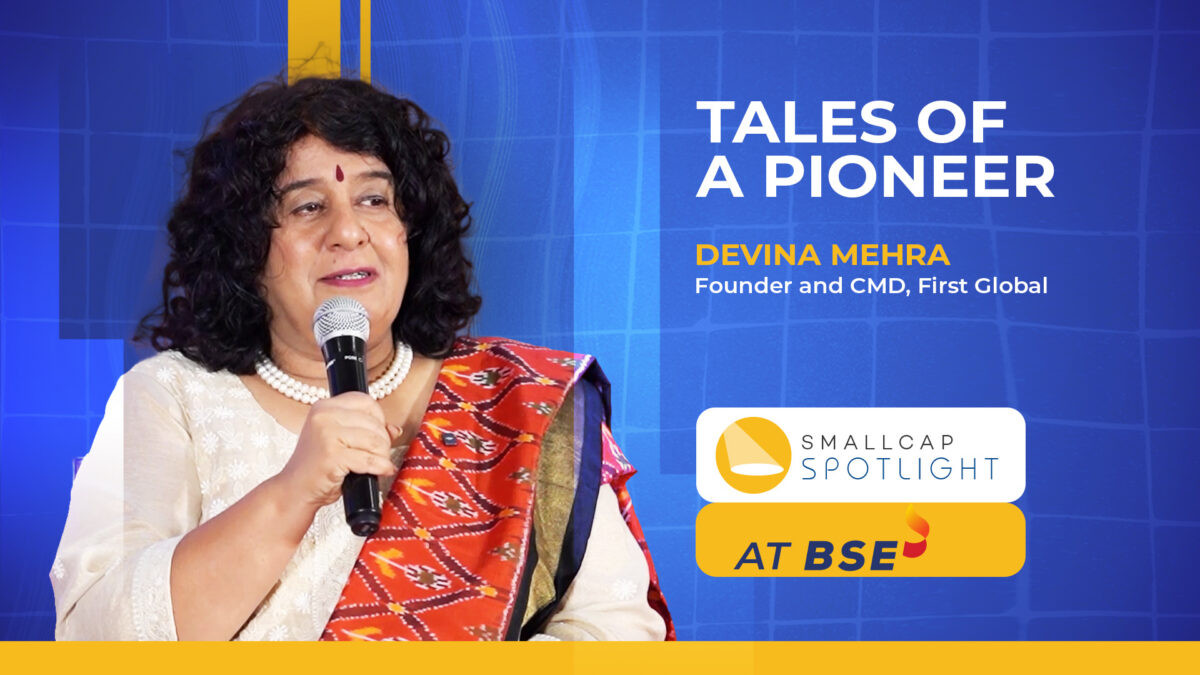
Devina Mehra, Founder & Chairperson of First Global, reflected on her entrepreneurial journey, the evolution of India’s capital markets, and the principles that shaped First Global’s growth. She also highlighted the importance of independent thinking, disciplined investing, and long-term decision-making in wealth creation.
Nikunj Dalmia: Imagine 20 years ago, how a Monday morning at Rotunda would be. This is where the heartbeat of the market was. This is where the trading was done.
How many of you have seen scam 92? You’d been on the floor when the trading was on? What was it like?
Devina Mehra: Yes, I mean, earlier there used to be no uniform or anything. So everybody’s shirts used to be full of pen marks. Then by the time I got my BSE card, which was end of 93, that time that they had these blue kind of jackets that you put on.
So I didn’t actually do trading, but I did come for a few days just to see what’s going on along with my actual traders. But soon after that, I think just a few months after that, it went on to what used to be called the bold system, which was basically went electronic. But it remained physical delivery of shares for a lot longer.
So every time there was a settlement, you had all these piles of shares tied up in red cloths. Then all night, because we were institutional brokers, so the volumes were high. So all night people would sit and count stuff.
Then you send it to the company and it will come signature differs. So again, you start. So I remember Ramdev Agarwal once saying that he sold ACC and it came back as signature differs.
So he got stuck with it and he made a tonne of money on it. So it was like his first big money he made on a trade because it didn’t go through. So this is where the trading happened.
This is where exchange of shares was happening today. You know, you can’t feel the vibe. But when you come here, like they say, the historical imprints are clearly there.
Actually, there used to be some really old traders. So all this American thing of that, trading is a young man’s job and you burn out. You used to see people who couldn’t even walk, kind of being brought in by two people and propped against the wall.
But they would be there for the entire three, four hours trading.
Nikunj Dalmia: You know, with Devina Mehra, I’m promising you don’t miss a single word. And from last 25 years, I’ve interacted with her.
She’s actually been just an epitome of great grace, knowledge. And what I’ve always admired about Devina is her ability to connect the past with the present and talk about future. She was, she is and she will always be one of my favourite guests.
I’ve learned a lot from you. And that’s what I think I’ll try and bring the best out of Devina. So Devina, we started a bit of nostalgia.
Let’s get into history. What was that aha moment in your life, you said,
I’m in love with numbers. I want to build my career in financial markets.
Because when you decided to choose financial markets as a career, it was not a very popular choice. But when did you realise that you love numbers more than anything else?
Devina Mehra: Oh, it’s never like that. So I mean, the young people here don’t think that you have to know from the beginning what you want to do.
So I was always clearer what I did not want to do. So it life evolves. So you can’t say what you will be doing 20 years from now.
And, for example, after class 12, I was the only person in my maths class who did not sit for the engineering entrance exams, because I was clear, I didn’t want to become an engineer, even though I’d never lost a mark in maths in 11th and 12th in any test or exam. And people said exam to the though I said, I’m clear, I don’t want to do this. And so I mean, it all changes.
I actually went to do an English honours after 12 to Delhi. And then I grew up in Lucknow. So very far away from financial markets.
I mean, absolutely no idea of financial markets. My parents were both professors and had no interest in money whatsoever. And so I went to do an English honours.
But then I realised that I did not like the Delhi system of studying only one subject. So after one term, when I’d come back to Lucknow, I was telling my parents, and then I changed to a combination of maths, statistics and English, I said, maths, we need English, we need English, let’s see how it goes. And when I landed up at IIM Ahmedabad, I actually didn’t even know what a share was.
I didn’t know what debit and credit were, I had no idea, you know, about financial markets. And at that time, in any case, capital markets as a career did not exist, we did not even have a course on securities research, because that career didn’t exist in India. So when I graduated, again, process of elimination, I had really no real world knowledge of businesses, I applied to banks and consultancies, I got through Citibank, which was, at that time, the most coveted job, I didn’t even go for the other interviews thereafter.
And I was in investment banking, and then in corporate credit, but I was looking for a change. See, I’m a learning junkie. So that is what defines me.
I realised now looking back over the years that I’m always interested in, you know, learning things, knowing things. And I thought, you know, I was looking for a change one, because I said, or what is the more interesting thing I can do. And also as a culture, I found that corporate culture of, you know, very negative internal competition did not suit me.
So I was looking, I actually went to what used to be then the Prince of Wales Museum and met the director, what is the interesting thing one can do in life, I went and met the economic times editor who was visiting faculty at IIM. So you know, I had kind of knew him. So I went and said, you know, what is the interesting thing one can do in life.
And I was looking and then, you know, there were two things which happened. One was Dr. Manmohan Singh’s budget, where he opened the market to foreign institutional investors. And I said, now the market will professionalise because till then, stockbroking was very much an old fashioned profession.
And it wasn’t even considered very respectable. I mean, I had no idea how it was considered. But I have very close Gujarati friends.
And you know, one of them was very interested in the market, but his parents just didn’t allow him. He said, you’ve done a CA and an IIM MBA to go to the markets. I mean, that is for no hopers.
So that was the impression. But I said, now the market will professionalise. So that was one.
The other was at that time, of course, National Stock Exchange was not there, SEBI was not there. And the biggest, there were 20 odd stock exchanges. And the biggest one was BSE.
And BSE advertised that we’ll give 71 new memberships to professionals. For in the early 90s, a huge amount, 55 lakhs, but it was a quarter of the market price. The market price of a BSE membership at that time was two crores.
And people told me, don’t even apply, you know, because BSE is 80% Gujju, 20% Madhu. You are a total outsider. You’re not from the right community.
You’re not even from Bombay. Your parents have nothing to do with business. And plus, you’re a woman.
So who will give you? They’ll give it to their brothers and nephews. I said, okay, let’s apply. We’ll see.
So that’s how it started. And of course, they did try their best not to give it. But in the end, I got two extra marks for my IIMA gold medal.
And that pushed me over the cutoff. And that’s how the journey started. But as I said, you know, I learned on the job.
It’s not as if I knew in advance. And along with the foreign institution investing in India, the foreign brokers also came. All the big names, you know, Maryland, Jardine Fleming, Morgan Stanley, everybody came.
And in the beginning, I thought, you know, these guys have been doing it 50-70 years. I must learn from them. But the first lot of reports I saw, I said, this is junk.
This is not good analysis. This is not written well. I have to learn from first principles.
I have to learn from the books. And that’s what I did. I learned from the books.
I learned. I even used to ask clients at times, you know, we were discussing some of them that, you know, what is a good book to learn valuation or to understand cash flows further. And I never hired from competition.
Nobody else hired freshers. I hired only freshers because I said, I don’t like what the market is doing. I don’t like what the competition is doing.
It is difficult to train new people, but it is harder to get them to unlearn bad habits. So I have trained literally generations of analysts and all of them are now all over the industry. So we have been like the, you know, Hindustan Lever is an FMCG that you see ex-Levers people everywhere.
You see ex-First Noble people everywhere in the industry and, you know, Teacher’s Day, Guru Poornima, I get messages. So my parents’ teaching genes remain strong. And the book is also really an outcome of that.
So that was the evolution. So it’s not as if, you know, in the beginning that this is what you want to do in life.
Nikunj Dalmia: Okay.
So you got the gold medal. So then what happens after that? What was the starting capital? How did you start building on the business? You were new, limited capital. Foreign brokerages had just about started coming in.
The old school boys, which is the old brokerages, they also wanted to be part of finalisation. DSP became DSP Merrill Lynch. Morgan Stanley became JM Morgan Stanley.
That was an interesting time. So how did First Global independently with limited capital, with no godfather stood out? How did you manage to swim with the sharks and sail with the whales?
Devina Mehra: I would say intellectual capital. I mean, definitely when I started out, there was no cachet to being a startup.
Leaving what was supposed to be the best job in the business to start a business was not considered anything great. It was good that my parents never bothered with what I was doing because their thing was that, we don’t know this field, you do what you want. But otherwise, it was not considered anything great and definitely nobody was willing to give you capital.
I mean, that concept again didn’t exist. So really intellectual capital. So it started with, I remember one of our first two clients is an American woman and she said, I asked about who to go to in India and yours was the common name that two people gave me.
And that’s how I’ve come to you. And just thinking from first principles, that same lady, I remember when she, these foreign institutions used to come here, they would ask you to set up meetings with companies and these would be like in three days you’re meeting five companies a day. And while at that time they were making these physical folders with the information about the company and all that.
So I started putting a questionnaire on top because you’re going to HDFC and then to Mahindra and Mahindra and then to HPCL. This is some person looking after 10 countries. What will she know what to ask? So she said, I mean, I’m operating in 10 countries.
No broker has ever given me this, that even the questions to ask the girl. So just start thinking from first principles. And as I said, people don’t work in depth so that if you are actually intellectually honest, I say there are two problems in research.
One is a problem of competence that you are not doing enough. You’re not really trying to get to the depth of things. The other thing is that there are always other agendas.
So you know, the names that you took, that there might be that you were looking for investment banking business there. So you will not write a negative report on that company or your clients or either your firm or your clients hold a lot of that stock. You will not write that.
So we always said it the way we saw it. So that was the other thing. So besides doing good work to the ability to say it and which I mean, even till now, every time I get off a stage, people tell me, oh, ma’am, you were so honest.
And I’m like saying, what did I say now? I don’t, you know, because it doesn’t occur to me to say anything other than what I mean. So I’ll give you an example. You know, everybody remembers that we were the first ones to have a big positive on HDFC Bank a year after its IPO.
That report is probably one of our most famous in history. But also in the 90s, we were the only firm to have a negative opinion on HDFC, the parent. And HDFC at that time was the most beloved stock of the foreign institutions, the most beloved, I mean, far and away, every time the limit increased, because earlier, you know, you started with a certain limit that foreign institutions could buy every time the limit increased, that limit will be full for HDFC on the very same day.
And I had a negative view, we wrote a negative report. And people said, Are you stupid people are waiting to buy this stock, how can this stock ever go down? And I said, No, I mean, the fundamentals are fundamental, the return on equity is diluting, because they are raising money every year. Ultimately, the fundamentals will prevail.
And that’s what happened. I mean, it didn’t fall, but for five years, it was at the same price, which effectively meant that it fell. So that was and you know, I’m a learning junkie that you have to understand it.
So I devised ratios, we did almost academic level work many times. Like another example, I remember from that time is the, you know, this is Tata Motors used to be only a commercial vehicle company before it got into cars before it became an international company. And commercial vehicles was a very cyclical business.
And we build a regression model to predict how much commercial vehicle sales would be in the next year. And this was the down, this was, you know, when it was a down cycle for that, and we did an exercise. And we said, Next year, we see a 25% volume growth, that truck sales will go up 25%.
And we got a call from Ratan Tata’s office that this is too aggressive, we will not do more than 15% extra volumes. And we went back, we looked at all our numbers. And we said, you know, we think it will be 25%.
And they did do 25%. So I mean, one of the things which often used to happen when you hire youngsters, I mean, one, of course, was that, in education, you have one answer to one question, the thing you have to get used to in the real world and the markets is to work with imperfect information to work with probabilities to work with ambiguity. The other thing is that people would say, Oh, I’m like 25.
You know, Farnam Mahindra has been doing this for 40 years, how can I question him? So no, if you go into the you know, oftentimes, when you are in the business, your vision becomes very myopic, you just extrapolate the immediate past, if you have a wider vision, if you know what has happened elsewhere, you can actually give a perspective, you know, like, for example, if you look at the in the 2000s, the telephone companies, the mobile telephone companies, we said this movie has played out in so many countries, you know, how the subscriber growth how it tapers off how the peas taper off. So if you look that look at that, you know how this is, this movie is going on. So that was that was it.
So 90s where we became very large in the institutional space. End of the 90s was another big change. And we used to do what are now called qualified institutional placements.
UIP is the term didn’t exist, but it was essentially the thing. But I was very careful to do only very few where I was convinced the investor would make money. For me all my life, the objective has never been that to maximise my revenue or fees, it should always make sense for the person on the other side.
Because it’s a big responsibility when you deal with money that you don’t do the wrong thing. So that to me is very important. So by end of the 90s, there was one big change, which was that we went global.
So I’m a first principles thinker. So this is end of the 90s. And one trigger was you guys might have if you read economic history, you might have heard of the Asian crisis in the 97 98 when all these Asian tigers, the Southeast Asian economies, which had been such growth engines, they went through a very troubled time.
And in one year, all those markets, the currencies fell, the markets fell in dollar terms, those markets fell between 50 to 90%. And 90% was Indonesia. And I’d spent a few months in Indonesia and my Citibank time setting up Citicorp’s security subsidiary.
And I said, this can be the danger. If you are in a single market, 90% of your network can go in a single year. So one should look beyond India.
And so that was one trigger. The other was, as I said, I was just getting bored. I said, kap tak infosys, HDFC, HPCL, SBI, bajaj auto karte rehenge, which is still pretty much the list has not changed that much.
So and by that time, as I know, almost 100% of our business was with foreign institutions. And as you were discussing, it is not just the India fund manager, the boss, boss’s boss, everybody becomes a friend, many of them are not in the business anymore, but they’re still your friend. So when I thought of going global, I went to some of these large funds in the world, and I said, what do you think? I want to go beyond India.
They said, add a Thailand or a Philippines. And you know, the India fund manager is typically either the Asia fund manager or the emerging market fund manager. So they’ll give you some business there.
I said, where’s the fun in adding markets, which are even smaller than India? So I don’t want to do that. I want to go to the bigger markets. They said, are you out of your mind? Who’s going to listen to you in the bigger markets? You are a nobody.
They have all these Merrill’s and Morgan’s and Goldman Sachs and Citicorps and HSBCs. Who are you? You know, even if you go there, first of all, how will you go there? Because at that time, nobody had thought that research could be done offshore. But as I said, I am a first principle thinker.
The data is there. The analyst meets here used to be physical then. But there it was already on conference calls.
I said, I can join from anywhere. My team can join from anywhere. So what’s the big deal? Why can’t I do it? They said, even if you do it, who will listen to you? And if you want to do it, do the smaller stocks there.
I said, let me go to the big markets and do the bigger stocks. So against all advice, in 1999, we were not just the first Indian. We were the first Asian members of the London Stock Exchange, other than the Japanese.
Only the Japanese had gone west. And by the time we did all those exams, we were discussing. So NASD took another year and a half, which is the US broker dealer.
So we got that. And we said, let’s do the big stocks and also macroeconomics. And I was doing macroeconomic research without anybody with an economics degree in my team.
I mean, they were regular engineer MBAs. And they came and told me, ma’am, how am I going to project UK GDP? I said, you just do it the same way you project a company, which is like you break up. See, in anything, if you break up everything and then project everything, then the number is much more reliable than just trying to do.
So the most heartening thing was that here, I know people like Nikunj Jaldhar personally there. I didn’t know anyone. So it was kind of anonymously all your work going out.
And in no time, we were in Forbes, Fortune, Businessweek, Wall Street Journal, Frontpage, Financial Times, just on the quality of the work. So if you are really doing good work, it shows. I remember showing Wall Street Journal, Frontpage to my father, because my father was always keen to do a doctorate.
For him, studies were not complete. He had done a doctorate. I said, I haven’t done formal research, Papa, but see, my research is recognised.
So that was the very heartening thing. And then, of course, the next change was that, as I was talking about the mobile telephony companies like that, you go around telling funds, whether by that time, of course, India Mutual Funds were also reasonably sized, telling fund managers to do something, and they may or may not do that thing. So it gets a little frustrating.
So the next change was to get into asset management myself. And there, I started with the global fund management first, and then India Portfolio Management Services in 2020, which came after. Again, I didn’t mind being the first to go global.
I didn’t mind kind of being the last to launch a PMS, even though we had the licence for 20 years, because I said, I can’t take people’s money till I am confident that I can do a good job of it, which doesn’t mean that I decide on my whims and fancies. There has to be some system where I have some predictability and consistency. And that came with an artificial intelligence machine learning system.
And that’s when I launched the PMS. So for me, that is, you know, I don’t have this thing of whether somebody has done it before. It is that whether I can do a good job, whether this thing makes sense to do it in the first place, and whether I can do a good job, especially for the person on the other side.
So I see a lot of young people. So don’t just get swayed by what everybody is doing. Just think very carefully about what you like, what you want to do.
And that starts from whether you really need the latest iPhone, because I see that 70% of iPhone purchases are financed in this country, which means, you know, people are prioritising that over. So just be careful on that you do things which make sense to you. You can afford it.
I am sure that you are not part of the 70% who are financing it. I have seen on Android. And I have written a whole book on the phone, because the Google voice to text works perfectly for me.
Nikunj Dalmia: Okay, now, we tend to always think that, he told me this stock. But Devina has identified such stocks, which have become zero from hero, and have become hero from zero. Very rare, very rare.
You know, you have somebody who has got the intellect to say, this is the next big thing. But this will not be the next big thing is also a phenomenon. So there are two stories, which I am aware of.
And Devina FMH has requested you to just take it forward, I’ll just set up the framework here. She mentioned HDFC Bank, and there is a whenever you get time, just Google, write HDFC Bank first global, some of you can do it as we speak. And there’s a lovely image will come a child and Arnold Schwarzenegger.
Okay, one is that second is they were able to predict the decline of Nokia, one of the biggest companies in the world, and sitting in India, a global company, a giant, large market share in the smartphone market. Devina was able to say that, ye to khatam hone wala hai. Wow.
Ye bada hone wala hai HDFC Bank. Ye khatam hone wala hai Nokia. That’s incredible, right? Getting it, getting two of the biggest wealth trends, right? One is wealth creation.
Second is wealth destruction. Ye to kahani hai, neha kya hone wala hai. So sabse pehle anybody, I mean, sometimes people send me this, these messages that you identified HDFC Bank in 1996 and Amazon in 2001, when all of Wall Street was negative on Amazon.
So you know, tell me the next one, which I can buy for my baby and leave for 20-25 years. I said, anyone who tells you that they have this magic wand that they know what’s going to happen to a stock for 20 years is fooling you. I mean, nobody has that crystal ball.
Even the CEO of HDFC Bank, Aditya Puri, didn’t know the trajectory or Jeff Bezos did not know the trajectory. It is total nonsense to say that anybody has that kind of framework where they can tell you who will be the multi-bagger. If such a thing existed, there would be at least one investor or one fund manager in the world whose portfolio even 50% were multi-baggers.
There’s no such person in the world. Because no one, I mean, I just said that, you know, investing is a game of probabilities and ambiguities. And sometimes low probability events happen.
And I would say many of the successes you know today, it is not like Apple, Amazon, Tesla, or the virgin group of Richard Branson. All these companies came close to bankruptcy, sometimes multiple times. They came within hours of bankruptcy, and they could just as well have gone bankrupt.
So, it so happened that some bailout happened at the last minute and they had a better trajectory. So, nobody has this crystal ball. I mean, you will be showing that clip on Rakesh Jhunjunwala.
Now, Rakesh, when you met him over the years, every party he would be talking about a different stock. So, he did not know that his money would be made in Crystal, Titan, Lupin, and a couple of others. Charlie Munger and Warren Buffett says in 70 years of investing, 10 to 12 of our decisions have accounted for almost all our performance.
If they had known which those 10, 12 were, they would have bought only that. Nobody knows this. So, nobody let know because life is uncertain.
You, at the most, when you’re recommending a stock, you can say it will double or triple. Titan was the biggest winner for Rakesh, right? I read this book called the Tanishq story a few years back, which was written by the CEO of Titan. Actually, when you read the stories of companies, you realise that the one-line story you know of the company is not true.
I mean, what’s the one-line story you know for Apple? That when Steve Jobs came back, he was this wonderful guy who turned around the company and Apple just went on a great trajectory. What is the truth? You look at the number. After Steve Jobs came back, not for one or two years, for seven years, Apple did nothing.
One year, it would make a marginal profit. One year, it would make a marginal loss. And then, iPod was a hit and the trajectory changed.
Similarly, for Tanishq, if you read that story, in those 20 years, I mean, at least three times they came close to shutting down the jewellery business of Titan. Twice, because they made great strategic errors, one because of regulatory changes. It is because, you know, Tatas are kind of benign venture capitalists that, okay, you know, see it for another six months, see it for another year, that you went through that and then it became this great success story.
But nobody knows in advance which will be this great success story. I have multiple times written on it as a chapter on a book on it, that nobody knows that in advance, including the company itself. So don’t fool yourself that you will be this guy who will know this.
And also now, it’s not even 40 years ago, when the information was difficult to get by. So, you know, you will find these hidden gems, which nobody had heard of, or nobody had data on. Even when I started as a BSE member, getting annual reports of a company used to be such a task.
And so now, when the information is easily available, there’s no way that you will have this crystal ball that nobody else can see. So the only way to do it is that with some, lot of analysis and a lot of system, you buy 25-30 stocks. Out of that still, 5-7 will be complete deads at least.
Some will give you normal returns and if you are lucky and if you’ve chosen well, maybe 2-3 will be multi-bagger. But you will not know in advance, which are going to be those multi-baggers. That’s the not so satisfying answer.
This is the truth. I mean, as I said, if anybody had this crystal ball, kisi ka toh hota na ki 50% of the portfolio was multi-bagger. There’s no such person in the world history.
So that is the thing of, as I said, you know, you have to train people to understand that life is about probability. The other way to say it is that life is investing decisions. For that matter, anything in life, the outcome is skill and luck.
It is both. It is only chess is kind of pure skill and lottery is pure luck. Everything else is on a spectrum in between.
Even when you hear the success stories of people, there’s always an element of luck of being in the right place at the right time. I think, you know, for example