
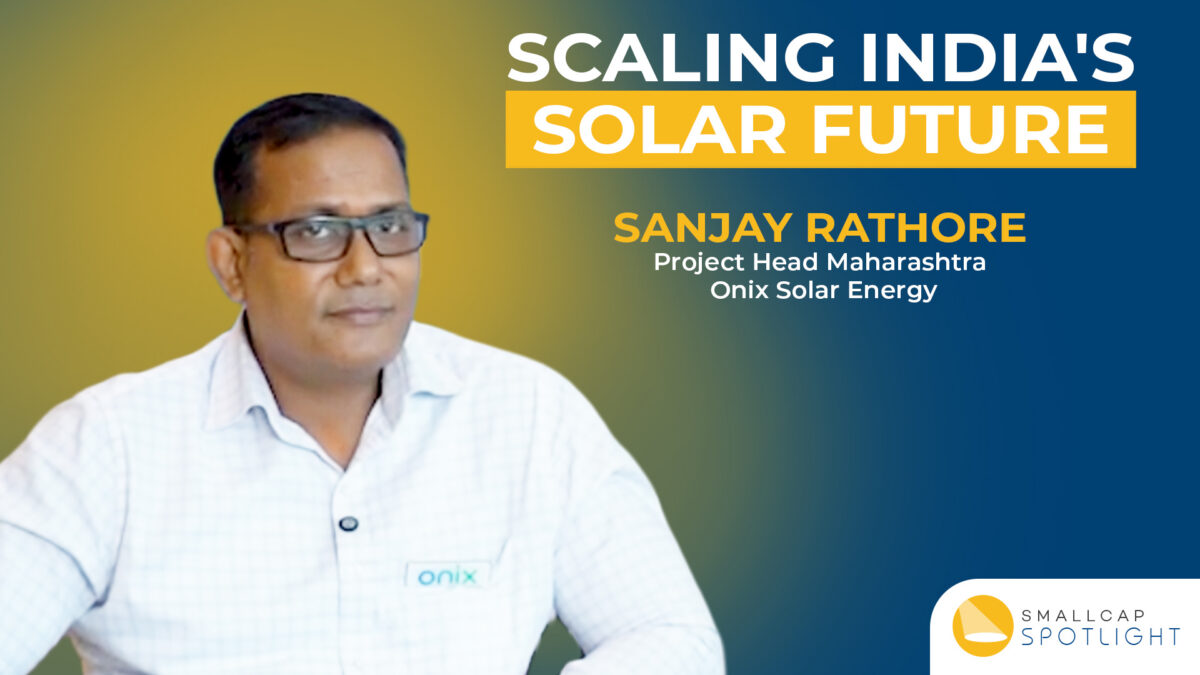
Sanjay Rathod, Head of Projects at Onix Solar, highlighted the company’s evolution from rooftop solar installations to an integrated renewable energy player offering manufacturing, EPC, O&M, and after-sales services. Speaking at The Growth Exchange 2026 – Investor Connect Series by AKMIL Strategic Advisors, he added that government policy support, a strong order book, and expansion into green hydrogen, battery storage, and solar manufacturing are driving the company’s growth ambitions.
Karunya Rao: Hello and welcome to SmallCap Spotlight and today we’ll be shedding the spotlight on a company called Onix Solar and I have with me Mr. Sanjay Rathore who is the head of projects at Onix Solar. Welcome to the show.
Sanjay Rathore: Thank you ma’am.
Karunya Rao: So first of all we would like to know what exactly Onix Solar does, how the journey started for the company and how it has you know sort of gone all the way through listing and tell us a bit about it.
Sanjay Rathore: Right. Actually ma’am, I told you in the presentation that we are focusing more on because in the India, in the very rural parts where conventional power cannot reach, solar power can easily reach there.
So we started journey 16 years before. We have seen in Gujarat, Rajasthan, so many rural areas where power scarcity is very high and people live in darkness. Still, the lights there hardly last for 2-3 hours.
So we made a mission from there that we will create a category in India where we can easily give power, user-friendly, where there is no much technology. Very simple, you install a solar panel and charge your battery from there and operate your appliances. We started the journey from there and made a vision that we want to give electricity and light to a small house.
So we started a vision from there. As soon as we started, we started a rooftop business that we used to buy panels from Maharashtra market and used to operate and install. Sooner, in later years, our strength increased.
Very good engineers and very good investors joined us. So we formed a company as Onyx Renewable Limited. In that, we engaged our small EPCs partners who used to work for us.
We also engaged the poor workers in the local community so that they get employment. After that, we slowly came to ground mounted from rooftop where we install solar panels on the ground. Then we saw that the market in future is very good, very growing.
So from 2015, we made a new vision that the vision of clean and green energy of the present government is going on and the next 50 years is the future of India in the power sector. So we started our journey in 2015 that we will go into manufacturing. But in India, so much of these regulations and policies were so strong at that time that we thought about it, but we could not do that.
So what we used to do, we used to buy products and install them and commission them and run them. But what happened was that in the last 4 years, the government of India changed the MNRE policies and it became so user-friendly that now every promoter, every Indian, if having a good capacity of this financial and technology, they can manufacture the product.
Karunya Rao: So what verticals do you work in today and what services or products do you make?
Sanjay Rathore: Right, so as I mentioned that when we started manufacturing here, we saw that manufacturing is not the only solution.
So we made our vertical that we will make our company in our plant and we will install our concerns for our customers. If they want you to operate it, then we operate it. And if they want to maintain it, then we maintain it.
If they want spare parts, then we provide after-sales service. So according to the customer need, we are a complete package for them. That is why we are one of the different companies and unique companies in India, which provides such solutions.
The rest of the people’s job is to sell the product or install it and running it is not easy. There is an interest in running it. That is why we are having an in-house of more than 1400 people around us, who work for us in a project, in an O&M, in a manufacturing, in all sectors, even logistics also.
So this is what differentiates the rest of the EPC players. Yes. And parallelly, we saw that there is a new revolution in India, Green Ammonia, Green Hydrogen.
So we participated in that as well and we are one of the bidders. You can check in Google as well. Onyx Renewable is a bid winner for Green Ammonia, which we won last year.
It is a very prestigious project. We have a tie-up with GNFC in Gujarat. Very soon, we are going to install our project in Bharuch and within a span of 3-4 years, it will be installed and our product will be launched.
Parallelly, we have also won an award in India. In that, we have to install a battery storage plant of 250 megawatts, plus the power that will be charged will also be taken from renewables. We have a tie-up with solar manufacturing.
So our product will come from manufacturing and we will install it ourselves. Our battery will be charged from there and power will be generated from the battery. So that is also a vertical for us.
So these are our different verticals and different services that we want to provide to our customers.
Karunya Rao: So largely, your base and market is in Gujarat?
Sanjay Rathore: No, we are having a span of all pan-India.
Karunya Rao: Which are your core markets, your key markets?
Sanjay Rathore: Key market is solar business.
Karunya Rao: In which regions?
Sanjay Rathore: I told that we have started from Gujarat, so definitely we are mainly based in Gujarat. But right now, we are having an office in Bombay itself, in Andheri East. Plus, we have bid for a 2000 megawatt order from PM Kusum, Maharashtra government.
And we have bid for a 200 megawatt separate entity, Onyx IPP. So in total, we have won an order of 2200 megawatts in Maharashtra. We will install it here as an IPP.
As an IPP, we have come here. And parallelly, the PM Component C, which is used for agriculture, the power that is given to the farmers for free. So the government has given us an extra subsidiary in that.
And they have allowed us for non-DCR as well, so that we can put the project at a lower cost. So that we also get a cheaper subsidy. And the farmers below, the landowners, they also get power at a very low cost, so that their water pump runs continuously, so that there is production as well.
So the Indian government has a very long vision, that the more we give flexibility to solar manufacturers and solar producers, the more benefit the other party will get. And it’s a green and clean energy. There’s no pollution, nothing, no hurdles.
Like the other conventional power plants, thermal power plants, there’s a lot of pollution, there are a lot of by-products, it’s a waste, you can’t use it. There’s nothing like that in this. It’s a fit and forget facility, plus it’s green and clean, almost zero maintenance.
Everybody, you can install it in your house also. You must have seen that in Bombay, even in metro cities, all the lights that have come up, they are all solar-driven. There’s no connection in that.
You just put a small battery, it will charge all day, and the power will be free all night. So taking this vision, we have defined our verticals. And we have also adopted modern technology.
Earlier, we used to adopt the Topcon facility. Now, in the future, we will go to HGT panel, which is the most advanced. Recently, means in the last 2-3 months, it has come in fashion.
But in the future, in the next 6 months, it will come to us as well. So in solar, the technology is very fast-moving. You can’t say that today’s technology will not be there after a year.
Because when I started my career in solar business, then hardly our panel’s watt peak was 400. Now it has become 700 within 2-3 years. And I feel that within a span of 6 months, it will also become 1 kilowatt.
Means less space, more power produced, and more efficient. Earlier, the efficiency was 15%. In today’s date, it has reached 26% within 2 years because the technology is more improved.
So that is why, the benefits and the fit-and-forget technology is very easy to adopt. Like there are many incentives of the government, there are many programs. One is PM Suryaghar, then there will be RPOs, state-level solar policies.
Karunya Rao: Because of all this, how much benefit did you get as a company, as a business?
Sanjay Rathore: Definitely, when we started this, PM Kusum did not come. PM Kusum was brought by Modi last 4 years before. He wants that every household, PM Suryaghar Yojana, every household should be, the electricity bill should be zero.
That is his dream. What will happen with that? Your conventional power will be used somewhere else. Not in the household, in the airports.
You can see, the airport in Hyderabad runs completely on renewable energy. Similarly, the revolution is coming. You can see that the future of solar is solar only.
That is why the government has given a subsidiary. In today’s date, there is a 30% to 70% subsidiary. If I can say in crores, if we invest 1 megawatt, let’s say the project cost is 4 crores, then 1 crore is directly given to us by the government.
But you have to use the panel in India, so all those things get added to it. So now the PM Suryaghar, the government subsidiary gets directly passed on to the owner, who installs it. So he also has a benefit.
So his payback period also comes in 7-8 years. After that, his lifetime electricity is free. So we also organize a lot of events where we tell the farmers, local villagers, what will be the benefit of this, the running cost of your pump will be reduced.
So they also have a benefit, we also have a benefit. Plus, the RPO obligations, mainly the manufacturers like steel and aluminium, they have a new rule that you have to take 25% of the power that you use, leaving the conventional power, you have to take it from the renewal only. So compulsorily, every industry has to take 25% of the renewable source only.
It was not like this before, it has changed in the last 5-6 years. And day by day, the 25% that is increasing now, it is possible that by 2035-45, it will be 100%. So it depends upon the availability of power.
Right now, the mission of 500GW in India, the power supply, almost 50% of it has been renewable. And the target is that in the next 10 years, it has to be 80% and in the next 10 years, it has to be 100%. So power should be green and clean.
That is their target.
Karunya Rao: So if we talk about opportunity, because the government has a focus on an unprecedented level, there are corporate sustainability goals, so what is the opportunity size for you now? And in the near term, do you have any growth targets or goals that the company has set?
Sanjay Rathore: Right. Initially, when we started 5 years ago, the manufacturing thought that we had, so we have an order of nothing.
So what we used to do, for rooftop, for 100 houses, we used to sell small things. But we saw that the central government in India, the MNRE, it drastically changed its policies. It also brought such a change that it also started subsidiaries.
So what happened in that is that it became easy for us to buy panels, to manufacture panels, to bring cells from outside, to make them in India. What happened with that is that our target used to be at one time that will we be able to do a business of 100 crores or not. Now we are thinking that we have to do a business of 2000 crores.
And we thought about it and we implemented it and we got an order of 2000 crores. And as I told you in the presentation, we have a full order for the next year. That is why our manufacturing capacity is increasing from 160 megawatts to 600 megawatts within this year.
Because we already have an order of 2 gigawatts.
Karunya Rao: So will you be able to maintain this growth rate by half?
Sanjay Rathore: Yes, definitely. Because our target is not 600 megawatts, our target is 1200 megawatts in the next 2 years.
And in the next 5 years, it is 10 gigawatts. We have to go up to 10 gigawatts. But we are going slowly because we also have some financial issues that we need money for.
Karunya Rao: Capital allocation strategy is something that we want to know. What are your plans? Are you planning any investments in acquisitions, expansion or any other business process?
Sanjay Rathore: Definitely. As far as this Onix Solar is concerned, we are having enough budget.
We just launched the right to show. We received almost 320 crores in that. With this, we completed all our previous loans to make a manufacturing facility.
We also used some 110 crores to purchase new IPP assets. In the last 6 months, Onix Solar has used and invested 300 crores. And we have seen the result in the share as well.
Earlier, our share was trading at 200. Right now, after this, everything is settled down. Right now, it is trading at around 650-700.
So, the profit that we have taken from the shareholders and used it properly in the market for the execution purpose is visible in the clear market. And earlier, 1 year before, our market capital was less than 500 CR. Now, we are having 2,500 crores of market capital already.
That means, the shareholders have faith in our execution. Our growth pattern, our strategy pattern, the shareholders also have faith in how we are working and how we are going to execute. So, all the capex that we receive from there, we put it strategically on the site.
We execute and maintain it. And that is our growth story.
Karunya Rao: Great. And who are the people, the key personnel, who are in the leadership team and what are the responsibilities?
Sanjay Rathore: Our chairman is Mr. Divya Sawaliya. She is the founder of the company. She started it. And her brother is Piyush Sawaliya, MD, who is present here. And the director is Mr. Hardik Adia. He has some health issues.
He couldn’t come today. And I am leading the project execution part. Whatever is happening on the execution site, the management, the cash flows that have to be maintained on the site, I take care of the execution part as the head of the project.
And I have a team of almost 300-400 people, who are present on the site all the time for the execution purpose. And we execute the timeline of the project execution. In the project, we have almost 350 personnels.
And in O&M, there are almost 150 personnels who work in the day-to-day activities. Plus 200 employees who are involved in the manufacturing facility. And about 100 people who work with our management team regularly.
So we are having a full force of more than 1000 personnels with us. So we have strength, engineering, everything is in-house. We are not dependent on outsiders.
If there is any special consulting, we do it from outside. And this is how we are working in the day-to-day activities.
Karunya Rao: Thank you so much for talking to us in such detail.
Sanjay Rathore: Thank you, ma’am. Thank you so much.