
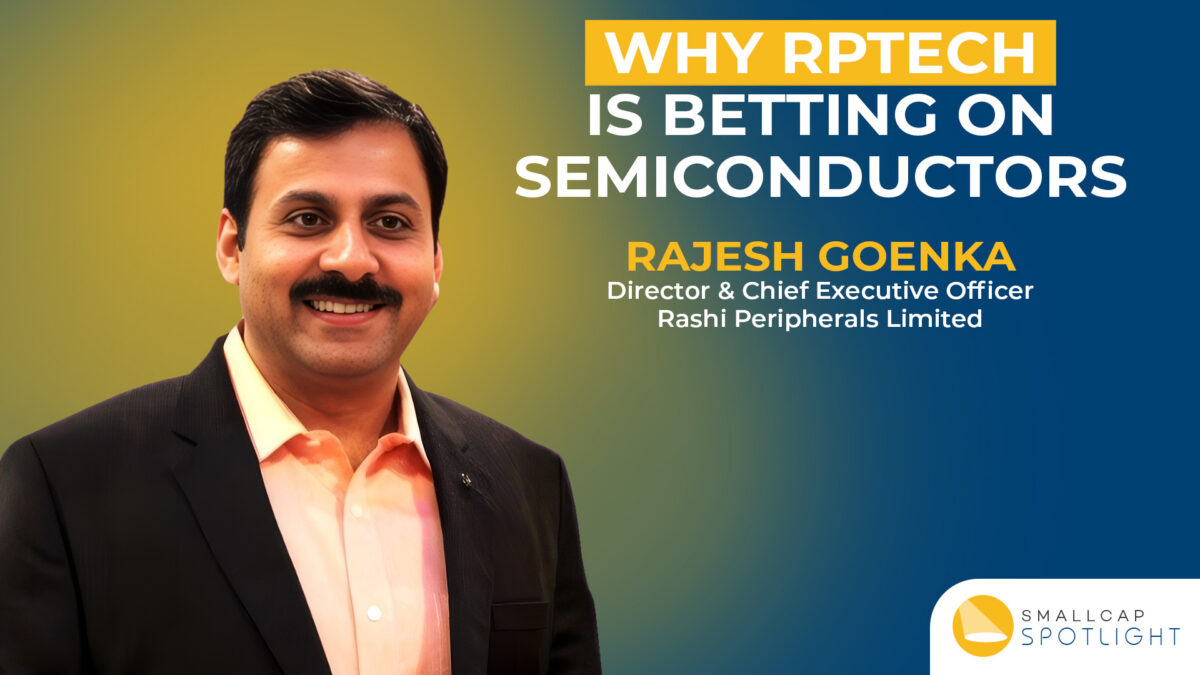
Rajesh Goenka, Director & CEO, Rashi Peripherals, highlights the company’s journey from IT distribution to a value-added technology distribution business with a presence across 57 towns and 700 cities. He adds that its semiconductor expansion, geographical reach and focus on emerging technology segments are supporting its growth opportunities.
Karunya Rao: Hello and welcome to SmallCap Spotlight. I’m Karunya and today we’ll be chatting with the management of Rashi Peripherals Limited. I have with me the director and chief executive officer of the company Mr. Rajesh Goenka joining us to talk to us about the company, its background, how it evolved over the years and what lies ahead.
Mr. Goenka, welcome to Small Cap Spotlight. Thank you so much and I look forward to talking to you and your viewers. So, what we understand is that RPTech has grown from an IT products distributor into one of India’s leading value-added technology distribution companies.
So, first up, if you could walk us through the company’s journey, the big milestones and what has been the strategy that has really worked for its growth.
Rajesh Goenka: So, Rashi Peripherals was accepted in the year 1989 by two chartered accountant friends namely Mr. Suresh Bansari and Mr. Kishan Choudhury. They started with manufacturing ribbons and cartridges in India.
Subsequently, they moved to IT import and then distribution and slowly and steadily as the IT demand in the country grew, they went on adding products and brands in Rashi Peripherals. One of our premier and initial brands that we started distribution with was Logitech and Asus, which we continue to distribute even today. As we grew, we went on geographical expansion.
We kept on adding branches in the metro cities of India initially and then later we went on expanding to non-metro locations and as we speak today, we have a physical presence of 57 towns of cities of India. Including Srinagar, including Agartala, including Rajkot and including places like Dhulia, all these places as well. On the product side, we obviously started with peripherals and accessories.
We added various components like CPU, motherboard, hard drive, all these products in our portfolio and then very soon we became the leading market share player in the country. Then further, we kept on expanding our product portfolio to various networking products, PC products, power supplies and all these products. Today, as we speak, in 2024, eventually we went public.
Currently, we are listed on BSE and NSE. We have 57 branches, close to 80 brands we distribute. We sell to more than 10,000 customers in 700 towns of India.
Last year, our declared revenue was 15,800 crores and this year we just declared our Q1 results two days back and we have shown a 61.5% growth on a YUI basis. So that’s our journey. In a nutshell, Rashi Peripherals mission and vision are two.
One is we want to be the technology enabler to every Indian in the country and second, we want to bring IT products and solutions available in the nook and corner of the country. Right now, as we speak, we are present in 700 towns of India. We want to go beyond that.
Karunya Rao: Wonderful. Can you also tell us what, according to you, is the secret sauce? What has been the strategy behind the kind of growth trajectory you’ve delivered? What’s worked well for the company? If there’s any big milestone or a turning point that you’d like to highlight?
Rajesh Goenka: Yeah. So I think the first is that we are the Indian company.
So we understand the Indian market more than anyone else. While the products that we distribute are all global products, top of the world, you say Intel or Nvidia or Logitech or HP or Lenovo or Dell, but then you need those Indian ethos to make these products available to the Indian consumer and I think that’s what we understand the best. Second is our unprecedented geographical reach, which I already mentioned.
It is unparalleled in the entire industry. We are the only company which has 57 branch offices in the country. And third is we have heavily focused and also partially invested in a wide range of products.
So in terms of products also, we have components, we have peripherals, we have networking, we have PC, and last but not the least, last few years, we have entered into semiconductor industry, which actually when we entered, semiconductor was not a buzzword. Today, semiconductor is, I think, after food and electricity, semiconductor comes the next power centre, global power centre. So we got into this and also I’m happy to share that two days back, we announced a joint venture company between Rashi Peripherals and Ristar Corporation Japan.
Ristar Corporation Japan is a $4 billion semiconductor design and value-added distribution company. So now this new JV company will be called as Rashi Ristar Solutions, Embedded Solutions Private Limited. So by virtue of this, we will bring enormous range of semiconductor and embedded product solutions, which will help improve or accelerate local manufacturing and promote make in India.
So I think that’s the big turning point as we speak right now.
Karunya Rao: Could you tell me a bit more about this joint venture? Because it is a big step into the semiconductor ecosystem. So what kind of value is this partnership going to unlock? And how will it strengthen your competitive position in India? And what should investors expect?
Rajesh Goenka: So absolutely.
So if you see all the government reports indicate that by 2030, which is just a few years away, the total semiconductor market previously was estimated to be $100 billion. Now it is estimated to $150 billion. Plus a lot of local manufacturing of semiconductors are also coming up.
Tatas are setting a plan. There are multiple announcements. All this is basically to help local manufacturing to promote make in India.
And that’s where this joint venture company between Rashi and Ristar is going to play an important role. One is we already have more than 2025 brands and products that we are already offering for local manufacturers. But with Ristar JV, we will be able to bring more and more global products, especially Japanese products and solutions to our country, which can again help for local manufacturing and enhance the percentage component of make in India.
The third angle that we look at it is typically right now our customer base in India is predominantly manufacturers who are basically Indian. Right now, there are many Japanese manufacturers in the country, but none of them are our customer. So maybe this joint venture company, when we go with India and Japanese together, we will be able to convert all these Japanese manufacturers.
Some of them, big names are Toyotas or Honda or Daikin, all these companies. Maybe they can also get converted into one our customer. And second, they can buy locally in Indian rupee, which again will enhance make in India and localisation.
Karunya Rao: Interesting. Well, let’s see how that plays out. I want to circle back to your performance.
You said that you’ve delivered a very high double digit growth in your quarterly performance in Q1. Now, tell us what is really fuelling the kind of run rate that you’re clocking and how sustainable do you believe this is over the medium to long term? And what would be let’s say the next three to five year outlook from a run rate and a growth rate standpoint?
Rajesh Goenka: So since the day of IPO, which was January 2004, I maintained the same sentence that last 20 years, Rashi Peripherals has grown with a CAGR of 20%, which is again very unprecedented. So we are one of the most consistent companies in the country.
And this consistency again comes by Indianness, comes by the physical reach that we have in 700 towns of India and the product line that we have. While saying so, off and on there are always ups and downs of the market, but our average view always exceeded more than 20%. However, April, May, June was a little bit abbreviation because of the price uptrend of the IT products.
As you most of the components right now are being bought by the large AI data centres at astronomical prices. As a result, the consumer prices have shot up. So the revenue actually has grown.
The unit growth is just about 15 to 20%, but 30, 35% has come from the average selling price increase. That is why we have declared a 60% top line growth. If you are asking for future, the near future, the trend will continue similarly.
It will taper down a little bit because now the price increase are not going to be as sharp as the previous quarters. So this year, I think something similar trend should continue. Next year, definitely there will be a correction.
But here, one, I am eternal optimistic person as Rajesh Goenka. Second, I believe in my country, our GDP, our growth rate is the highest in the world. Second, implementation of digitisation across all segments, including Aadhaar, UPI, that goes unabated.
Third, having one of the youngest population, every parent now wants to educate their child and to educate the child, having an IT product and solution is mandatory. So by virtue of the entire ecosystem of the country and with our core strength of being physically present with wide range of products, we are very confident of maintaining our trajectory, good trajectory. I cannot, of course, forecast a good percentage, but good trajectory in the coming years.
And to further create a value for our investors, we are not only just expanding our regular business, but recently we announced the acquiring of VDA solutions, which is a large system integrator, very reputed in the country. So with them, we are enhancing our capabilities of pre-sales and post-sales, how to do business with large banks, all this. And obviously, these kind of businesses are a little bit higher margin.
So when they get added into our Rashi peripherals, they will not only add top line, but they will start adding substantial bottom line as well. Of course, the ratio between our current top line and that top line is very different, but progressively in three years, I think they will bring a strong value creation for us. And third, as I already said about the joint venture company, again, this is a relatively high margin business.
So this also, apart from top line, will also bring higher bottom line and more value for our investors.
Karunya Rao: Okay. Interesting.
But apart from the core business areas, we all know that there is rapid adoption of AI, cloud computing, cybersecurity, digital infrastructure is constantly evolving. So amid all of this, what are the biggest growth opportunities for you, for the company over the next few years as things evolve and pan out?
Rajesh Goenka: So basically, IT consumption in the country will continue to grow. There is no question about it as for the reasons I already explained.
But then how do you get additional growth? And for that, you need to explore newer segments. So semiconductor is one segment, enterprise is another segment. AI, everyone is now talking of AI, and I would say that now 30% plus laptops that are sold currently by us and in the country are already AI enabled.
Another big growth driver is going to be the AI implementation and data sovereignty by virtue of AI data centres that are being set up in the country. As we speak today, there are public announcements of more than 10 AI large multi-gigabyte data centre projects to be installed. And here, Rashi Peripherals is very uniquely poised because we had the privilege and the challenge, of course, to execute India’s first and so far the largest AI data centre, which was implemented by IOTA about two years back.
And there, we did the end-to-end work. So we have a very strong experience and credential in setting up, supplying and executing large-scale AI data centre. And there is a big opportunity in that segment and we are working towards it.
Karunya Rao: So you already have a very strong presence as you established at the start of the conversation and customers, channel partners, global brands. Talk to us about how you created and sustained these long-term relationships and more importantly, how much focus do you put into customer service and how important is that for you for driving repeat business?
Rajesh Goenka: So basically, I think again, Rashi Peripherals is very unique. We are again, the only company which does not do only distribution, but our every branch office has an attached service centre.
So that means all the customers who buy products from us, they can walk into the same office and get carry-in warranty services. So that becomes an added advantage. This actually gives us stickiness with our customers so much so that even we are a B2B customer.
So we sell to our partner and then partner eventually sells to end-customer. But end-customer comes looking at the Rashi Perifils sticker because they will get a warranty very soon. So that’s the loyalty chain that we have developed in our partner ecosystem and even in customer segment.
Second being in operations since 1989, almost now 37, 38 years, very ethical business practises, very consistent approach. Our brand structure is not like North, South, East, West, like other distribution companies. We structure in state-wise.
So there is more focus. On an average, our branches and our people are in the company for more than 15, 20 years. So all this gives us consistency, reliability, trust, same face.
And of course, keep on upgrading our technology at the same time has enabled us to create a very strong, longstanding customer base as a result of which we have been growing very consistently for the last so many years.
Karunya Rao: What about the risks? Because I mean, you know, everything looks very great, what you told us about the growth prospects, your new partnerships, etc. But what about the risks facing the business today, whether it’s from changing technology cycles, inventory management, vendor concentration, competitive pressure, anything? And more importantly, how is the company trying to mitigate or sort of keep those risks at bay?
Rajesh Goenka: Yeah, any business always has risks.
It cannot be with zero risks. Only thing is now since we have moved to a mid-size scale, we are able to mitigate the risks. And plus, we have now more than 30 years of experience, plus our both the co-founders being chartered accountants.
They are experts in managing the finance. So far, we have been able to mitigate the risk. But some of the risks, like one risk right now that potentially could come is the IT products and solutions, particularly laptop prices in last one year has almost doubled.
So one year back, an entry-level laptop was costing Rs. 30,000. Now that same laptop is costing Rs.
60,000 and still not available. And a mid- and high-end laptop has moved to Rs. 80,000, Rs.
1 lakh and more. Now, for a country like India, it is a little difficult to afford a laptop worth Rs. 1 lakh.
Not only to a consumer or a student, but even for mid-size corporates also. So there could be a potential drop in the consumption for some time until some new form factor or price correction happens. Second, dollar fluctuation, our rupee keeps on depreciating.
And this product category is essentially import-based. Even if it is local manufactured, all the CKDs are imported. So this also hits to some extent our P&L.
Of course, we do hedging and then we also keep on changing the prices regularly. But apart from this technology obsolescence and all these things, generally, there are very minuscule risks because in case that happens, then you can always sell it at an older or a lower price without making any losses.
Karunya Rao: But in terms of investments and spends, how much of it goes into tech R&D?
Rajesh Goenka: Yeah. So we are a distribution company, so we don’t spend much on R&D. Only thing is our semiconductor business is design-based. So therefore, we have a laboratory in Bangalore, so where we do the basic design, we have a team of hardware and software engineers.
But one point I want to also mention that in distribution, working capital, I think that’s the heart of the entire ecosystem. And we need to continue to invest into working capital. And that was one of the reasons that we went for IPO because we wanted to expand our working capital.
And the more working capital you utilise to get inventory, you can sell more, of course, depending on the demand as well. So we stay very focused on this. And last quarter, we have improved our working capital cycle also, which also has helped us to improve our ROCE as well.
Karunya Rao: Okay. You started the interview by telling us about the founders, two friends, but we would also like to know who are the other people, the team that’s helming the company and the different verticals, if you could give us a peek into that.
Rajesh Goenka: Yeah.
So Mr. Choudhury, our co-founder, is the chairman of the company. Mr. Pansari, he’s the second co-founder. He’s the vice chairman of the company.
Mr. Pansari’s son Kapil, he’s the managing director. He’s the second generation Mr. Pansari. And Mr. Choudhury also, son Keshav Choudhury is in the company.
He drives the enterprise business. Apart from them, we have five independent directors on the board. They are all experts of law, finance, HR, and business.
I am on the board, Rajesh Goenka. Then we have a CFO, Himanshu Shah. He’s also on the board apart from our CS and VP finance.
So this is our leadership management team. Beyond this, every vertical, we have a business unit head, one on business, on service, on finance, on logistics, and so on and so forth. Currently, we have close to 1,600 employees located in 57 towns of India.
And our attrition is a little bit higher on the double-digit side, which is still lower as compared to industry. And last but not the least is, which I take pride on, we recently received the fourth consecutive time, the great place to work for, Rekha Grisham. All right.
Karunya Rao: You know, before we wrap up, there’s something very investor specific as well, I would like to ask because people who have been looking at your company or perhaps invested in your company would want to also hear from you about the big growth targets that you’re chasing or any financial milestones that you want to achieve in the next three to five years. What should investors be watching out for in terms of performance and growth trajectory?
Rajesh Goenka: So what I have been told is I cannot give any forecasted numbers. So I always repeat my own legacy.
Last 20 years, we’ve been able to maintain our CAGR of 20%. Even though the base goes on increasing, you know, 120% is 120. On 1,020 is much higher.
So I can only tell your viewers that we are very confident of maintaining and improving this kind of trajectory, not only just because we are Rashi Peripherals, not only because of our infra, not only because of our product line, but also as a country on IT, penetration is just about 15%. So 85% of our population today is still not using any of the IT products. They are either glued to a mobile phone or some of them don’t even have that.
So for us, the opportunity is this balance 85%. And to cover 85% of our population, I think it will take one generation. So the opportunity is immense.
And with our structure, we are very confident of maintaining our winning streak and achievements quarter over quarter and year over year. So any metrics that investors can watch out for or should be tracking while looking at your company going forward? Yeah, so they should not only look at our bottom line, but they should also look at our top line. They should also look at our overall working capital improvements.
And last but not the least, what matters most to investors is ROCE and earning per share. We are very conscious of bringing value to our shareholders. And that is the reason we do not just run after achieving a high top line, but we try to do value creation and VDA and semiconductor and all these are part of that value creation for our investors.
And we are very focused on that.
Karunya Rao: Great. Thank you so much for giving us such a detailed outline of what is it that you guys are doing at RPTech and the way forward for the company, the new opportunities as well that you’ve identified and lined up.
It’s lovely having you on the show.
Rajesh Goenka: Thank you so much. And we promise that we’ll bring IT products and solutions to practically every Indian in the country.