
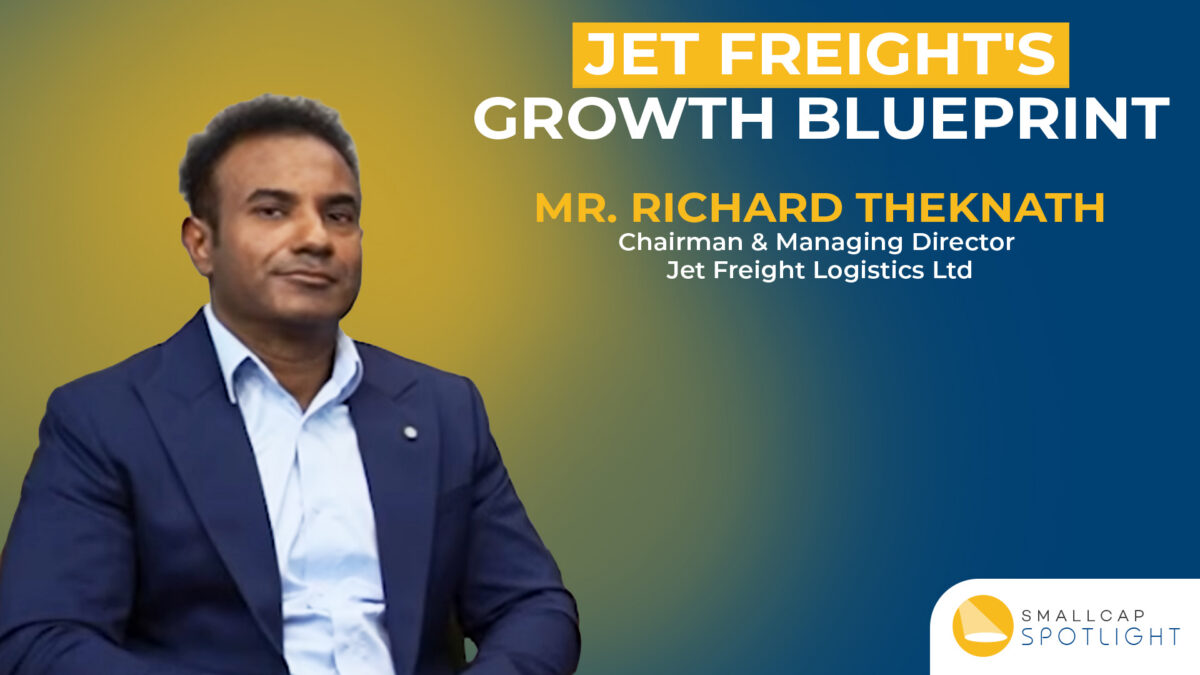
Richard Theknath, Chairman & Managing Director, Jet Freight Logistics Ltd., highlighted the company’s evolution from a customs clearing business into an integrated global logistics solutions provider. He also discussed growth opportunities across air freight, sea freight, and international expansion, supported by technology and strategic acquisitions.
Karunya Rao: Hello and welcome to SmallCap Spotlight. I am Karunya and today on the show we have with us the Management of Jet Freight Logistics. Mr. Richard is here with us.
He is the Chairman and Managing Director of the company. Welcome.
Richard Theknath: Thank you.
Karunya Rao: So, you have transitioned from being a traditional freight forwarding company to becoming an integrated global logistics solution provider. What does that mean? What exactly are you doing now and what are the kind of services you are offering?
Richard Theknath: So, as you know, our company is nearly 40 years old. This is our 40th year and when my dad started it, it was a custom clearing and forwarding company.
Over the years we transitioned into air freight and having more branches across India because we have seen air freight developing from other stations besides Mumbai. So, then we set up branches there and we grew in those states. After that we started looking at sea freight, then imports.
So, as India is developing, there are various new verticals in logistics that are upcoming, which have a lot of potential. And even today the market is very fragmented. So, we just tried to grab every opportunity we could get in the logistics space and that is what is keeping us growing.
And I think that the next 10, 20 years is going to be the same story and radical growth in this industry is possible.
Karunya Rao: So, what would you call as the biggest opportunity for you or has been in the recent past that you are now tapping on and trying to grow the top line and the profitability?
Richard Theknath: Biggest opportunity for us was the growth in air freight actually. Air freight as you know is extremely niche.
The freight is extremely expensive and only those commodities that can pay that expensive rate can move on air freight. Otherwise, sea freight is, the freight is much lower. So, we focus a lot on that niche.
Most of our journey, you know, I think for 25, 30 years, we focus more on air freight only and then sea freight we focus on later. In air freight, all our customers who are giving us business, most of them have sea freight and that is what, where the opportunity was actually. Besides that, in air freight, there are many commodities as India was developing, there are many commodities that kept on mushrooming, you know, government tried to, you know, support various sectors.
For example, biggest example is e-com, courier, how well they have done domestically in the past 10 years. That kind of growth is now coming in international also. So, these are the kind of commodities that kept coming up like engineering goods, pharmaceuticals and Indian fruits, vegetables that is going to the Indian diaspora out of India.
As the Indian diaspora out of India is growing, that business is growing. And as you know, the Indian diaspora out of India is only going to grow and they are very ethnic, Indian people love their own food. So, all that, all those commodities including agro products and go by C, like rice and wheat and a lot of other things.
So, these are the things that where I see there is a lot of growth coming in the past and will continue to grow.
Karunya Rao: So, who are your biggest customers, which segments do you see the most amount of business from and even market wise?
Richard Theknath: So, we have 14 offices in India and we do various commodities from each location and each location is capable of doing all the verticals in logistics, which is air freight imports, air freight exports, seafreight exports, seafreight imports and domestic logistics. So, because we are able to cater to such a wide range of verticals in logistics, the client base is phenomenal, it is huge.
Every exporter and importer is my prospective customer. So, that is…
Karunya Rao: But in the existing base, is it largely agro and food and stuff?
Richard Theknath: Yeah, why we focus a lot on agro and food and temperature controlled cargo is because that kind of, those commodities are repeat business versus someone who wants to buy a shirt, maybe once in two months or three months. It’s more discretionary.
Exactly and people need like their fresh fruit and vegetables and meat and seafood every day, every day. So, it’s moving almost every day. So, that’s volume business is what we have been focusing on that has helped us a lot.
Karunya Rao: I can’t help but ask with the recent geopolitical conflict that was playing out, what was the kind of impact you saw because your primary business is import export like you said. So, are things looking better now? How are they shaping up?
Richard Theknath: So, I feel that this, it’s sad to say but this war and the Russia-Ukraine war is happening and we have all kind of forgotten about that but it’s still going on, right? So, while that war is happening, another war has started and I feel this is the new normal now because there is no clear idea of when this is going to end and it’s sad. For us as a business, we are in these essential commodities which have to go.
So, because of which our business fortunately is sustaining. We have given our customers very innovative suggestions on how they could keep on exporting at a good price, especially in these kind of commodities like fresh food and temperature control etc. Like we have done like I think maybe 30-40 charters, full charters of food only to Gulf and the Middle East and all these sectors.
Karunya Rao: Was that a big cost for you?
Richard Theknath: It’s actually a big cost, yeah. It is a big cost but it is essential, it has to go.
Karunya Rao: But you passed it on to the customers.
Richard Theknath: Yeah, we passed it on to the customers like some of our customers are Lulu Group, Musabara Lulu Group, all the big supermarkets. So, they had the biggest share in that. Other supermarkets also were there but Lulu Group had the biggest share.
And there are various other unique suggestions we give to our customers so that they can save on the freight because the freight is increased tremendously now. And how we kind of negotiate with the airlines, with the shipping lines and see that our customers are able to get whatever benefit and rate they can get even in these times of surge. So, in the post-war, post-COVID era, how are you managing the inflationary costs that have now really gone up across the board, whether it’s fuel, whether it’s commodities, whether it’s any product and services that goes into your business as well.
Karunya Rao: So, what has been your strategy to mitigate or at least minimize these risks?
Richard Theknath: So, with regards to fuel, the fuel, when the airline or the shipping line increases it, whatever, it is passed on to the customer. So, we kind of try and advise our customers which is the airline with the lowest fuel and how they can probably save on that. Besides the fuel, if we talk about transit, fast transit, some customers need really fast transit.
So, we give innovative ways of how they can probably do something like a combination of sea and air, where the transit also is fast, but at the same time, the freight is less compared to directly going to overseas country, direct flight, which is the freight is extremely expensive.
Karunya Rao: So, you are saying that you are passing on cost to customers and this pricing power that you have is because primarily you operate in the essentials category, is it?
Richard Theknath: Yeah. So, we have cargo that’s going 365 days a year with most of the large airlines, like Air India, Emirates, Qatar, Lufthansa, all the big airlines and more so the other ones also, the smaller ones also.
And it is a mix of various commodities, it’s not just one commodity. So, because of that, we have an edge or most of the other foreign companies are not in air freight or are doing a less amount of air freight. And we also are able to pass that on to our customers and give them not only assured space, because we sign contracts with the airlines or the shipping lines, we give them assured space and ensure that the cargo moves, especially in times like this, where it’s extremely important for them to move.
Karunya Rao: 40 years is a long time, you’ve been in the business for that long, for four decades, any big milestones or any, you know, turning points that you would want to flag for our viewers?
Richard Theknath: So, 40 years is my dad started the business, I’ve been in the business for last 28 years and I learned under him for the longest time and that really shaped my experience and my knowledge and my learnings. And like you asked me with regards to anything like, you know, COVID was one big thing. When we started out, when I joined my dad’s company, we didn’t have the essential licenses.
For example, I had a license, International Air Transport Association license, which is very, very difficult to get at that time, I’m talking 95, 96, 97. So, in that time we, I kind of, you know, really pushed that through, it took me about a year and a half to get that license. But that was one of the big milestones that made us deal directly with the airlines.
And now we are the airlines representative. Then when I also got my own customer agent’s license, although my dad had one, but I also wanted to pass that exam, that was another difficult exam to pass. So, I sat for that exam, pass that exam.
Then we, when we opened our other branches like Delhi, like out of, we are always from Mumbai going and setting up in a new station like Delhi or Bangalore, I felt were very big achievements for me because these are very big markets. You know, so even Gujarat for that matter, Kerala, you know, today we have four offices in Kerala. So, these are achievements that I think that kind of made us a little different from other freight forwarding companies who have presence only in few locations, you know.
Karunya Rao: So, you do have a strong network across the globe as well. So, you know, just to go back to my previous questions, what are your biggest markets and do you have a plan to expand within that or beyond that if you could tell us a bit about the global plans?
Richard Theknath: Yeah. So, our markets largely are Gulf and Middle East, the UK, Germany and US and Canada, also Australia and Singapore.
These are our largest markets. Now, after having such good volumes in these countries, it just makes logical sense to have our presence in these countries and our business is only growing in these countries. So, my plan in the future is and I have already taken steps towards it in Dubai, but other locations also will follow.
My plan is to have our own setup in these countries and handle our own business that moves there and then look at business that move from there in back to India. So, we have business both ways and this is not something that I am thinking, this is just what multinationals have done like DHL, FedEx, UK, this is how they have grown. Their economies grew 40-50 years back and they were in that position that they could have offices globally.
Yeah. Because their country gave them that opportunity. I feel we are sitting on that opportunity now in India and my company has that opportunity, it has that chance to become the next multinational.
Karunya Rao: So, any countries you have already started setting base in?
Richard Theknath: Dubai. Dubai and then now the next is going to be London.
Karunya Rao: Okay. How soon is that happening?
Richard Theknath: London should happen before this financial year end.
Karunya Rao: Okay. So, also this is a very dynamic industry, a lot of automation is taking place, there are these ship visibility platforms, lot of digital initiatives happening. Where are you positioned in that space? Yeah. What are the investments you are making? What is the kind of digital upgradation you are looking at?
Richard Theknath: So, I totally believe and always believe that we have to be up to speed with technology and we were one of the first ones in India to get a software from a service provider in Dubai when no one has actually heard of, you know. So, fast track many years back just pre-COVID, we started something like make my trip but for cargo, that business did actually quite well.
Like an aggregator? Like an aggregator platform, when the customer just comes, books, gets a freight, puts the details of cargo, gets a freight and books the ship instantly, gets their tracking everything, you know. And along with that, a lot of other bundles of services we can kind of sell to them. That did well then, then COVID happened and then we had to kind of, because the rates became dynamic, right? So, we had to kind of stop that.
Then a couple of years after COVID, I tried that again and honestly I failed because I am not a software or a tech person myself but the people we kind of got and the infrastructure did not actually work. So, we lost some money there but I am not going to give up and I am going to try again and now I am working on something very soon, maybe in the next six months, our own platform. Now, you know, it is not as expensive to build like it was, you know, four years back.
So, now it is much better, cheaper and we have the business available. The plan is to put all our rates and all our service offerings on a platform and then give out franchises across India but that will really blow the business.
Karunya Rao: Okay, you know, I am sure you must be onboarding more tech talent also for, you know, taking this project up.
But tell us about the team that is running the show, who are the kind of people who are assisting you in the core team, vertical heads, what kind of people are running the show?
Richard Theknath: So, you know, we are an asset light company. So, our assets are our people and so we invest a lot in them and we also kind of appreciate the people who have been with us for a long time. So, but we are also a company that is very aggressive.
We try to get people, sometimes things work, sometimes things don’t work, you know. Sometimes we as a company fail to keep up our commitment, sometimes the people we hire, they have probably tried their best and couldn’t give, you know, just things don’t work sometimes. So, that process is always on but I have a very large team.
We have about 250 people and a very large portion of them are very old employees who I am extremely proud of and without them I am nothing, you know. So, the kind of services that they have, the knowledge that they have, the kind of, you know, stability that brings to our business because like I said, our people are assets. We don’t make any product.
We only sell a service. So, those people are the ones that actually I am dependent on and we have a fantastic team. We have all regional heads.
We have got finance, a large finance team also, you know.
Karunya Rao: You are talking about, you know, hiring people and expanding your team but are you also looking at expanding your business beyond services because like you said, you are primarily in the services business but within the entire spectrum of supply chain, is there any other business that you are looking to organically or inorganically sort of expanding to where you see a lot of synergy and which could be a good fit?
Richard Theknath: Yeah. Just yesterday I was talking to a company that is kind of introduced us to three small, really small companies but they are in locations where I would like to increase my business.
So, one is in Kerala, one is in the South Bangalore, Chennai and one is in Mumbai but they are doing a business where I am not very strong in. So, like I mentioned to you earlier that we have, you know, the business is very fragmented and there are lot of opportunities coming up and there are many small, small, small, small players. So, this is the time for consolidation actually.
So, we are looking for acquisition, we are looking for smaller companies, good promoters who will tell. But what kind of businesses? They could be in sea freight, specialized sea freight, they could be in a location where I have less sea freight and they have a good market share. So, all of that will bundle up and increase my thing, you know, my numbers and those promoters there will have also a good network and, you know, they are strong in their region.
My point is I just want to kind of consolidate and see that the company becomes bigger and bigger and the reason for being listed was that only, how else do you grow, you know, that is the whole plan.
Karunya Rao: Interesting. But how has life changed post listing in terms of engaging with the, you know, the stakeholders or compliances or the way you function, anything that has changed for the better?
Richard Theknath: So, I kind of had an idea that life is going to get more, I would not say difficult but more compliances, compliances, compliances, right.
So, I had an idea but I had no idea it is going to be so difficult.
Karunya Rao: How are you managing it?
Richard Theknath: Yeah, no, fortunately for us, I have always had good people and those people are kind of managing it but they are just briefing us and we have to just follow whatever they say, they are the experts. Sometimes they may also not have the actual answer, then we depend on external consultants who advise us what to do.
So, being compliant is extremely important when you are listed as you know, but then it has got its benefits also. So, I knew that was going to happen and we were ready for it. So, it is just another thing that we have to do.
Karunya Rao: Interesting. And finally, you know, would you like to leave our audience and some of your investors as well watching this with some kind of a guidance or a vision for growth that you have a road map or any targets that you have set for the company?
Richard Theknath: I just want to tell all my prospective investors and the current investors, stakeholders, you know, my employees, clients, customers, family, everyone that my vision is to make Jetfred Logistics a multinational company and my competition in multinational companies are the likes of DHL, FedEx, UPS. So, that is my vision and we have come so far and I am pretty sure that those steps that we continue to take, it has become a process now, right.
Karunya Rao: So, that will yield enormous returns in the future. But in the next 4-5 years, any revenue target, top line targets, anything that the company has laid out?
Richard Theknath: So, we have a target for, we have done 450 crores roughly last financial year. We have a target for about 550 to 600 crores.
In, by the end of this calendar, by the end of the financial year and I think we have already surpassed, I think close to 180 crores in the first quarter itself. Okay. So, I think we should be easily able to reach our target which is almost 40% more than last year.
Karunya Rao: Right. All the very best for that and the business beyond this fiscal as well. Thank you so much for joining us on SmallCap Spotlight.
Richard Theknath: Thank you. Thank you so much.