
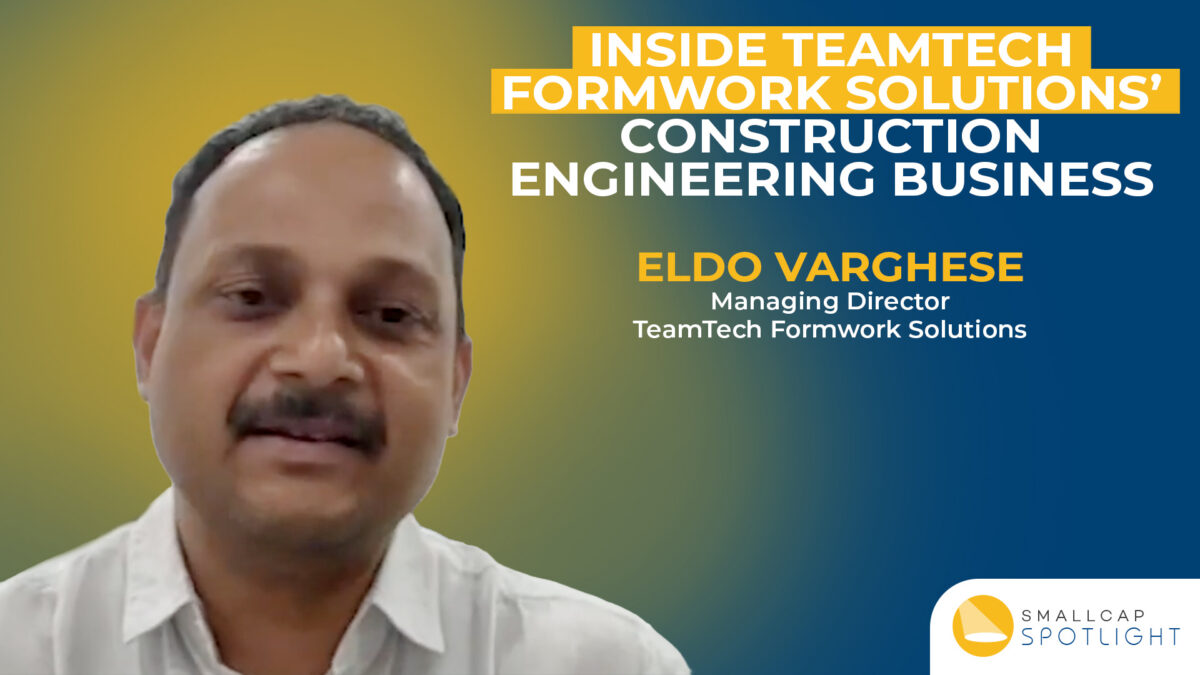
TeamTech Formwork Solutions is redefining concrete construction with reusable, engineered formwork systems designed to improve speed, precision and sustainability. In conversation with SmallCap Spotlight, Managing Director Eldo Varghese discusses the company’s growth journey, infrastructure projects, rental-led business model and long-term expansion plans.
Richa Jain: Hello and welcome to Small Cap Spotlight. I’m Richa Jain. In focus today is TeamTech Formwork Solutions, a Hyderabad-based, unlisted construction engineering company founded in 2018 that specialises in modular homework systems, essentially reusable moulds used in large-scale concrete construction, offering a mix of manufacturing, rental, selling and engineering services to improve construction speed, quality and cost efficiency.
The company produces steel and plywood-based homework solutions, provides customised designs and supports major infrastructure and real estate projects across India, positioning itself as a mid-sized, technically focused player aiming to disrupt traditional shuttering methods with more efficient standardised systems while maintaining a presence in both domestic and select international markets. Let’s welcome on board the company’s Managing Director, Mr. Eldo Varghese, as we uncover TeamTech’s transformation journey and what lies ahead. Thank you so much for joining us, Mr. Varghese.
Thank you so much for having us. Absolutely, Mr. Varghese. Just to begin with, why don’t you tell us a little bit about TeamTech Formwork Solutions, what do they do in very simple terms?
Eldo Varghese: Sure, TeamTech Formwork Solutions designs, manufactures and supplies reusable moulds.
It’s called formwork that shapes concrete in construction projects such as say bridges, buildings, dams, highways, that kind of RCC structures. So in simple terms, we provide systems that hold wet concrete in place until it hardens, making construction faster, more efficient and more precise. Traditionally, in many developing markets, if you really see, formwork relies on timber and plywood.
While widely used, these materials offer limited reuse, generate significant waste and demand high labour for repeated assembly and dismantling. This often results in inconsistent quality and environmental challenges. So at TeamTech, we are rethinking this conventional approach by introducing durable, reusable and user-friendly formwork systems.
We help reduce material wastage, enhance the productivity and ensure superior construction outcomes. This is not just a product shift, it is a part of a global transformational journey, you can call it, toward more sustainable and efficient construction practises. True to our name, TeamTech represents a team of experienced professionals committed to making a meaningful difference in industry, driving innovation, improving standards and shaping the future of concrete construction.
Richa Jain: Lovely, as we move towards a more sustainable world, it’s actually lovely to hear that, so thank you for sharing that. Why don’t you tell us a little bit about how your journey has been with TeamTech formwork solutions so far?
Eldo Varghese: Oh great, it has been fantastic journey so far and I’m very confident that the future will be even more exciting. Like any organisation, TeamTech started with humble beginnings, but over the past seven-eight years, we have grown manifold by focussing on identifying real challenges in the construction industry and consistently working on solutions on that.
This problem-solving approach has not only driven by our growth or just for our growth, but also translated into strong performance and measurable results in financial terms as well.
Richa Jain: Let’s talk a little bit about, we alluded to this in the beginning, what makes your formwork systems better than traditional shuttering methods?
Eldo Varghese: It’s a wonderful question. What sets our formwork systems apart from traditional shuttering is a combination of durability, efficiency and sustainability.
They are designed to be user-friendly and faster to assemble, which lowers labour and dependency and improves site productivity, overall productivity. At the same time, they deliver higher precision and consistency in concrete finishes, minimising rework and enhancing structural quality. With the help of special software, we make the planning of formwork activity quite quick and efficient.
Most importantly, our approach supports a more sustainable way of building, as you rightly mentioned in your words, by reducing wood consumption, promoting reuses and optimising resources, we can really make a sustainable effort here. In a sense, we are not just offering a product, but enabling a smarter, cleaner and more efficient construction process itself.
Richa Jain: Mr. Varghese, it’s lovely to hear that we’re moving towards a more scalable, efficient process, but in a highly competitive world now and market, what sectors or projects drive most of your revenue today?
Eldo Varghese: It’s again a very good question to answer.
Our current focus is on the vertical formwork systems. We don’t really do the horizontal side of it. We are focussing on vertical formwork systems, which are applicable across virtually in every RCC construction.
However, from a revenue perspective, if we look at the majority of our business comes from large scale infrastructure projects. It’s because of their volume and the continuous demand. The industrial structures were highly repetitive in nature.
So that is also part of our major revenue streams. That said, the broader trend across the construction industry is very clear. There is a gradual but definite shift toward more systematic and engineered formwork solutions.
Past projects increasingly prioritise speed, quality and sustainability. We see growing adoption across all segments of concrete construction, not just in the infrastructure and industrial, but also commercial and residential developments. But currently, our major revenue comes from infrastructure and industrial projects.
Richa Jain: Would you like to share with us a few key projects you’ve recently executed?
Eldo Varghese: Sure. We are really proud of being part of major, very challenging projects in our country. To name a few, I won’t be able to take all the names here, but to name a few, these include the world’s largest lift irrigation project, which is in Telangana.
It’s called the Kaleswaram Dam project. India’s high speed rail project, which we are proud of, like it’s going to be the first bullet train project for India. That’s Madabad to Mumbai.
Our country’s largest hydroelectric project, that’s Subansiri Dam in Arunachal Pradesh. The longest extra-dosed cable bridge, which we all can be proud of, that’s coming up in Assam to Meghalaya above Brahmaputra. Asia’s longest highway project, that’s Delhi-Mumbai Expressway.
It’s about 1,400 kilometres. The world’s largest startup incubator, that’s in Telangana again. It’s called T-Hub.
These are the few projects that I wanted to name. We are very grateful to be part of this very, very challenging and noteworthy projects.
Richa Jain: You must be so proud. In fact, there are some of the projects you mentioned that I have personally known about. So these are contributing to the country’s economic and social good. So congratulations.
Now just going back to within the horizontal and vertical streams that you mentioned, and then the commercial or even the residential projects, what would you say within manufacturing, rental or even services would become your more revenue gaining streams per se?
Eldo Varghese: Very good. The selling continues to be our primary revenue stream because as a growing company, you really need to have cash flow coming in. So that’s a major revenue stream.
It contributes approximately 77% of our total revenue. In last financial year, I’m talking about 25-26. Rental forms the next significant portion, which is about 22% of the revenue.
And right now the refurbishment services is just picking up. It’s hardly 1% at the moment, but that’s going to grow faster in coming years. These ratios are quite dynamic.
It may evolve over time depending on the nature of the project, scale of the project, the duration of the project. So the market is as the market matures, we expect rental and refurbishment to play a significant role in future.
Richa Jain: That’s lovely. And it’s a good segue into what I wanted to understand next, which is not just in terms of revenue. Could you throw some light on the rental segment of your business on how that is contributing to business growth and will continue to like a little deeper dive into that possibly.
Eldo Varghese: The rental segment is strategically very important to our business growth.
It serves two key purposes. If you really look at the rental revenue that comes in, the nature of the revenue that comes in, it serves two key purposes of our business. First, it creates a steady and recurring revenue, which we can depend on like for your all regular expenses or fixed expenses, adding stability to our overall business model.
The moment rental revenue grows, your business becomes more stable and steady. The second, it allows us to cater a segment of customers who may not be in a position to buy and invest in our system in the initial stage. It’s a capex overall.
So they may not be able to afford that kind of investment. Beyond this, rental acts as a powerful entry point. So if somebody wants to taste our product, so that’s an entry point, right? It gives customers the opportunity to experience our product, the services, they gel with us, they understand us better.
That built the confidence in the systematic formwork arrangement, gradually scale their adoption, and they get more projects by using, I mean, with a minimum amount of money, they will be able to demonstrate their capability and get more projects in hand. So in many cases, this also becomes a pathway for long term partnership with that particular company. So future conversions will happen from a rental model. That’s the idea.
Richa Jain: It’s a great way to also build trust, Mr. Varghese, the rental side of your business, right? People come in, people test it, and then the partnership goes ahead. So that’s great to know.
Now, in a very competitive and cluttered market, a lot of times, what do you think are your key competitors? And how do you differentiate yourself with people who are doing similar things?
Eldo Varghese: There are many competitors in the field, but most of them are like multinational companies, international players who are operating in India at the moment. They’re all good companies, global expertise, and India needs them. That’s very important.
But we have positioned ourselves very effectively for the domestic market. We know the market very well, to be precise. Our key differentiation lies in our deep understanding of local conditions and project realities.
This enables us to respond faster with practical and customised solutions for them. We offer quicker delivery timelines, strong price competitiveness, and I can say highly responsive for sales support, which is very important. We need to and hold the customers for a very long time.
Above all, our strength comes from our team. So being closely connected to the ground realities in our country allows us to design and deliver solutions that are not just technically sound, but also highly relevant and efficient for our customers.
Richa Jain: You know, Mr. Varghese, from everything you’ve just said, it sounds like your company and you and your team are putting effort in exactly the right direction, whether it’s the timelines, whether it’s communication, everything.
But then I’m curious to hear, with all of this, with such good service, how do you maintain strong margins in, like you said, a very competitive intramarket?
Eldo Varghese: Firstly, it comes down to a disciplined execution and you’ll have to maintain a value proposition that truly matters. So we focus on delivering high quality, reliable products and pricing them based on the value they create rather than competing purely on cost aspects. Second, we maintain tight control over the design, manufacturing and operations.
This allows us to manage cost efficiently while ensuring consistent quality measures to be taken. So, a balanced standardisation and smart customisation helps us to scale without adding unnecessary complexity in the process. Third, the strong rental presence improves our asset utilisation.
If you really see how much asset we are putting into the rental arena, instead of putting the amount, the expense that we put into marketing, how do we allow them to taste it and get back to us. That creates a steady relationship with the customer. Finally, our ability to deliver faster execution, reduce the labour dependency and ensure superior project outcomes, that’s what we aim at.
So, how to control the cost aspects that we will always maintain to do that, we will always maintain the profitability as well.
Richa Jain: It sounds like a really tall task and I’m happy you’re leading with that clarity. Now, with this growth, with this journey that you’re on, what are some of the biggest challenges your company is currently facing?
Eldo Varghese: It’s challenging, any transformational journey is challenging for sure.
The biggest challenge we face is mindset. So, shifting from traditional practises to more systematic engineering solutions and disciplined solution often comes with resistance to change, that’s for sure. Both at the individual level and organisational levels.
However, we see this as just not a challenge, it’s an opportunity but as an opportunity. Change resistance naturally slows down adoption but it also allows us to engage more deeply with our customers and demonstrate the value and build long-term trust. In that sense, the gradual pace of change actually supports a more stable and sustainable scale-up, enabling us to grow steadily with while strengthening our foundational industry.
So, slow and steady wins the race.
Richa Jain: It sounds like slow and steady, patience and perseverance is what the path you’re going to and that’s lovely. Now, let’s switch gears a little bit.
I would love to hear about the fact that with the government also focussing on a lot of infra projects sometimes, so how dependent is your business on government infrastructure spending?
Eldo Varghese: Government infrastructure spending and the fiscal policies that we call are important drivers for the economy as a whole and for organisations like ours that contribute to national building. Naturally, they do have a positive impact in our business especially in large-scale infrastructure projects. However, our business is not solely dependent on government spending.
The scale of government investment is far larger than our current size. We are a very small company. If you compare ourselves with the large infrastructure spending that government makes, we are very small.
We also have a strong presence in private sector developments including infrastructure and commercial projects. So, this balance is a healthy balance in our revenue streams that makes us grow. By participating in both public infrastructure and private developments, we are able to de-risk our growth and ensure a stable regardless of fluctuations in government spending, the growth story will continue.
Richa Jain: Is there anything in particular that you’re looking at apart from everything that you’re doing as the growth strategy for the next couple of years?
Eldo Varghese: We have a lot of things coming up for sure. Currently, some expansions are going on. We are getting into a bigger space with robotic fabrication and powder coating units and we are just trying to improve the facility to speed up and scale up our operations, that’s for sure.
And down the line in another two, three years, you may see a larger expansion from our end that is also being targeted, I can say. While the future is always uncertain, again I’m seeing it as an opportunity, a source of motivation to push ourselves with our boundaries. It will be a challenge.
Past has given us a tremendous growth and future is of course, a lot of ambitious plans are there that will also come up. So, last year, if I really see from last year, we touched about 55 crore and we targeted to grow almost 70 percent by this financial year which is 2026-27 and 27-28, we wanted to grow with the same pace and same level. At the same time, our focus is not just on top line expansion.
We consider the profitability as an equally important aspect because we really need to have that power in hand to have larger expansions which is set in. The capacity, the product innovation, the market reach, the kind of offices that we wanted to set up and get the routes spread across India, everything is an expansion plan. So, overall our strategy is to grow aggressively for sure but in a disciplined and sustained manner.
Richa Jain: It’s lovely to hear from you Mr. Varghese with such clarity and conviction and you leading at the helm of it all. Last but not the least, I would love to understand what is the strength of your team and how and who in the team is helping achieve the company’s long-term goals?
Eldo Varghese: It’s completely a team game as our company’s name suggests. We don’t believe in individual importance as much as we believe in clearly defined roles that contribute to a larger purpose.
Every member of the team plays a part in driving this organisation forward. At the same time, our team goes beyond the people within the organisation. It includes all our stakeholders, say employees, customers, partners, a larger ecosystem that we operate in.
Our strength lies in this collective approach. We aim to remain socially relevant by making a meaningful difference in our field, uplifting everyone who is part of our journey and growing profitably together. It is this shared vision and alignment that is helping us move steadily towards our long-term goals.
Richa Jain: It’s a beautiful parting thought Mr. Varghese. Thank you so much for joining us and all the best for your journey ahead and thank you also to all of our viewers for tuning in. If you like the video, don’t forget to hit the like button and subscribe to SmallCap Spotlight for more such conversations.
Thank you.