
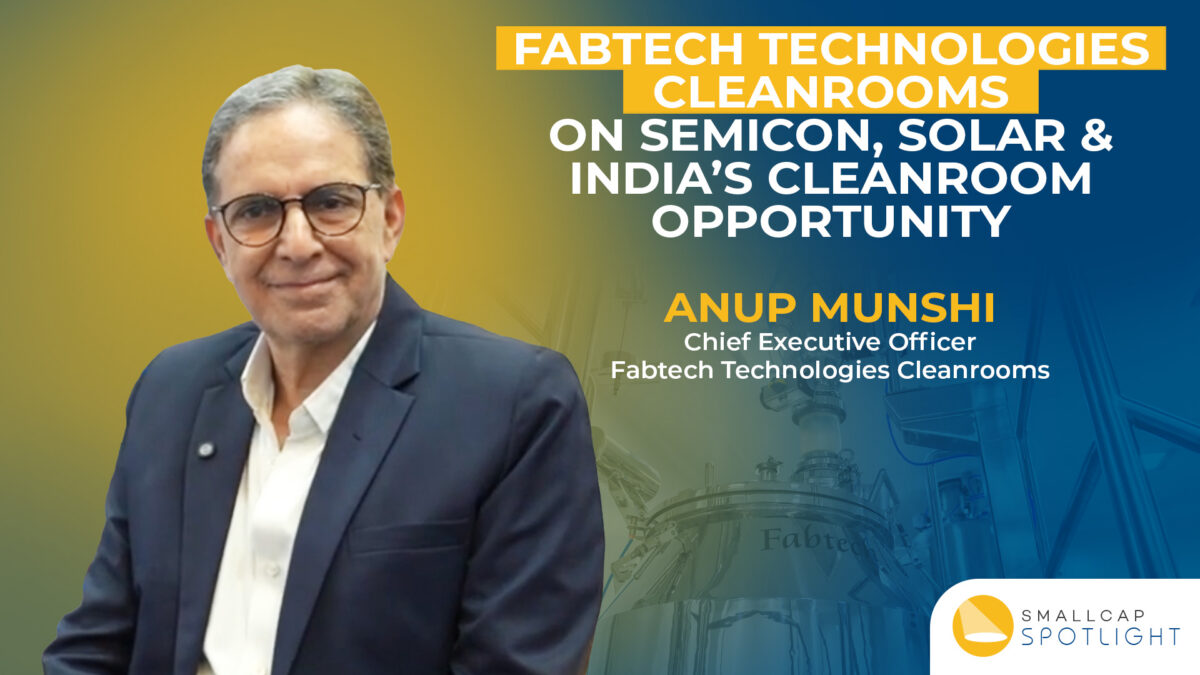
Anup Munshi explained how Fabtech Technologies Cleanrooms builds controlled manufacturing environments for industries ranging from pharmaceuticals and healthcare to semiconductors, solar and food processing. He highlighted the company’s focus on turnkey cleanroom solutions, strategic acquisitions and technology-led expansion as demand for high-quality manufacturing infrastructure grows across sectors.
Anjali Palod: Hello and welcome, you’re watching Small Cap Spotlight and today on the show we are joined by Anup Munshi, the CEO at Fabtech Technology Cleanrooms. Welcome Anup to the show and we start right at the basics on the show. So tell us what cleanrooms are and how do they basically differ from any other manufacturing unit?
Anup Munshi: Okay, so first of all thank you very much for having me to have a chat with you on our industry, our company Fabtech Technologies Cleanrooms Limited.
So basically we are into cleanrooms. Now cleanrooms are, you know the nomenclature is cleanroom wouldn’t mean a cleanroom like any cleanroom but this is a technical cleanroom in the sense that a cleanroom is a manufacturing area which is a controlled environment within that area where what you control is the air, the quality of air, the purity of air, water, relative humidity, particulate matter, any particulate matter and of course above all the bacterial contamination or any of these microorganisms which are present there. Okay, obviously by the definition you will realise that cleanrooms are essentially required to make products which require to be made in such sterile area.
Right, yeah. Okay, so therefore obviously the first thing was pharmaceuticals. So we also started the same way, Fabtech Technologies Cleanrooms.
We were making cleanrooms for the pharmaceutical industry. Right. That’s where we started.
Yeah. And the journey continued and it added and then hospitals came into the picture, other healthcare areas came into the picture and off late over the last few years what got added to this, our market expanded substantially and today we have a situation where microelectronics has become a very big market. Right.
Which is predominantly which is our solar. You must be reading about, you know, solar units being put up by very famous, Dwari is a very major company. So we are doing a project for them like that many other companies like Gupin, Satvik, these are all solar projects.
So that’s one area. Semicon is coming up as a big area now, semiconductors which you must be reading again. Yes.
But that is still in the nascent stage more or less. And of course now what has also happened is that, you know, due to the requirement to make high quality products and due to the pressure, let’s put it this way, from the consumers, you know, from the producers also have become now more conscious about the quality of product that they make. Okay.
So therefore you see that in food and beverage, like we did some work for Coca-Cola, we did some for Pepsi, we did something for another food and beverage company. That kind of transparency is being demanded by consumers as well to have a peek into what these manufacturing units of the producers look like. Yeah, it’s not exactly that the consumer has an access to the manufacturing area.
Not in a literal. But the pressure, yeah, but the pressure from the consumer groups. Right.
For me this product, you know, like I told you, I’ll give an example. There’s somebody, there’s a company in India who’s making diapers in clean juice. Because the quality of diapers and the freedom from contaminations of diapers, especially the paediatric ones for children, kids rather, very important.
Otherwise, you know, if it’s infected, the kid gets infected. So there are a lot, you know, a lot of industries, like say you can see that aviation, there are specialised microelectronic, you know, equipments, I mean parts, which are part of the cockpit, let’s say. They require tremendous kind of clearing.
I mean, there’s got to be not even an iota of dust on any of those, you know, components. So that, those avionics has become. Now there are certain automobiles, certain parts are made in clean rooms now.
Anjali Palod: So there’s a whole gamut of new industries that are now coming up. But I want to take you back to the beginning of this journey. When did it start? And what part of this entire clean room do you look at? Are you looking at just, you know, making them, but also maintaining them, but also doing just some parts of a clean room? What are the different kinds of businesses that you are in?
Anup Munshi: Okay, so let me give you a little flavour of Fabtech, clean FTCL, as we call it, is that we are a company, which we are making clean rooms.
So we make the entire clean room. Now in a clean room, another important part of managing the clean room is what is known as HVAC, which is what we call the upstream, you know. So I can show you a model later on, where, you know, how does it look like.
So you have the downstream, which is the clean room, you have the upstream HVAC. Now that was not what we were doing ourselves. We were subcontracting it, let’s say.
So over the last couple of years, we looked at providing a turnkey solution to a consumer, to the industry. So we acquired a company called Kelvin. Okay.
And we took a major investment in the company, and today it’s a subsidiary. So Kelvin is specialised in HVAC. So it does the HVAC part.
So that’s another thing. Then when the Semicon and the microelectronic sector opened up in the last couple of years, there is a slight difference in the technology and complexity of making a clean room for the microelectronic sector. Okay.
So that is where, to add strength, what we did was that we brought in an investment. We took an investment in art, which is run by a technocrat, as I was mentioning to you, Mr. Rajesh Gupte. So that gives us the added strength, because he has international experience in multinationals who have built semiconductor units across the world.
So we bring that on the table for the Indian market with art coming in. So you can say that the bouquet is complete now with the acquisition of art. So now we can provide a turnkey job.
So our whole idea was that we will give one-stop shop to the client, that we give you all that he needs, we have it under our umbrella. Right. And therefore, the client has one point of contact.
He does not have to deal and coordinate with three, four different agencies. Right. So that’s what we provide.
So that’s how Fabtech has been. It has always been a customer-orientated company. It has been a company which has learned from customers.
Anjali Palod: Right. And it has been a company which looks at, you know, filling in these small, you know, loopholes which are there.
Anup Munshi: Not exactly loopholes, but let’s say gaps which are there, which the customer wants.
And therefore, we provide it under one umbrella. And technology has been a major part of our journey. And that’s where we are.
And as I told you, we have a sister company also called Fabtech Technologies Limited, which is into full turnkey jobs overseas. Right. That’s also a listed company, got listed just about two, three months ago.
We are also listed. We got listed about a little more than a year ago. Right.
And so that company takes full turnkey projects overseas only. Right. And we are operating in India.
India. And especially in the cleanroom space, but now with upstream HVAC as you mentioned, those specialised companies that you’ve acquired, you’re now also getting into sort of turnkey. We’re already into those.
Right. But we do want to know about your personal journey as well. Take us through your professional journey.
Anjali Palod: What led you to Fabtech cleanrooms and how has that journey been?
Anup Munshi: Well, let’s put it this way that there are times when you meet people and they are part of your friend circle. Right. And then something or the other comes up out of that.
So let me start by saying that, of course, I did my graduation from BITS Pilani. And then I worked with a company called Borengar Mannheim for about a year. And after that, I joined a company called ACG Worldwide, which is now known as ACG Worldwide.
I was there for about 10, 11 years and spent a lot of my time there, a great learning place. And then I became an entrepreneur. I was running a company of my own for a few years.
And somewhere towards the end of 90s, met Asif, who’s the founder of Fabtech. And so he was just then, he had already started the company and he was planning to make panels. Right.
So we got into a discussion. He said, why don’t you come on? And yeah, let’s do the thing together. So since I was a hardcore marketing guy at that point in time, so he said, let’s set up the marketing.
So you take care of that. And he was into the overall. So I was part of that startup.
Let’s put it that way. Yeah. And he continued for about eight, nine years.
Anjali Palod: So are you largely a marketing person? Because this is also a largely technical field.
Anup Munshi: I am a marketing person, you can say, but over a period of time, what happened is the exposure, which, you know, I got, it sort of elevated me to a point where I got a great exposure into HR, into partly to manufacturing. Entrepreneurship does that to people, you know, production planning area.
So like that, and a little bit of finance, let’s say applied finance. Yeah. So that’s, that is how it, this thing.
So I was associated initially, as I said, for eight, nine years on a regular basis. Then I had a lot of, I have a lot of interest in training and teaching. Okay.
That’s my sort of passion. So I gravitated into that a little more. Okay.
And then got into full-time training. So I set up my own training organisers. But at the same time, I used to come to Fabtech for training, as a head trainer till around 14, 15.
And that connection was maintained. That it was there. And of course, otherwise, we have a great bonhomie, me and the founder Asif, because we work together, we have a lot of common interests in that sense.
And so about two years back, he called up, I was working as a dean in an institute. So he called up, he said, kya kar raha hai? You know, and then suddenly, as it is, no, no, you have to come back. I’m going public and this is that.
And so that’s how, like friends, with friends, it’s like that.
Anjali Palod: So your first stint with Fabtech and your new one, and you’re in charge of taking it ahead from now. So tell us what’s in store in the coming years, you have some milestones in mind, any new areas that you’re going to be entering from here onwards, in terms of industries, in terms of products?
Anup Munshi: Well, in terms of, we have huge plans for the future, tremendous plans, we, we believe that we need to plan things with milestones.
But obviously, for various reasons, I can’t reveal the milestones to you. But, but we do have solid milestones, you know, panned out. And we, we intend to expand our services to the, to be to be a sort of a sector agnostic cleanroom company.
Okay. We, we intend to become the largest cleanroom provider in India, over a period of time.
Anjali Palod: Are there any industries that you’ve not touched yet? And you mean to say from the user point of view? Yeah, I mean, you mentioned all the different industries that you are in, Semicon and data centres being the new ones, but is there something that requires more sort of expertise you’ve acquired companies before to be a player in those industries? So is there anything else that is on the anvil?
Anup Munshi: See, if I may tell you the microelectronics and Semicon area, it itself is a huge sector, right? It’s, it’s, as it unleashes across India, right? Further, it’s a, it’s a humongous market.
And are there a lot of cleanroom players in that market or? There are, see, there are three or four organised players, basically. And then there are, of course, others, others, which are there, are organised more or less, but basically, four major players. We have the unique distinction of being the only Indian company.
Okay. Sorry, the other, other three have all been acquired by the Japanese. So, so we are the only indigenous company in that sense.
We’re purely Indian company. And that’s our competition. So you can imagine that we are competing with the Japanese in that sense.
And God’s grace, I think we’re going okay till now.
Anjali Palod: Okay, perfect. Mr. Munshi, thank you so much for having this conversation with us.
It was lovely to know about Fabtech’s journey so far and the big plans that you have for it ahead. So that was Anup Munshi of Fabtech Technologies Cleanroom on SmallCap Spotlight. Thank you so much for watching.
Do like, share and subscribe.