
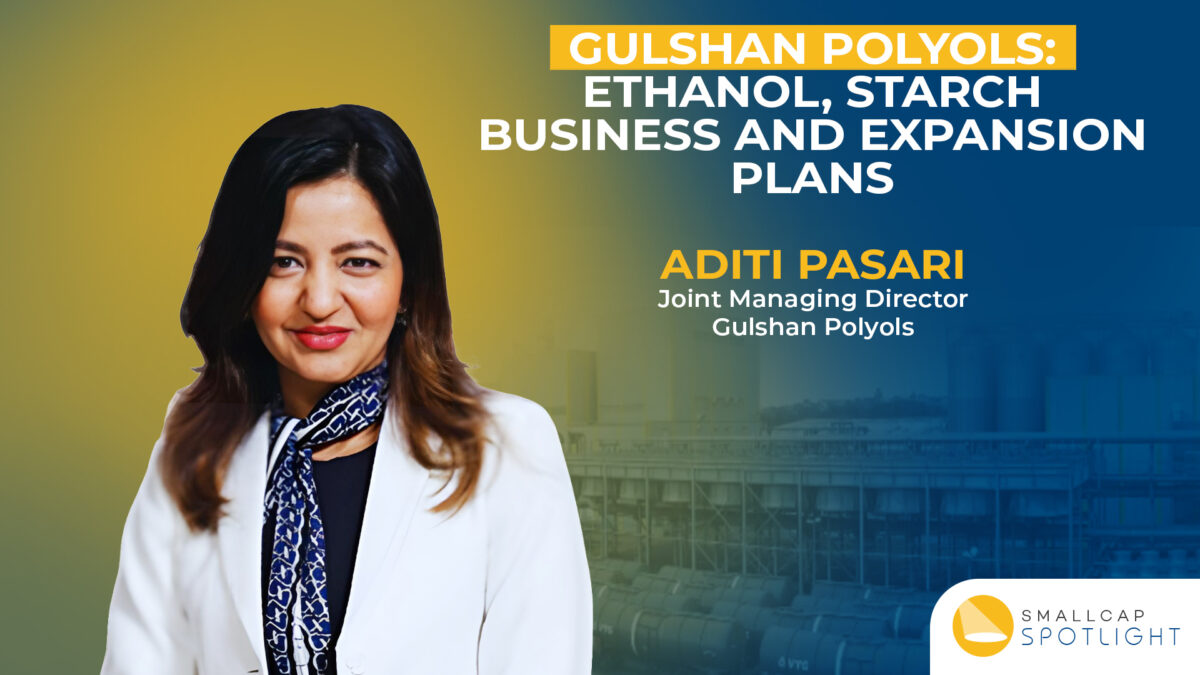
Gulshan Polyols, with over four decades of legacy, has evolved into a diversified player with ethanol emerging as its key growth driver, contributing a significant share of recent revenues. The company is leveraging early-mover advantage, large-scale capacities, and long-term offtake agreements to strengthen its position in India’s expanding ethanol ecosystem. With improving industry dynamics and government support, it expects stronger capacity utilisation and continued growth across segments in the coming years.
Mubina Kapasi: Hi everyone, welcome to SmallCap Spotlight. I’m Mubina Kapasi and today the company that I’m going to be speaking with is the future of mobility and energy, Gulshan Polyols. I have with me Aditi Pasari, the joint MD of Gulshan Polyols Ltd.
Aditi, hi, thank you so much for joining us. To begin with, you know the company has a legacy of over 30 years. If you could tell us a bit about the evolution, how it started off and what the business looks like today.
Aditi Pasari: Yeah, hi Mubina and thanks for this introduction. So, Gulshan Polyols is actually a more than 40 year old group. It was started by my father, Dr. Chandrakumar Jain in 1980.
It was known as, it was incorporated as Gulshan Sugar and Chemicals and started with a very small capacity of production of precipitated calcium carbonate. And yeah, and today we have multiple products, multiple locations. We have over nine locations all over the country and we are into manufacturing of multiple products like, of course, ethanol, which is one of the larger revenue contributor in the basket.
Apart from that, we are into starch, starch derivatives, solvent oil, fructose, animal feed, as well as calcium carbonate and derivatives of calcium carbonate. We also have a product called Onsite PCC Plants, where we set up onsite plants on the site of paper mills to supply them raw material onsite. So yes, the company has grown from zero to where it is today in the past 40-45 years.
I have been on the board since 2010 and it is the company, my father is the chairperson of the company and my elder sister Arushi and myself, we are both the directors and looking after the day-to-day operations of the company.
Mubina Kapasi: So if you could tell me a little bit about your own journey in the company, the fact that, you know, it’s been started by your father, I guess maybe in a way entry into the business was kind of a given, but I want to know about your early years in the company and how you sort of came to eventually becoming the joint MD, what sort of experience perhaps did you have before you reach this level, if you could tell us a bit about that.
Aditi Pasari: Well, you always start from groundwork and always start from the basics, it could be the basic operations, basic accounting, you just start from always the more the basic works in the company and slowly, slowly you actually step up the ladder as you gain more experience, gain more knowledge, you continue to evolve yourself every day as a new learning and yeah, eventually you will see yourself being able to head a new project altogether.
Mubina Kapasi: All right, okay, wonderful. Let’s talk about your current operations, you mentioned ethanol, you mentioned starch, etc. And I know today you’re largely an ethanol player.
So what was the revenue contribution like, you know, before and now today, what’s the revenue contribution like from the various business segments?
Aditi Pasari: So in 21-22, our company does 1000 crores revenue and that was mainly from the sorbitol and starch business. Ethanol was a very small contributor, just about 150 crores. But last year in FY25, we touched revenue of 2000 crores where the revenue from ethanol alone was about 1200 crores and the balance was from sorbitol, starch and other businesses.
Going forward also, we are expecting ethanol to drive the top line by more than 60% as well as the bottom line. So yes, for the next one to two years, we expect this trend to go on.
Mubina Kapasi: So what sort of brought about that shift, you know, from sorbitol and starch to ethanol, if you could describe that entire journey also, because now, like you mentioned, it’s a big part of your business.
And eventually it’s going to it’s going to contribute about 60 to 70%. So what about brought about that switch in 21-22?
Aditi Pasari: So we were looking at expanding, we are looking for new products, we were looking at growing the company, and the government came up with the opportunity of producing ethanol from grain. We already had a small distillery, a 60 k lpd distillery in Madhya Pradesh, from which we were making ENA, which was capable of converting into ethanol, which we did immediately.
And we saw the opportunity there, we saw the government’s requirement of ethanol going ahead. We found the whole project scalable and sustainable. Also, we believed in the government’s dream about blending ethanol into petroleum, we found the whole policy very, very sustainable, because it was directly linked to the farmers, where the major income was going to the farmers.
And secondly, it was also helping the government improve its fiscal deficit. So both the points were there to was for the benefit of the country. And we were anyways into grain processing.
Our main raw material is maize and rice, even for our traditional business, which is sorbitol, starch and fructose. So we had an expertise in this segment. And I think it was a great opportunity for us to take it up.
And actually, we were one of the first movers to actually announce large capacities in the ethanol sector. And yeah, I think they’re enjoying that advantage. Who would you say are your competitors? And also, the fact is that it’s a bit of a commoditized business.
Mubina Kapasi: So how would you differentiate yourself from competitors in this business?
Aditi Pasari: So it’s very difficult to say, to point out any one competitor, because we’re into multiple products. So in different products, we compete with different companies. So I will not be able to actually do any kind of apple to apple comparison here.
In ethanol, we have different people who are in the segment. And sorbitol, we have a different set of companies. Starch is different.
Just for ethanol, if you could probably share. There are many, many ethanol plants in the country. There are over 400 ethanol plants in the country.
But we are one of the largest capacities, one of the largest capacities in the country. So there are many of them, actually.
Mubina Kapasi: Okay. If you could tell us about what sort of advantages you have. I mean, like you mentioned, you were already processing grain. You had that experience, and then you just sort of brought out this amazing byproduct, ethanol, which is now sort of being touted as the future, right? So could you tell us about how Gulshan Polyols stands out in that way?
Aditi Pasari: So of course, we have an experience in grain processing. So that has always helped us, because the basic production process, the manufacturing process of ethanol remains similar to what was our traditional business. Apart from that, we also were one of the first to set up these capacities in the country. We have a long-term offtake agreement with the government for 10 years, which gives us an advantage of assured orders from the government to a certain extent.
And I think going forward, that is the main key, because with so many capacities which have come up in the country, they’re all actually fighting for allotments, for quantities and orders from the government. But there we get an upper hand, because we have a long-term offtake agreement, which is just about 30-40% of the current ethanol capacities in the country have that agreement which is signed, you know. And companies which have the agreement and are operational.
So I think there would be about 30% companies only. So we get that advantage over there. Plus, yeah, having large capacities, we also enjoy the economies of scale.
And one of our plans is in Madhya Pradesh, which is actually a green belt. We get the advantage of cheaper raw material in that belt. So multiple advantages, which give us an edge in the industry.
The long-term offtake agreement definitely sounds great, that revenue visibility.
Mubina Kapasi: So currently, what are your capacities? You said you’re the largest ethanol manufacturer. One of the largest.
One of the largest. So what percentage would you say perhaps is secured by these long-term offtake agreements? And maybe, do you think we could be seeing more such agreements signed with state governments on the anvil?
Aditi Pasari: I’ll answer the second part. No, no more such agreements have been signed by the government. In fact, there are lots of players, over 200 plants who are struggling to have this agreement with the government. But government is not signing anymore, because government doesn’t require so much ethanol, the amount of capacities which have come up. So they are very clear that, you know, we have only signed up for how much we wanted.
And the ones who have the agreement signed will get the priority. So we always get priority allocation on that basis, you know. And sorry, what was the first question?
Mubina Kapasi: The other question was that, what percentage of your current manufacturing capacity is secured through these long-term offtake agreements?
Aditi Pasari: So government currently is vending about 1200 crore litres of ethanol into petroleum. And we have a capacity of 26 crore litres, which is about 2%. It sounds small, but actually, it is quite large, because it is a huge industry. Got it.
Mubina Kapasi: All right. Okay. You know, India recently hit that E20 blending milestone. How do you see this shape up the entire demand roadmap for ethanol? Because like you mentioned, right, it makes sense for the government to do this, it’ll improve our macros, etc. So how do you, I just want to take a macro view from you, how do you see the future of ethanol pan out and the demand for ethanol pan out?
Aditi Pasari: So the government’s roadmap for blending ethanol into petroleum has been inspired by Brazil. And currently, Brazil also has E100 vehicles with 100% ethanol vehicles. They have two wheelers which are running 100% ethanol. And they have vehicles, flexi-fuel vehicles, which are consuming about up to 55% ethanol. So government’s vision has always been that, in fact, that is what they had mentioned in all their speeches while we were setting up our ethanol plants.
So E20 is just the first target which has been achieved, where they were basically testing the waters, they were testing the readiness of the industry, readiness of the vehicles, readiness of the economy, and that has been achieved. Currently, we are seeing a temporary halt in any further, increasing the blending further, because of some social media outbursts, which happened a few months back, where, you know, there were some news, false news about engines getting damaged, but that has been proven wrong, you know, the engines are not getting damaged with ethanol, up to 25% blending is completely acceptable in the current engines. No, there is no technical report to prove that there has been any damage to engines, you know, with blending ethanol.
So we are quite sure very soon this blending percentage will increase up to 23%, maybe 25%, maybe next one year, we are quite confident and looking forward to that. So that will help us also increase, get 100% allocations for people like us who have priority allocations, and also many more, you know, who are really struggling with allocation. And going forward, yeah, this is just the start.
Government is already working with automobile industry on flexi fuel vehicles. And it is the future because as you see, it is 70% of revenue which we receive from ethanol from the government is actually goes to the farmers directly, because the raw material is maize and rice, which is a farmer produced. So it goes to the farmer.
So it is the rural industry, which is getting richer, you know, by this, the farmers are getting better compensation, and government has saved more than 140,000 crores in foreign exchange with under this policy. So it’s a win win. So it has to only only increase.
Mubina Kapasi: All right, okay, great. Um, you know, ethanol is more than just involved in the fuel bit, there are a lot of byproducts as well. So there’s DDGS that comes about. So how significant are these byproducts to your overall financials?
Aditi Pasari: Very significant. DDGS has a contribution of about 25% on top of the revenue contribution from ethanol. So very, very significant.
Mubina Kapasi: All right. Now, raw material, I know you spoke about how you’re procuring the grain, etc, from the farmers in the greenbelt. But there is still a bit of volatility right over there.
In fact, in general, commodity prices are subject to a lot of volatility. So how do you manage that and, you know, manage the price fluctuations?
Aditi Pasari: So, very fortunately, basically, there has been a mandate from the government to procure 40% FCR rice for ethanol production. So 40%, we have to procure FCR rice from the government at a fixed price and sell ethanol made from FCR rice. That has actually fortunately really improved the grain availability in the country, and the grain liquidity in the country because of which the prices have softened. And that is the reason for one of the major reasons why there has been a turnaround in the profitability of the company. See, in the last two, three years, there was an influx of ethanol plants.
We were a capacity of 1500 crore liter came up in the last two to three years, you know, which is huge, which means that the grain requirement in the country was, had suddenly gone up, you know, had, there was an influx in the grain requirement, which is, of course, because of which the prices for grain had gone up, you know, and we also face some serious challenges in our bottom line in last one to two years. But big relief came from the government because there was also again, a win-win for both. Government was sitting on huge stocks of FCR rice, which was getting actually rottened in there.
They were having warehousing issues with that and ethanol industry came as a relief to the government and government came as a relief to the ethanol industry, you know, by issuing FCR rice at a certain price. So that really improved the overall liquidity of grain in the country and softened the prices. And the good news is that this oversupply of FCR rice with the government is here to stay for at least next two years, because we know that they are over there actually having their housing issues, you know, so they will continue to giving, continue to give rice to the industry for at least next two years.
We are quite sure of that. So until that is happening, I see prices on the softer side and availability on the higher side. Almost like a win-win situation.
Mubina Kapasi: Yes, it is a win-win for everyone. Yeah. I want to move a little bit away from ethanol, you know, talk about the starch segment.
I understand that recently you mentioned that there were a few headwinds you were facing. Could you explain what was the reason for those headwinds and, you know, the plans to turn it around?
Aditi Pasari: Well, because of the long-term prices, which had gone up considerably in last, you know, one to two years. So basically, the exports had become unviable of a lot of these products, Sobitol, starch, because the maize had become so expensive and the end product had become so expensive.
So a lot of dumping was happening domestically. However, with all this agro economy, which has, you know, come in place for all our segments, you know, maize prices having corrected, the selling prices for starch and Sobitol having corrected, my export is again a possibility. Again, you start exporting these products to other countries, which has eased off the pressure on domestic sale, you know.
So going forward, yes, I’m expecting an improvement going forward in this segment as well. The selling prices have, you know, kind of improved, the margins are improving and going forward, I see the EBITDA levels to improve for this segment as well. You know, coming back to ethanol, I know that this is one industry that has a lot of SOPs too, there is PLI, there are some other schemes as well.
Mubina Kapasi: So I want to understand if you’ve been a recipient of any of the interventions and the policies that the government has announced for the industry?
Aditi Pasari: Oh yes, in fact, we have two plants of ethanol, one is in Madhya Pradesh and one is in Assam. And both the plants are eligible for PLIs from the state governments. In MP, we get a PLI of 1.5 rupees per litre for seven years and in Assam, we are eligible to get a PLI of 2 rupees per litre for the next three years.
So both the plants are eligible for PLI. Apart from that, there are some other state incentives like GST reimbursements, some capital subsidies. So yes, and we also have received our first trench of subsidies in MP from the MP government.
We have received the PLI for 2023-24 and 2024-25 up to a tune of 21 crores, which was reported in Q3.
Mubina Kapasi: So, yes. My next question was on the debt on your books. If you could tell us what the debt stands at and you know, the reason why the debt has been taken, any roadmap perhaps to trim down the debt, if any?
Aditi Pasari: So we have a debt of about 400 crores in total, which is about 200 crores would be in long-term debt, which was taken for the CAPEX for both these plants. And the balance is working capital. So a long-term debt enjoys an interest subvention scheme.
So it’s available to us at about 4%, you know. So we are getting an interest subvention scheme from the government. So that subsidies are coming to us.
A little slow, but they are coming to us. So debt is available at about 4%, which is quite reasonable. So no plans of reducing long-term debt. We will just continue with the repayments, which are happening annually, virtually. The balance is working capital. And we are looking at improving the cash flows in the coming four to six quarters.
And as the cash flows improve, the working capital will automatically come down.
Mubina Kapasi: So, all right. Okay. You know, now I know you’re more or less set for the next two years because you have this ethanol capacity that’s only going to get utilized. I would like to just go a little further into the future. And if you have to talk about maybe FY28 onwards, I’m pretty sure that your contribution from ethanol is only going to be increasing. So what are your long-term targets for Gulshan Polyols? If there’s anything set, whether it is revenue-wise or whether it’s product segment-wise, if you could share a little bit about that.
Aditi Pasari: From the current capacities, current infrastructure, our company is capable of producing a revenue of 3000 crores with all the plants running at 100% capacity utilization. That is subject to allotments, orders, market conditions.
But yes, that’s how the capacities have been designed. Of course, we will be looking at achieving at least 80 to 90% capacity utilization by FY27, you know. That is the whole target.
Again, subject to allotments. Any kind of new CAPEX will happen in 27-28. We are looking at new products in the speciality chemicals space.
But any new CAPEX from the books will only happen in 27-28. We will look. In the meanwhile, of course, we are in the planning stage, which takes time, identifying products and, you know, doing the backward planning of any new expansion.
But in the meanwhile, we are just looking at improving the cash flows.
Mubina Kapasi: I mean, I know you mentioned that your father is the chairman and it’s you and your sister, but if you could tell us as well a little bit about your leadership team or the key individuals who are really helping you achieve these targets that you have set out for yourself and helping you really grow the ethanol business and reach its full potential?
Aditi Pasari: It’s a teamwork, you know. So each of our plant, we have nine plants, each of our plant is managed with its own professional team.
We have chartered accountants, we have technical heads stationed at each plant, you know. Each and every person counts. Very difficult to point out anyone, you know.
The rest is, of course, the leadership has to be strong. The company is professionally run by a very, very decorated team of professionals. We have a good board of directors comprising of five independent directors and five working directors.
So, yeah, all together we have a great team and great leadership.
Mubina Kapasi: I’d just like to close by, you know, perhaps asking you to maybe share a message to viewers, they may be potential investors already, somebody who’s a shareholder of Gulshan Polyol’s because, you know, this was, ethanol was often called as a business which was very policy dependent. And now all of those doors seem to be opening up. You already mentioned, right, that you are the recipient of several initiatives from the government. If you could just share, maybe, a message of how the future is looking like for the ethanol industry and for you as well.
Aditi Pasari: So last two, three years were challenging for the industry. It was a new industry. It was a nascent industry. The ecosystem to settle such a large industry, which had suddenly cropped up, was taking time.
It was nascent. The government was also new, the industry was new, the supply chain was new. Everyone was trying to figure it out.
But each time, I think the good news is that each time we were in a challenge, the government has always come out in support of the industry. It gave, periodically it gave us incentives in prices for ethanol. It gave us FCRI.
So it has always and always come out in support of the industry, which shows its dependence and interest and belief in the ethanol industry, you know. So that is a very, very good news that we have always and always got a lot of support from the government. And the good news is that now we are in the U-turn recovery mode, as well as the profitability is concerned.
The bottom line is, it started improving in the last three quarters and we continue, we are very confident that it will continue to improve quarter and quarter going forward, you know. So I think the worst is behind us. The industry is very, very much settled.
The government is here to stay, you know. And yeah, everything that we had actually anticipated while setting up these, doing these large CAPEX is now, you know, coming true. Like yeah, we have started receiving the PLIs, we have started, the execution is bang on.
So all going in favor. So yeah, I think going forward, we are looking forward to good times.
Mubina Kapasi: All right. Well, Ms. Pasari, we wish you all the very best. Thank you so much for speaking with us. Thank you.
Aditi Pasari: Thank you for having me.