
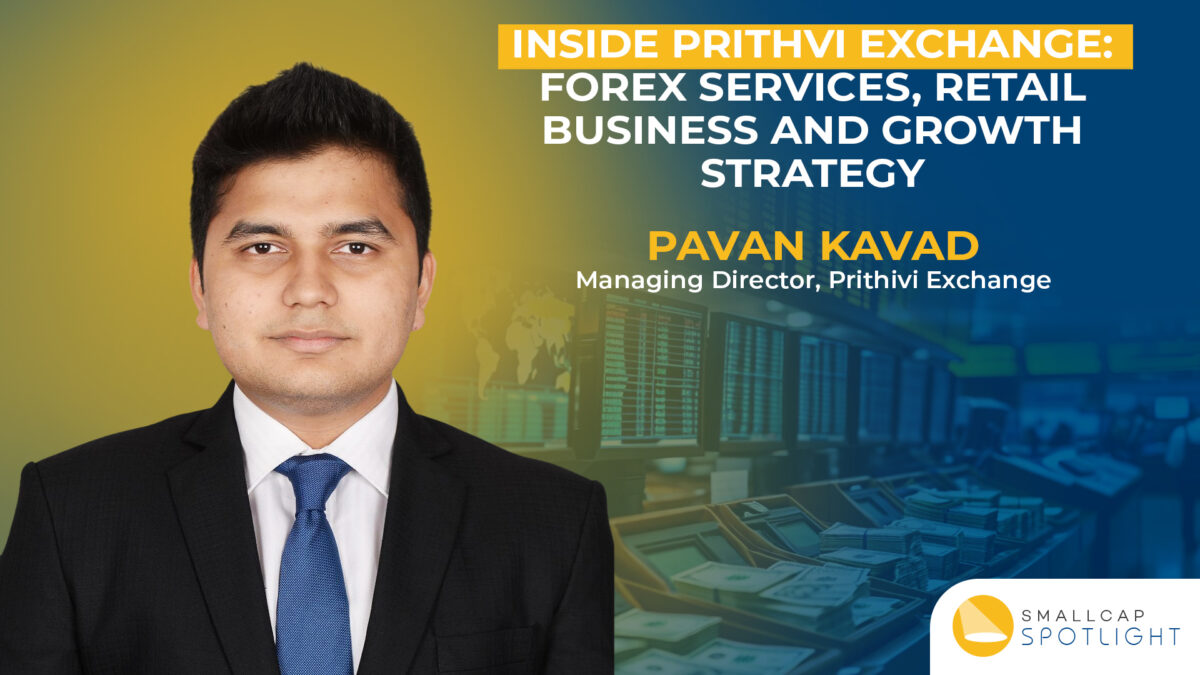
Prithvi Exchange, an RBI-licensed forex and remittance provider, offers cross-border currency solutions for both retail and corporate clients. The company operates on a low-margin, zero-speculation model while expanding its physical and digital presence, alongside new offerings like forex cards and insurance broking.
Mubina Kapasi: Hello everyone and welcome to SmallCap Spotlight. I’m Mubina Kapasi and today we have a company that works in the BFSI space, an RBI licenced foreign exchange and remittance services provider based in India. It specialises in cross-border currency solutions and related services, not just for individuals but for businesses as well.
I have with me Pavan Kavad, the Managing Director of Prithvi Exchange India Limited. Pavan, thank you so much for joining us today. While I’ve given a brief introduction into your company, it would be best if you could as well explain the core services that Prithvi Exchange provides for customers.
Pavan Kavad: Definitely. Firstly, thank you Mubina for having me here. It’s an absolute pleasure.
So Prithvi Exchange, we are a 32 years, we are a 30 years young listed company. We are Fortune 500. We are base listed.
We are based in Chennai. We provide the services of foreign exchange, namely foreign currencies, forex cards and remittances abroad. We cater to clients who travel abroad on leisure for education, for corporate business visits, for making international payments with respect to O2O payments, etc.
Film shooting is also one thing what we also specialise in. Even MICE payments is what we specialise in. You mentioned you cater to education or to any other need that’s there for foreign exchange.
Mubina Kapasi: So if you could give us a mix roughly, who would be your biggest clients or your customers? Would it be individuals who needed for personal use like education or perhaps corporates, if you could give us a rough mix of that?
Pavan Kavad: Yeah. So if you see now, majorly my clients, I have a mix of about 34% goes in my retail who are people travelling for holiday to meet their friends and families abroad, etc. About 10-12% of my book is roughly with respect to corporates.
I have got a 30% of my book with remittances. We remit money abroad for various purposes like it can be education, it can be a tour payment, travel agent remitting money abroad for your bookings, etc.
Mubina Kapasi: Roughly, if you could give us an idea of what kind of margins do you get in the forex business? And if it’s different from the different segments that you cater to like travel agents or customers, if the margin differs?
Pavan Kavad: No, see absolutely no, it differs across because with corporates where credits are being involved, right? Where we give them credits for a longer duration, maybe a couple of days ahead.
So of course, the margins over there varies well. But if I have to speak about retail travellers, like for example, the margins would roughly hover around quarter percent to half a percent. It depends on the seasonality, the availability, the procurement, etc.
A lot of factors are there. But on an average, if I have to, you know, generally, if I have to annualize it also, it’s about quarter to half a percent is what we end up making.
Mubina Kapasi: How would it work when it comes to currency vagaries? Because obviously, it’s a forex market, right? It fluctuates every day, every minute, in fact, for that matter.
So is it like a simple markup over what the RBI rates are or the market rates are? How would it work over there?
Pavan Kavad: Okay, so it depends on city to city, say, for example, the rates what I can offer in Mumbai would be different, what I offer in Chennai will be different. Eventually in Gurgaon, it’ll be different, right? So the local market demand supply plays a major role here. Fluctuations, of course, you know, it matters a lot to us because with, you know, wafer thin margins, like quarter percent, half percent, etc., right? You do not have that kind of a liberty to hold on for a long term and say, okay, when the price will be sold, then I will sell, that doesn’t happen.
And also on the downside, it’s, you know, it’s the same way, right? You know, if you are stuck with volume in your hand, like, for example, presently, the USD had touched 92, then it has now come to almost 89-90 levels. You know, of course, you know, it will, you know, eat away whatever you have, you know, earned maybe in the last couple of years, I would say. But, you know, we follow a simple strategy, a very straightforward principle of zero speculation.
We say whatever you have a requirement, you purchase, we import, we procure, we deliver to branches. We don’t, you know, do any speculative business of, you know, holding a stock in the branch for long. And hence, you know, we protect our margins, we protect us from, you know, all these losses, you know, which can easily eat you away, mercilessly.
Yeah, I mean, the environment itself has been such that you see these violent fluctuations in currencies. So you don’t hold any inventory. That’s one mechanism to it’s just-in-time inventory, you could call it that, right? When there is a need, you procure.
We hold it to an extent, like, for example, we don’t hold large volumes, optimum utilisation of, you know, fund is what we believe in. You know, we look at the market scenario, we look at the market pulse, and then we procure, we may need 10,000 or we may need 100,000, it depends on that. But technically, basically, what I want to say that we don’t speculate saying, okay, we will hold, say, you know, half a million dollar, a million dollar we hold, and then we say we don’t do that.
And that’s how we stay insulated.
Mubina Kapasi: Any hedging mechanisms you practise, you know, for example, inventory, of course, is one way, but I’m sure there must be certain F&O contracts you keep to protect or, you know, to cap your, keep a fixed rate at least. So that way, there is predictability, at least in your margin.
So anything you could share with that?
Pavan Kavad: Absolutely. No, we hedge. I’ll give a scenario.
So, you know, in a branch, you know, we have given them their minimum stock and maximum stock, what you can hold. And even in that minimum stock policy also, we tell them, okay, up to x value, you can hold it, it’s a freehold. More than that value, you have to hedge it.
Okay. And that’s how we know we are able to be protected. You know, you mentioned something very interesting that your margins actually differ depending on where you are.
Mubina Kapasi: I want to understand how that works. I mean, isn’t that metro cities, perhaps is where you have scope for higher margin and smaller towns less or how would it work?
Pavan Kavad: No, it is completely depending upon the city and the season what they are into. Like, for example, imagine a case in say, okay, let me give a classic example of, you know, the present, you know, what trending is right now is about the Songkran festival in Thailand.
Okay. So, you know, how we have seen is that India gets divided into two halves, North and South. So the proximity of Thailand is more for the Southern part of the country.
So hence a lot of demand for Thaibat is that down South. Now, if I take North, say for example, MP and upwards, we are West and the North, they have closer proximity towards Dubai, towards the West of the world. Like, you know, you can take your Emirates, you can take your Europe and the US of the world.
So they have more proximity and requirement of that currency is more over there. So it depends on that. It depends on the seasonality, the requirement, the market, how it plays, maybe, you know, that’s that they’ll say about a group of say 200 people travelling abroad, that market will suddenly, you know, change out, you know, and there’ll be immense requirement of, you know, one particular currency for that whole, you know, three, four days or one week time.
It also kind of gets artificially, you know, inflated because, you know, not, you know, everybody will not contact one, you know, player. No, they will call 10 different players, artificially market, you know, the perception, the market changes, suddenly, you know, everybody will call and tell, you know, so somehow, you know, it also becomes negative also. But I think that’s how, you know, market is nobody can time master market.
Mubina Kapasi: Well, yeah, yeah, I think that’s what we say for the stock market as well, right? These are all I guess, a part and parcel of when you’re dealing with such industries. This is very interesting. So I want to understand currently, where are you in India? What kind of touch points do you operate and any expansion strategy that you have? And also to what extent do you need to be offline as opposed to, you know, as most BFSI now is tending to move towards the digital mode? So to what extent do you feel the need to be offline as well?
Pavan Kavad: Okay, so although you know, we may be online, right, physical currency has to be delivered at a client’s place.
Eventually, a card has to be delivered, we have to do the KYC part. Of course, there is video KYC, there are digital ways of, you know, onboarding a client. But still, you know, we Indians, we still have that hang of touch and feel.
You have to feel money in your hand, right? That gives a lot of comfort zone. So I would say, I would say no, we are presently in that particular, you know, era, you know, where we want to be forward, we want to be like a, I would say Gen Alpha, looking to do everything digital. But we also have a legacy, I would say, of being with our parents where you have to touch and feel everything.
So that’s where we are at that intersection point right now that okay, you have to move forward, but carry a small baggage along with you, right? So digital stores are required, physical stores are also required, digital footprint is mandatory today. It is no more a luxury or market, it’s not that way. We have to be present on the D2C place.
And we’re also, you know, evaluating other modes, you know, how we can become relevant for the future. Say, for example, like, you know, recently we are in the final stages, it should be a day or two, you know, we will have the Forex on WhatsApp, you know, which will be launching soon. Then we’re coming up with a D2C website also soon, you know, which will find its way down in the next couple of months, I would say.
Forex cards, say, for example, you know, we are in the process of, you know, as I said, launching our own Forex cards, you know, with the membership with Visa, where we become an issuer.
Mubina Kapasi: Could you tell us a bit more about that Forex card? And if there’s anything in the pipeline over there? What’s in the works? When can we see a card being issued?
Pavan Kavad: Okay, so typically, launching a Forex card, you know, takes about 12 to 16 months of, you know, relentless pursuit is what you need first way. And second thing, you know, you have to, you know, look into various other regulations, what the regulator requires you to have Visa also has its own regulations.
You also have a TSP in place, you have a lot of, you know, I would say, production keys have to be exchanged. You know, all three, four of you have to work together. It is not as okay, one person who has other cases, okay, I don’t have time, it doesn’t work out that way.
So, you know, we are almost about 12 months, you know, deep into the project. Now, I would say, technically, by the end of March, we’ll be 12 months deep into the project. And we have made a considerable progress, you know, as we are speaking, I think we’re anticipating to launch the card, probably in the month of April or May, I’m assuming a maximum by Q1.
Mubina Kapasi: Alright, well, we look forward to that. I want to understand a little bit about what exactly and how exactly do RBI regulations affect you? Because naturally, the RBI controls the forex reserves in the country. So how closely is your business and I’m sure it is very closely, but anything that investors, potential investors should be aware of, as to what kind of RBI rules and regulations affect your daily business?
Pavan Kavad: No doubt, you know, so first is, you know, they are the fathers and mother, they give us a licence, the regulator.
So, you know, any policy, which they, you know, come up with, it affects us, you know, to the core, say, it can be positive, it can be negative, both. Like, say, for example, you know, while we are speaking, the last year, we had a regulation where, you know, Reserve Bank had capped the portion of retail sales as against what we sell to a bank. So there was no cap earlier, now it is made 75%, I have to sell in retail.
So fortunately, you know, we have always been retail focused. So we never, we had a very, we had a sharp dent, no doubt, but not as catastrophic as how other peers of ours are facing. That’s one.
Now, eventually, on the flip side, when I look at the positive side, Reserve Bank had, you know, released a draft circular about two years back, where they said, they’ll improve the scope of work for, you know, 80s. Like, you know, presently, we are not allowed to do any trade remittances, we cannot do anything if the client has to go to a bank. But Reserve Bank has said they have given a draft circular where we can also, you know, we can also process trade remittances.
Now, that’s a big, you know, benefit for us, like how a PACB is there today, right? So a payment aggregator for gross border can remit 25 lakhs equivalent, whatever value, you know, Reserve Bank has fixed. Now, similar value we are getting without the need to apply for a PACB licence. So that gives us an upper hand, when you know, things like this change.
Mubin Kapasi: But still, I would imagine that your competition is a lot with banks, right? Because naturally, maybe not retail, it’s clear that you have a good hold over there. But maybe for corporates, etc, you know, you’re banking with a particular bank. So it’s naturally the entire gamut of transactions then, you know, happen with that bank.
So any plans to break into that? Because there are obviously some benefits that you also carry given your structure. So any plans to break into that competition?
Pavan Kavad: So technically, you know, predominantly, we have handled clients, I’m saying corporates for about a decade, two decades, etc. Okay.
But of course, you know, as I said, we always, we have been retail focused. But now, you know, we are having a change. We are looking at, you know, onboarding large corporates across the country now, as we are speaking, right? The advantage, you know, what a bank has got what, sorry, the advantage what we have got as against the bank.
So one is, you know, a bank cannot go and deliver to the client’s place, they do not work, you know, post office hours, they have their times of loadings and reloads and unloadings, etc. The client may call from abroad saying that, okay, he’s stuck with something, it’s it may be 8pm in the evening. But you know, a bank cannot do all those things.
They say, okay, it’s post market hours, I cannot load your card, etc. Whatever it may be that we don’t have all those tantrums. You know, we, we look at, you know, our client first, we have a very customer centric approach.
You know, where instantly know when a calls up, we definitely look at how we can, you know, solve their issues. See, because he’s in a pain point right now, I had to give him the medicine than seeing all the rules and regulations.
Mubina Kapasi: Okay, understood.
If I had to, let’s say talk to you in the next three to five odd years. Yes, I know, I’m going to be hopefully seeing the new card come in from Prithvi Exchange. But any growth trajectory that you’re looking at? How do you see Prithvi move forward any new business segments, revenue verticals that you’re targeting over the next three, five, seven years?
Pavan Kavad: So one thing what we did recently is that we have diversified into insurance broking.
So we have a wholly owned subsidiary by the name of Octagon Insurance Broking, where we provide insurance advisory services. That’s one we know what we have done about diversification, if I have to say. Okay, about Prithvi down the line, if you ask me on the standalone forex business, of course, the market is huge, the time is huge.
You know, LRS in India, India LRS is a $30 billion market. You know, I’m saying even if I touch the 1% of that also, it’s a big volume, right? So we’re looking at a couple of, you know, those kind of metrics, how the market is growing, how we grow along with the market. To give a perspective, I’m saying, two, three years back, we were at 15 odd stores.
Today, we are at 32 branches, as we’re speaking. We have doubled our store count, we have, you know, we have increased our volume considerably. I’m seeing a similar trend going down the line with, you know, expansion plans in place with new business coming in new corporates coming in.
And you know, a lot of team members who are adding up to the, you know, kitty.
Mubina Kapasi: Could you tell us a bit about your team? You know, I mean, insurance is actually a very different vertical, obviously, from forex. So you naturally need people who specialise in that particular segment.
So could you tell us a bit about the team who is helping you, you know, achieve all of these goals and increase your volumes and all of these targets that you have?
Pavan Kavad: Okay, so you know, we have, fortunately, I would say, I’m extremely fortunate, I would say to have people who have been with us for about 20 years, 23 years plus. So we have a couple of people like, you know, I have no two VPs are there with me, right? So one, Mr. Jayaprakash, who handles the entire bank business, I have Mr. Srinivasan, who leads the, you know, operations forefront. And also he looks at the he’s ahead of the banknotes.
Then I have Mr. Mahesh, who handles who again, who has been a veteran, he’s with a he’s with the company for about 18 and 1820 odd years, again, he he handles the entire education portfolio for all the student business what we do. And also recently, he has also been asked to take control of the strategy of the company. So a couple of people are there like that we have, you know, back end we have, you know, accounts is there we are treasury we have like audit principal officer is a couple of other folks are there.
We are in total, we’re a 300 member team.
Mubina Kapasi: Thank you so much, Pawan for such an insightful conversation and giving us that introduction to your company as well. Thanks very much for joining in and all the best.
Pavan Kavad: Thank you so much. Thanks a lot. Nice speaking to you.
Mubina Kapasi: Well, that was the management of Prithivi Exchange giving us a brief introduction into the company. Please remember that this interview does not comprise any investment advice. Conduct your own investment research before making any decisions.
Thank you so much for watching and stay tuned to Small Cap Spotlight.