
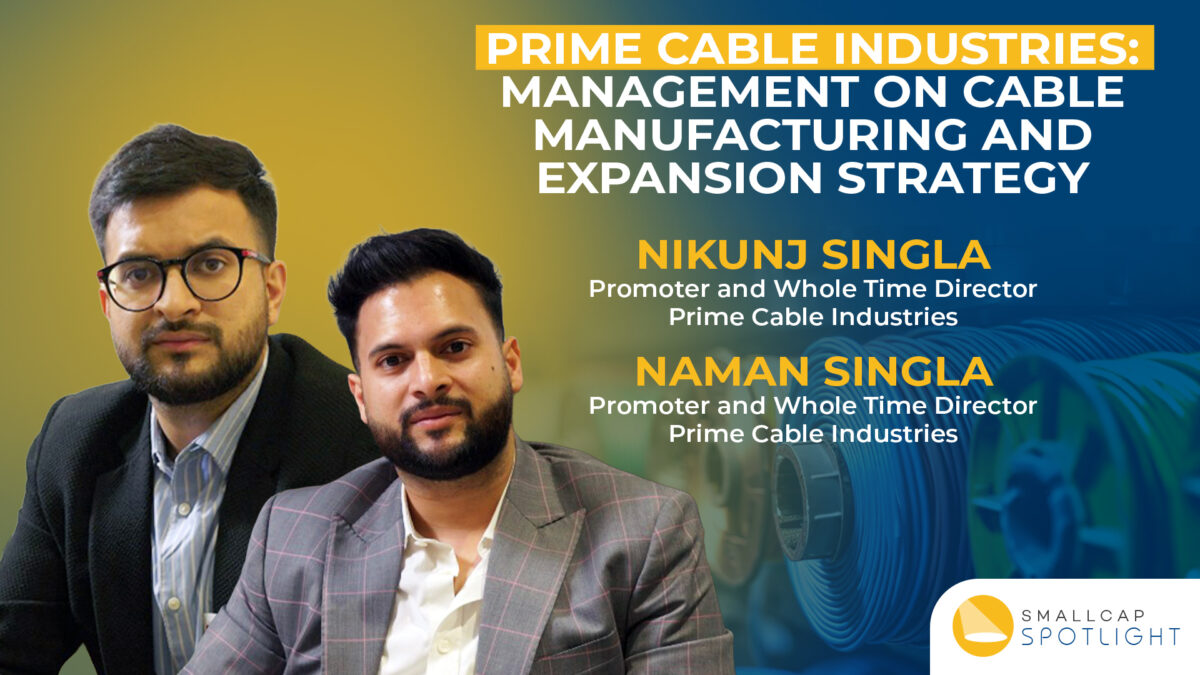
Prime Cable, a nearly three-decade-old cable manufacturer, is positioned to benefit from India’s expanding power transmission and distribution infrastructure. With strong PSU approvals, a diversified client base, and ongoing capacity expansion, the company aims to scale alongside rising sector demand.
Mubina Kapasi: Hello everyone and welcome to Small Cap Spotlight. Today the company that we’ll be speaking with is in the business of cable manufacturing and a pure play one. India of course is undertaking a massive overhaul of its entire power infrastructure.
Transmission lines are also expected to more than double and in all of this there is this company that might be seeing quite a bit of potential. Let’s discuss how they plan to capture this opportunity. I have with me Nikunj Singla, the promoter and whole-time director of Prime Cable Industries and Naman Singla, promoter and full-time director as well.
Gentlemen, thank you so much for joining us today. Nikunj, let me start off with you first. This is a company that’s almost three decades old.
You started manufacturing cables, wires, conductors. Could you give us a brief overview of the company, the history of it and you know a little bit about what the company looks like today?
Nikunj Singla: Definitely. Hi Mubina.
So, the company was started by our father Mr. Pushyam Singla back in 97. So, he started the factory with like taking a loan from friends and family and earlier he was working for 10 years in a cable company only. So, he started the company with the factory on rent
So, at that time the whole market was you know very different as of now. So, he used to supply to the electrical distributors who used to supply to the contractors back then. So, back in 2002, he got his first government approval in Karnataka wherein the direct supply to the consumer started.
So, that is how he ended up you know starting supplying to the consumers, EPC contractors and the government clients. So, that is more about how the journey started. It’s been almost 30 years now.
We have shaped up in a very different economy and we have come across manufacturing cables ranging from 1.1 kV to 33 kV. So, we are manufacturing LT cables which includes copper control cables, power cables, instrumentation cable, EB cable, covered conductors. Almost every type of LT cables is being manufactured by prime cables and we have recently entered into the medium voltage segment also.
So, now we are manufacturing 11 kV and 33 kV cables also. Apart from that, we have two manufacturing units. One is in Gilo, Rajasthan and one is in Delhi, Narela.
So, that is more about the company right now.
Mubina Kapasi: Nikunj, if I could also ask you that currently from the entire portfolio of products you mentioned, what’s contributing the most to your revenues? I mean would you primarily be called a cable company at this point? So right, we are primarily a cable manufacturing company supplying cables to the T and D generation and the distribution segment of the economy.
Nikunj Singla: So, the most prominent product of ours would be control cables.
So, that has been our USP since long and that is the product which is used in the transmission segment of the industry and we have been manufacturing most of the prominently controlled cables in a very good number way. So, that is the most prominent product of prime cables. Alright, okay.
Naman, let me go across to you. As Nikunj mentioned, you know that basically you’re into distribution, transmission and that means you’re working a lot with state governments, governments in general. So, could you tell us about what that journey is like because I imagine those are one of your key sectors.
So, could you tell us a bit about how you go about procuring those kind of orders with governments? I imagine it would involve a lot of liaisoning and also there are other sectors as well that you’re catered to. So, the revenue contribution has been majorly from the power T and D as our generation as a sector and we approved majorly in more than 15 odd states, approximately 18 to 20 states as of now in the power T and D generation sector. So, that has helped us to gain a major revenue from that sector.
Apart from that, we are approved by the second most contributing sector to our top line is the oil and gas. So, we approved a lot of refineries like HPCL, IOCL and followed by steel, real estate and mobility like railways, NHI, etc. So, we are approved with almost every PSU who’s working with the power sector like Harvard, NTPC, BHEL.
We are approved with all these major states which are working in developing this transmission network lines and these generating substations. So, this is how we have worked with these sectors.
Mubina Kapasi: Naman, what would you say is your competition?Because to be a PSU approved company, of course, it is a big moat.But having said that, of course, there are a lot of cable manufacturing companies out there. So, would you say that the fact that you are an approved PSU is your biggest competitive advantage? Or if you could share with us, how do you defend your moat or how do you keep your competitive edge in cable manufacturing?
Naman Singla: Obviously, the more the approvals you have, better you can serve your client. So, your client doesn’t have to move from one supplier to other if the current supplier is approved with almost every PSU or every state.
Second of all, we also offer them the whole spectrum of products which are required to fulfill the required job for an EPC or for the right government client also. We offer them all the cables or the conductors, wires, everything that is related to the power transmission we offer them apart from the equipments. So, they have to give us the requirements and our technical team just takes care from their own.
Moreover, everything that we make is a quality guarantee to the client. So, that is done through our in-house NABL approved quality testing lab. Moreover, we have a supplier records of thousands of kilometers of each execute of cables.
So, any cable or wires that these clients are procuring for their big projects, they can rely that we have been making them since more than a decade now.
Mubina Kapasi: All right. I’d love to talk to you about your expansion plans but before that Nikunj, let me ask you this question. While, of course, the government is a big client for you, we noticed that there’s been a significant increase in contribution from the private sector as well. Could you tell us a little bit about that?
Nikunj Singla: Definitely. So, back in 2000s, I would say that the government used to purchase cables directly.
So, what they have observed that the private contractors like L&D, Siemens, Schneider, they definitely do the work in a very systematic manner and they do the work relatively faster. So, what they have done is they have made sure that most of the contracts, the EPC contractors, they get the whole subsession outsourced to them through the tendering part and these contractors then they have to purchase the cables or the equipments that are put into the subsession from the approved vendor by the end consumer. The end consumer is the state.
So, as Naman mentioned, power grid could be the end consumer or a state electricity board, any state electricity board could be the end consumer. They have to procure the cables from the approved vendor. So, that is how the movement in the private sector of ours has significantly increased because most of the jobs are outsourced now to the private contractors by the end times.
So, it is just basically a transactional bit. At the end of the day, your end consumer is still basically the government. The end consumer for these cables, 95% of the times is the government.
Mubina Kapasi: I want to talk to you about this big opportunity that is there because India is planning this expansion in transmission lines and I think the last statistic that I have with me said that currently where we are at around 5 lakh kilometers, they want to more than double it to 11 lakh kilometers. I want to know if you guys are primed to take advantage of this opportunity that could be presenting itself.
Naman Singla: Yes, as you know, as we already talked about like our maximum exposure and approvals are in this sector.
We have approved more than 20 odd states out of 28 states in India for the power distribution transmission. So, any increase in the amount of jobs because it is almost since the independence, whatever the amount of work that has happened is about to happen in the next 5 years. So, obviously, it will give us a lot of benefit.
We believe that we will be getting a lot of orders and we will have to pick and choose on the orders rather than just chasing the order book.
Mubina Kapasi: Could you tell me right now what sort of capacity you have to manufacture cables because it should not be a situation where your clients have to look elsewhere because prime is full and prime is picking and choosing orders. I just want to know what your current capacity is like.
I think Nikunj mentioned you have a plant in Haryana, you have a plant near Delhi as well. So, if you could tell me a little bit about what sort of capacity you are operating at right now and if there is an expansion plan there.
Naman Singla: So, the current capacity in terms of numbers would be like in terms of revenue would be around 350 or across upon 24,000 kilometers of cables that we can produce as of now.
And with the CAPEX that is currently happening. We have done a groundbreaking ceremony of a unit 3 also next to a unit 2. So, that is also happening and that CAPEX would give us an additional capacity of around 200 crores. So, we believe that by June or July this year, we will be having a capacity of around 550 to 600 crores.
Mubina Kapasi: Right. Nikunj, I want to know a little bit more about your distribution or your expansion rather. Currently, you are at around 15 states.
You are going to be increasing capacity like Naman mentioned. So, any plans to increase your footprint state-wise?
Nikunj Singla: Right. So, definitely 15 state approval we had.
This was the number we had in September 2025. So, this number has significantly improved also. We have got three more states on board in terms of our LT cables approval.
So, we definitely plan to expand more into more like people into the whole Indian ecosystem where we plan to you know chase all the 28 states by the end of 27 to you know have a significant approval in all the states of India. Apart from that, we are also planning to highlight some of the PSUs that we are not currently approved into and get our approval done there also. And apart from that, what we have done in the past few months is that we have got ourselves approved in five states as a medium voltage player also approved.
So, that is a significant milestone that we have achieved in last three months that the medium voltage cables that we started manufacturing in the month of November, we have got five states on board where we can supply cables till 33 kV now. So, definitely the whole industry of ours where we are working B2B or B2G, it works on a system of an approval basis. More the approvals you have, more the turnover or the capacity utilization you can do.
So, that is the end goal. We are also getting ourselves approved in a couple of renewable energy space as a vendor. So, hopefully things will fall in place.
Mubina Kapasi: All right. Okay, I want to talk about something else that y’all are doing and that is your foray into solar cables. I know it is relatively new, but we would love to hear about it because obviously the buzzword is renewable energy.
So, Nikunj, if you could tell us a bit about that foray. Sure.
Nikunj Singla: So, solar cables, it requires a big entry barrier.
So, solar cables are generally very high quality cables that the end consumer is procuring. So, it requires a UV test wherein the cable is tested in a lab for around 70 to 100 hours to justify if the cable that the manufacturer is manufacturing is of efficient quality or not. So, we gave our sample to a third-party lab back in, I think, around Jan 25.
So, the testing just got completed and successfully we have, you know, the sample has passed the successful 10-month-odd testing. So, we’ll be getting the license just around the corner and we’ll be getting into the solar cables with a prominent footprint, you know, to expand into the solar sector of the whole economy. Apart from that, we’re already working in the renewable sector.
We are approved with a couple of renewable players. We’re also supplying cables to big players like Wari and others. So, solar cable would be a sector we’ll be focusing on in the coming few years with our solar cables being approved.
So, we are going to take the BIS license in a couple of months for the solar cables as well. So, we’ll be entering into the solar cables market.
Mubina Kapasi: I’d like to now talk a little bit about your financials because I’m looking at the last five-odd years and it’s been a nice steady increase in your top line.
I think last year you all crossed 140-odd crores. I just want to know that you mentioned how approvals keep increasing your revenue and you’ve mentioned that you’re already in the pipeline for a whole lot more approvals, your capacity expansion, your new forays. So, could we see this growth continue, Naman?
Naman Singla: Yeah. See, we already have the approvals, set of approvals that we have with the power generation, TND, oil and gas, steel, mobility. These are sufficient enough to cater to at least a thousand crore order book also. But we as a company believe that we need to add on to the approval so that our dependency on one sector or one player doesn’t happen.
So, that’s why we are entering into other states also, we’re entering into other sectors also, we’re entering into the other portfolios also. And we tend to maintain the growth that we see because of the recent developments in the TND sector and hopefully we’ll be achieving them.
Mubina Kapasi: Naman, I’m going to ask you a bit of a technical question because many of our viewers may not be knowing the nuances of cables as a business.
You mentioned that you’re now manufacturing the entire spectrum of different cables and as I understand these cables are divided into different KVs. You recently got the BIS OK or the certification rather for the 33 KV power cable. Now, I want to know that how do these different cables contribute to your margins? I mean, would I be correct in saying that maybe a 33 KV cable would have a different margin contribution than maybe perhaps another KV? So, could you tell me a little bit about that?
Naman Singla: Right. So, I’ll explain how basically it works. So, you can divide the entire cable spectrum into three zones like depending upon the voltage that they can support. So, first is the low voltage cables that are up till 1.1 KV.
Then comes the medium voltage cables that are up to 33 KV and then comes the EHV or extra high voltage cables that are above 33 KV till 400 KVs. So, the major market is of the LB cable that is approximately 60% and then 30% is of medium voltage cable and remaining 10% is the extra high voltage cables. So, with the current portfolio, we can manufacture almost 90% of the total market of the cables.
And obviously, when you scale up the ladder, so low voltage has the minimum margin contribution. As you climb up this ladder, then 33 KV would be contributing more to the margins. So, and in the LB KVs space also, products which have copper in it are margin contribution higher.
And then I call it by aluminium products.
Mubina Kapasi: All right. Okay. Let’s talk about now the raw material aspect of it. And we’ve seen really what’s been happening in copper prices. There’s been this massive volatility on account of all those geopolitical factors.
Now, people are talking about aluminium as well. And if I’m not mistaken, I think these are some of your key raw material prices, key raw materials, pardon me. Now, volatility is a given really in commodity prices.
So, how do you all manage the fluctuations?
Nikunj Singla: So, definitely, the raw materials have been, you know, jumping up and up since the last couple of months, and definitely has made a few, you know, changes in the whole system. But definitely, like, it doesn’t affect us a lot, as the copper and all other metals that we procure or all other raw materials that are used in the manufacturing of cables are either hedged by us, or we get a price variation from the end client. So, basically, what happens is when the government rolls out a contract to an EPC contractor or directly to us, or they purchase cables, they give us a base trade of the raw material price.
So, there’s a governing authority in the whole ecosystem that is EMARC, which every month states out the prices of all the raw materials that are used in the cables. And everyone in the industry follows those prices. So, supposedly, we got a order from the government in October 24.
And at that time, copper was 800 rupees, then the order will be executed by us, supposedly, after a year, the cable requirement happens after a year, or maybe six months, or maybe five months. In that month, whatever the raw material price would be, we’ll get a difference of raw material on the prices that we quoted. So, we as a manufacturer are pretty much safe in this scenario, whenever the prices go either up or down, we tend to be safe in this volatile market also.
So, this is a very, very good step by the government to, you know, safeguard the manufacturers that are supplying cables or any other equipments to them. So, I am 20% like, out of this 180% of the order book flows like on a price variation basis from the end client, and 20% of the order book is generally based out of firm, the prices stay firm, even if it increases or decreases. So, for that, we hedge the raw materials for that, right?
Mubina Kapasi: Okay, so that’s definitely something that does help you preserve your margins. I’d like to talk a little bit about your order book now. I understand that it’s standing at around 130 crore rupees. Now, Nikunj, Naman mentioned that you have actually capabilities of 1000 crores.
But, I mean, firstly, I want to ask you about what that does to your fixed costs, right? Because if you have these capacities, but you’re not being able to utilize it yet, and I’m sure you will in the near future, does that impact your fixed costs? And also, secondly, if you could tell us about what is the timeline of execution of this order book?
Nikunj Singla: So, the capacity that we have is for 350 crores as of now, and we are bringing additional capacity of roughly around 200 crores in the month of June, where we’ll be able to start the utilization of that capacity in July 26. So, the 1000 crore that Naman meant was that we have those level of approvals to get our turnover from currently what the levels we have to 1000 crore. So, that is the amount of approvals any 1000 crore company running as a competitor to us have.
So, that is what we mean by the 1000 crore that we can target. And this 130 crore order book would be utilized in three to four months. So, we generally tend to maintain a four month order book for us.
So, the orders that we have are in the pipeline would be executed in the next three to four months.
Mubina Kapasi: Understood. All right. Okay, let’s talk a little bit about the demand picture then. Naman, if you could tell us roughly what’s the demand outlook like? You know, considering these new products that you’ve brought in, is there any revenue target that you’re also looking at maybe in the next three or five odd years?
Naman Singla: So, overall demand outlook as in cable industry is very good. We are looking at around almost three lakh crores top like Douglas Driscoll market by FY30.
And it has been a very consistent research I wrote in that. And we being a very young and small organization, we think 50 years called to take a market share from Haram, given the access to capital market given the additional capacity that we have. And we’re targeting a healthy growth.
We’re trying to maintain what we had maintained in these last two odd years. We will try to at least double up from here on in the next couple of years. You know, we love to ask our promoters these questions that you mentioned it was started, the business was started by your father, the last five years, we’ve seen this amazing growth.
Mubina Kapasi: We’d love to hear Naman and Nikunj from both of you a little bit about your background as well. What prompted you all to come into the business? What were your beginnings like? Naman, maybe we can start off with you first.
Naman Singla: So I joined my father’s business in late 2015, I guess when I was finishing my college.
So before college, during college only in the meantime, when I used to get some free time, I used to visit a factory and I used to sit down with the quality team and see how the testing happens, how the coaching happens. So I was really keen with joining business from day one itself. And then that’s how I joined in 2016 and it’s more than a decade since I’ve been part of this business.
And we have seen every employee, every member of our team just growing from there on. 2015-16 was also when I think the power industry was going through a tough time. So you’ve seen the tough times as well.
Yeah, yeah. For sure. I’ve seen the tough times.
Earlier, the capital, the privatization that is happening today and the capital that is playing the power sectors is immense. Earlier, there’s a lack of capital, all these restitution transaction companies were all in debts and the payment cycle is very poor. And you have to maintain an approach where you should have a good licensing system where you had degree access to the information where the funds are flowing to supply the cables only into those products.
And we still maintain the learning that we had during that phase. We still maintain that. We don’t want to grab onto the orders just to present the order book.
We want to maintain the healthy order books where we are supplying to the states and to the products which have a good, healthy cash flows to them.
Mubina Kapasi: All right. Nikunj, what about you? Tell us a bit about your beginning journey and maybe any lessons that you also learned early on that you’re applying today to prime cables.
Nikunj Singla: So, I joined the company back in 2016. I did my graduation from Delhi University and then I did my MBA from SPG in Bombay. So, since then, I’ve been working with my dad and elder brother Naman.
So, I’ve learned a lot from both of them. My journey has been all, I would say, I haven’t seen those setbacks much as he would have or my dad would have. But definitely, I’ve learned a lot in the last nine years where we have built something really from scratch as the manufacturing unit that we have in Gilaut was set up back in 2022, which is the biggest milestone that we have executed now because it’s one of our biggest unit that we have.
So, definitely, it has been a very upward journey till now and looking forward to it.
Mubina Kapasi: I’d ask any one of you to answer this question that in your day-to-day operations of prime cables, of cable manufacturing, are there any challenges that you come across? It could be maybe procurement of raw material or it could be, you know, labour issues, anything. If you could tell us a bit about the day-to-day challenges that you all might face.
Naman or Nikunj, I’ll leave the question open to either of you.
Naman Singla: Yes. So, the biggest challenge I had, I won’t say challenge, it’s basically the working capital that we require, like it’s all copper and aluminium for us.
So, these are cash items that we need to purchase on daily basis and obviously, our payment terms extends to 45 days and sometimes to 60 days also to the clients. So, that is a small challenge that we face on a daily basis or a monthly basis. And we have been very good in managing our working cycle now.
We would be seeing it falling from 100 to 80 and less than 80 now because of the orders and the quality of clients that we are maintaining.
Mubina Kapasi: All right. Well, great to hear that.
Naman Singla: We have been managing our inventories also beautifully now and we have made systems around that. So, our inventory turnover ratio has also improved drastically. Therefore, the working cycle dependency is also narrowing because of that.
Mubina Kapasi: Well, great to hear that. If you could also maybe shed some light on, apart from the three of you all, who else is a part of the management team or the leadership team who’s looking after these day-to-day operations and also contributing in a big way to meet that bigger goal or target that you all have for Prime? Nikunj, maybe if you could.
Nikunj Singla: So, yeah. So, apart from three of us, we have a CFO, Mr. Naman Jain, who looks after the financial part of the day-to-day business and we have our company secretary, Vandana, who looks after the compliance part or the lingo part. We have our operational head, that is Swati Rola, who looks after the operations, the project operations that happens on a day-to-day basis. We have our plant heads.
So, both the plants are run by the plant heads individually and with their whole team as them. So, Mr. Chandan Singh is there to handle the tiller unit and Mr. Saurabh Bansal is there to handle the Narayan unit. Apart from that, we have Mr. Rakeshji, who handles the tendering part of the operations, getting the tenders on board and getting the business from the direct tendering that happens in the EPC booths.
We have our sales team. So, sales team is led by Mr. Satveer Singh, who looks after the EPC contractors, getting orders from those EPC contractors. We have a whole purchase team.
We have like all the people are like every individual that is working in Prime Cable is working hard enough to get those things on line and make sure that we are up and running.
And also, so, as me and Nikunj are very young and we always look for some mentors to add up to the thoughts that we want to make a transaction. So, Mr. Sudhakar Gupta is helping us there. Then we have two of our independent board of directors who come from a financial background to help us with our finances.
Mubina Kapasi: Alright, Nikunj as well as Naman this was a lovely conversation. Thank you so much for giving us that glimpse into Prime Cables. Wish you all the very best. Well, there you have it. That’s the management of Prime Cables and remember that this interview does not in any way comprise any sort of investment recommendation. Please conduct your own investment research. Thank you so much for watching SmallCap Spotlight. Stay tuned for more such conversations.