
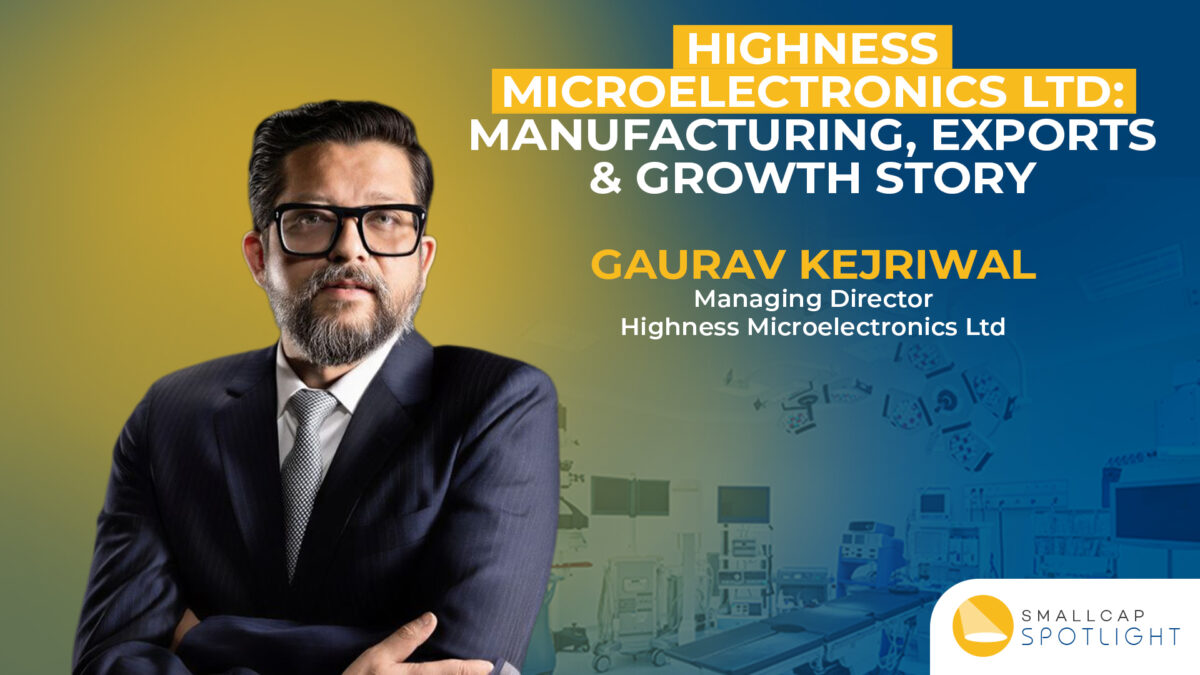
Highness Microelectronics provides end-to-end digital imaging and display solutions for critical sectors like healthcare, defence, industrial automation, and transportation, with a strong focus on precision and compliance. The company is seeing rising demand across segments and is investing in backward integration and localisation to strengthen its supply chain, improve margins, and tap into global opportunities.
Mubina Kapasi: Hello and welcome to SmallCap Spotlight. I’m Mubina Kapasi and today the company that we’ll be introducing or interviewing is a leading manufacturer and exporter of digital imaging and display solutions, Highness Microelectronics Limited. I have with me Gaurav Kejriwal, the Managing Director of the company.
Thank you so much Mr. Kejriwal for joining us. To begin with, for viewers who are hearing about the company for the first time, can you briefly explain what the company does and the key problems your products solve?
Gaurav Kejriwal: Hi, good morning. Thanks for having me on the show.
Our company, Highness Microelectronics Limited is a leading manufacturer of digital imaging solutions and we offer some mission critical displays that are used in some specific industries such as medical and healthcare transportation, defence and industrial automation. So is it the entire display solution right from the back end, the front end, everything and you’re giving the solution to the hospital directly or is it that you all are a component provider? So we are not a component provider. We offer a complete display solution and this is end-to-end manufactured by us and not just manufactured, I would say this is also designed by us and however you know we don’t supply the displays directly to the hospitals but a lot of component manufacturers will use our displays with their cameras or with their modalities to bundle it together and offer it to either hospitals or doctors directly.
Mubina Kapasi: So I mean the fact that you’re providing to such critical industries like medical, obviously there’s something different in the product that you manufacture versus any regular you know display that we see outdoors or in our homes for you know personal or residential uses. So what is different in the product?
Gaurav Kejriwal: So when you say medical grade monitors, we take it as a life-saving equipment and the doctors perform surgeries like endoscopy and laparoscopy looking at the images or the videos coming out of the monitors. So these monitors really you know they are colour calibrated for showing even the details to the doctors because his decision making depends on what he sees on the monitor.
So our monitors are way different from commercial grade monitors because we take care into you know the even minutest details. Colour calibration plays a very important role as well as these displays are meant to be put inside an operation theatre because you know every OT after a procedure is done is fumigated. So our displays have the capability to withstand those fumigation processes.
Mubina Kapasi: So is there any sort of you know maybe medical grade approval etc that your displays require considering it is in that kind of an environment that has to be obviously absolutely sanitised. What I want to know is if there’s any tech, any compliance, any regulatory approvals that you have that maybe others do not which gives you that more.
Gaurav Kejriwal: Right. So obviously there are norms in place to manufacture these displays. Not anyone in can make them. So starting with our factory is an ISO 13485 compliant factory which is the basic thing that one must have to make these kind of products.
At the same time we have the medical devices regulation under CDSCO of the Government of India. This particular licence allows you to manufacture class B products which are not although directly connected to the body of a patient but then they provide critical information. So at the moment we have these two certifications.
Some of our specific monitors also have European CE which is meant for use with some of the products which are exported out of India.
Mubina Kapasi: So apart from healthcare any other industries that you’re catering to if you could share roughly what is the you know the pie that you have in terms of sectors.
Gaurav Kejriwal: Okay so Highness operates across four important industry segments namely industrial automation, medical and healthcare, transportation and defence and aerospace.
And looking at our revenue contributions based on the numbers in FY25 industrial automation stood at about 49.45 percent, defence and aerospace was about 29.99, medical and healthcare was 17.57 and railways was 2.99. But in last nine months ending December 25 our industrial automation was 4.5, defence and aerospace was 45.14, medical and healthcare was 21.73 and railways was 28.56. So as you can see out now you know defence and aerospace contributes a huge chunk of our revenue. However we are also very bullish about our revenue from medical and healthcare and transportation segments. So again defence I mean it depends a lot on government contracts I’m assuming you have to be a registered government vendor there are a series of checks etc that are in place.
Mubina Kapasi: Could you tell us a bit about you know the kind of contracts you enter into and I imagine maybe those carry a higher margin and correct me if I’m wrong or is it the medical ones. So how exactly do these different sectors contribute to your profitability?
Gaurav Kejriwal: So speaking of defence and aerospace of course the project gestation period is long. It goes through a series of you know compliances and regulations and certification processes.
But once we have the orders the orders are in for a decent period of time so we are guaranteed for regular supplies of particular products. So speaking of specially aerospace we have already had some design means for displays that are being used in cockpits. So these are very critically manufactured displays which are airworthy and some of our other offerings have gone into defence segment where you know they have been used for artillery gun upgrades, radar stations and some other night vision cameras etc.
So of course the margins on these displays are comparatively higher. But at the same point the numbers in this industry is not in thousands, mostly in tens and hundreds. But what we also see here is a definitive and double digit growth in the transportation segment where our displays are now being used with railways, long distance trains, metros, urban networks etc.
And as you can already see that 20 plus cities in India are already making their urban network, metro networks. So this particular industry is an upswing and we see this as a great contributor of our revenue source. But not forgetting also the medical and healthcare segment because as we can see that the government and private sector spending is at an all-time high and we are perfectly placed because we have the required licences and we are already supplying these displays to the healthcare industry.
So again this again is going to be a key factor for us our growth in future.
Mubina Kapasi: All right. Okay let’s talk a little bit about supply chain because I think that’s something that everybody is talking about right with the disruptions that we are seeing to you know global supply chains and the geopolitical crises.
What are the components that go into making your screens and what sort of security you have in their sourcing?
Gaurav Kejriwal: So one of the key components that go in our displays is obviously the display glass which in technical terms we call open cell glasses. At the moment we source a majority of these glasses from either mainland China or Taiwan. We’ve been in this industry for 19 years now and we have some key supplier contracts with our regular vendors in these two countries.
So we have secured some long-term supply contracts with them. So we are pretty much safeguarded against the supply chain disruptions. However as part of our long-term strategy Highness is trying to localise most of the supply chain.
We are trying to do backward integration by manufacturing these open cell glasses in our upcoming facility. Basically if we are able to localise our supply chain in India we will not only be able to safeguard ourselves from global changes but at the same time we will have a better grip on the quality as well as we are able to localise most of the manufacturing process in India. I can imagine.
Mubina Kapasi: Could you talk to us about a little bit about your manufacturing facility? I mean right now of course you are just making the display solutions. You slowly maybe want to backward integrate and create some of your components as well. So right now what’s your manufacturing capability? Are there any expansion plans? And if you have this plan of creating that glass that you mentioned here is there any target date for that too?
Gaurav Kejriwal: Okay so at the moment we have a design and manufacturing setup in Rabale in Navi Mumbai.
Basically it is here that we give shape to our ideas and there is a lot of thought process that goes behind making any product. So here we have a set of very passionate and capable design engineers, product engineers as well as people with mechanical and electronic engineering capabilities. So here we make open cell glasses which essentially are being used in TFT LCD manufacturing.
But going forward as I mentioned that our new facility is going to start manufacturing these open cell glasses where you know some critical processes will be onboarded like COG, FOG which is chip on glass and film on glass. Essentially we see about one year’s time frame for this facility to go live but that is a big step in our backward integration. At the same time in about couple of months time frame at our existing facility we will start cutting TFT LCD glasses.
Now with that process on board we’ll be able to make stretched and bar type displays which are widely used in transportation segment. If you see most of the metros and planes they use stretched glass displays. So we should be able to manufacture these glasses in about three months time frame at our existing facility.
While the other one will take about 12 months to go live.
Mubina Kapasi: And I imagine that once you start making it in-house not only quality improves but also there is room to improve your profitability and your margins as well. I’d like to know a little bit about how are you perceiving a demand.
I know you mentioned that transportation is something that’s going to be a big contributor. But if you could tell us a little bit about how you see your revenue moving from here. How you see the nature of Highness you know changing from here on.
Gaurav Kejriwal: So specifically speaking of the demand pipeline you know we see a very strong demand and because there is a huge push in localised manufacturing of electronics and semiconductors in India. As we’ve all been hearing from the government and private sectors a lot of investment is going in and setting up fabs in India and manufacturing is definitely going to have an upswing for electronics. So we don’t see India as just a consumer of these displays of electronics but we see India as a key supplier of these display components in a global supply chain.
So having said so we’ve already been in discussion with several companies overseas who want to diversify their supply chain and they are looking at India in a very big way. We’ve had some visits from foreign potential customers who already are in process of finalising some long term supply contracts with us. So going forward we see that this demand pipeline is only going to get bigger and localising manufacturing is in the interest of our company as well as interest of the country.
So yeah I think this we are very rightly placed and this is really the time for us to start doing these things.
Mubina Kapasi: You also mentioned that you export so could you tell us a bit about how much of your products do you export?
Gaurav Kejriwal: So we’ve had interestingly we have had three design wins from Australia where you know we have made displays here in our Rabale factory and exported all the way to Australia which are now being used in Australian trains urban metro networks. Essentially those design wins have come because we’ve been able to indigenise some of the key designs here in India and for the customer there it has not just been a great value add in terms of design but also they’ve been able to buy it at a better cost from their previous vendor.
So we’ve been exporting some products which are going in railways as I said. At the same time we have been exporting some products which are going in avionics and defence segment. At the moment we are supplying it to UAE as well as Australia but like I said that we have had interest from other European customers so very soon we see even those orders to convert in in big numbers.
Mubina Kapasi: I’d love to know a little bit about your own background as well Mr. Kejriwal what prompted you to you know get into the display solution industry was this something that you were already working on even before Hynes? So just a little bit about your own personal journey in the industry or otherwise.
Gaurav Kejriwal: I’ve always been working with the display industry and I set up this company right out of my college and you know I was I was doing displays even before many people knew what LCD TFT panels were so you know there was a time when owning laptops was a big thing in India I’m talking about the year 2000-2001 and it is then that you know I fancy these thin screens and I started you know studying more about it I started attending a lot of exhibitions overseas. I visited a few small and medium industries in Taiwan and China which were manufacturing these displays and I always knew that this was going to be something great in coming times and it was only a matter of time before it could come to India because at that time people were still using CRT monitors but over a period of time you know it has evolved and now people have moved to TFT displays and given our position in global supply chain with regards to the semiconductor electronics etc.
Display is the missing link that India needs to have sooner and we as Highness feel that you know we are very rightly placed and I have actually seen this industry grow from almost ground up to where it is today so we are we are very confident and I personally feel that you know we should be able to take this a long way.
Mubina Kapasi: One more question why the name Highness?
Gaurav Kejriwal: It gives a feeling of Highness because when you do things like this it makes you feel nice.
Mubina Kapasi: All right okay you know you mentioned of course a couple of ambitions that you have especially with respect to backward integration about you know expanding the product portfolio.
I want to know who is in your team helping you achieve all these ambitions if you could throw a little bit of a flavour of the kind of people you have in your core leadership team or even out there on the factory level who’s actually in charge of manufacturing these high-end equipments.
Gaurav Kejriwal: It’s a set of team which actually takes care of you know things on every single level right from small things to bigger decision making so this is this is a company which is run by a contribution of teamwork and we have you know people who are working with us for 10 years 14 years even 20 years so they have all grown alongside they have seen from how from where we started to where we are today and you know every single person in the team contributes in their own possible ways and you know we have a we have a set of really technology hungry people who look out on a daily basis on what technology has to offer how we can bring it on board what are the process improvements we can you know inculcate in our manufacturing setup on a day-to-day basis so here you know there is there is a combination of passion as well as technical capabilities and put put it all together you know we have a very very capable and deserving team who is able to put up this this show for us.
Mubina Kapasi: All right well Mr. Kejriwal we leave it at that.
Thank you so much for joining us today on Small Cap Spotlight. Thank you so much appreciate. Well that was the management of Highness Microelectronics Limited.
Do remember folks that this interview does not comprise any sort of investment advice. Please do your own research before taking any investment decisions. Thank you so much for watching and stay tuned to SmallCap Spotlight.