
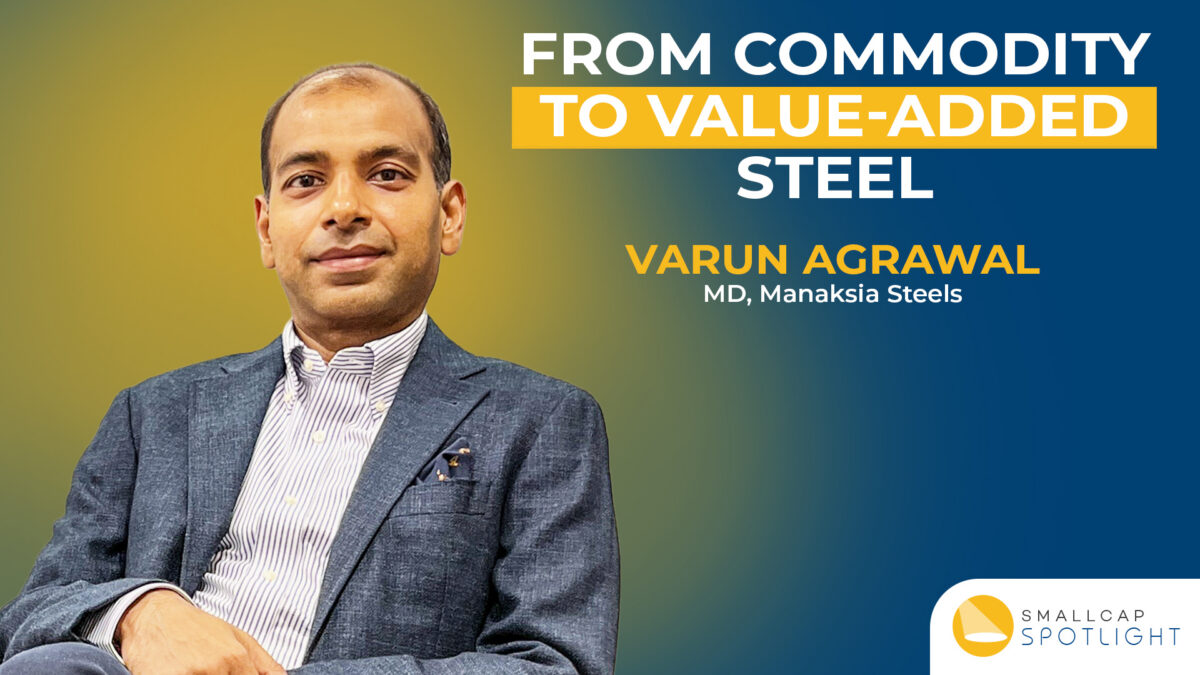
Varun Agrawal, Managing Director, Manaksia Steels, discussed the company’s value-added steel products, expanding domestic presence and growth opportunities in the warehousing and roofing sectors. He also outlined the company’s ₹800 crore expansion plan, highlighting capacity enhancement, rising demand and a focus on maintaining a debt-free balance sheet.
Manaksia Steels is a Kolkata-headquartered niche value-added steel company specialising in customised coated and flat steel products. The company manufactures galvanised, colour-coated and Alu-Zinc steel products for the housing, industrial and warehousing sectors, with manufacturing operations in West Bengal and Nigeria and an expanding international presence.
In this conversation, we speak with Varun Agrawal, Managing Director of Manaksia Steels, about the company’s business, its value-added steel products and its growth opportunities.
Meenakshi: Hello and welcome to SmallCap Spotlight, I’m Meenakshi. Today on the show, we have Varun Agrawal who is the Managing Director of Manaksia Steels. Manaksia is based out of Kolkata and it’s a niche value-added steel-coated company. They
manufacture and export customised metal products that are used in housing, industrial and
warehousing and they have facilities in West Bengal and in Nigeria. So Varun, welcome to the show and thank you so much for speaking with us today.
Varun Agrawal: Thank you very, very much Meenakshi and it’s a pleasure to be with you today.
Meenakshi: All right, so we’ll get straight into it. The company was incorporated in 2001, if I’m correct. So can you begin by telling us about the history and how it all began?
Varun Agrawal: So actually, Manaksia Steel is actually a part of the Manaksia Group. So Manaksia Group was actually, it started in the year 1984, here in Kolkata, and then in the year 2015, the company was de-merged with the steel division which went to the Manaksia Steels. And although the company, Manaksia Steels, was formed in 2001, however, the main operations actually was de-merged and it got the light from the year 2015. So Manaksia Steels has been in the business of galvanising and cold rolling from the year 2015.
Meenakshi: All right, so you are the Managing Director but who else is part of the management and who are the people in key roles right now?
Varun Agarwal: So the company was actually started by my father and he’s a
chemical engineer with about 45 years of experience. So it was started all by him. And then later on, I mean, actually I started looking after the business prior to the
demerger, when it was a part of the Manaksia Limited business. So in the year 2006, that is when I actually started looking after the steel and the aluminium part of the business. And then eventually when the company was de-merged, we started focusing on building the company and today we are where we are.
Other than him, I mean, of course the entire, I mean, it will not be fair for me to name only a few people but because each and every individual in the company is very, very important for us. And we treat everybody like family and most of the senior employees who have been with us, I mean, I guess most of them have the average period that they have spent in the company is about 15 to 20 years. So it’s been quite a journey, I mean, with everybody.
So to name a few people who have been looking after the key roles, one is our CFO, Mr. Rajesh Singhania. So he has been there in the company for the last 20 years. Then the Chief of Operations is Mr. Indrajit Guha and he has been there in the company for the last 18 years.
And on the marketing side and the procurement side, so we have the business, President,
Business – so he is Mr. Govind Muthal. So he has a lot of experience of about 35 years of coated steel business. So, I mean, we have a fantastic team and below all of them, we have a very, very young, diligent, young team, I mean, who are now handling day-to-day operations.
Meenakshi: Okay, that’s excellent. So a family run business, which has also professionalised the next rung for the future.
Varun Agarwal: Yeah, yeah, absolutely. In fact, I mean, as far as my role is concerned, it is basically about, I mean, day-to-day operations is not what I am actually looking after. So it’s more of the vision and the investments and how to make our product different than the others and give value to the market and to the shareholders. So, I mean, the day-to-day operations are handled independently by the team.
Meenakshi: Okay, so on that note, could you walk us through your product portfolio and the supply chain from your sourcing to the finished product? And also if you could tell us a little bit about which the biggest revenue generators are within the product portfolio.
Varun: Right, so as far as supply chain is concerned, Manaksia Steels has always been a company which has been manufacturing cold rolled steel and galvanised steel. So that has, I mean, we had started that from the year 2006. So that was when it was a part of
the Manaksia Limited. So we had originally, I mean, we had always been buying hot roll coils being our main principle raw material from Japan, the company called JFE Steel. And we have been buying HR coils from them till I think about 2020 on a regular, regular basis.
However, post COVID and due to the COVID scenario when all the shipments and everything got affected, so then we ventured into buying something domestically as well. However, as on date, as we stand is that most of the procurement has completely shifted towards domestic now. And we are buying almost everything from the domestic market because of the safeguard duties which the Indian government has imposed to protect the hot roll coil manufacturers from cheap imports.
So this has actually helped us in a way because the inventory, what we used to carry for about, because whenever the shipments used to come, it used to be 25, 30,000 per vessel. So, which used to be a consumption for us for about three or four months. However, now we are buying every month and we are consuming every month. So our inventory cost and the risk on the inventory has actually reduced quite drastically. So, I mean, this has actually helped us a lot. So we are buying the hot roll coils from the domestic mills. So practically all of them. And then other than that, we are buying our zinc – being the second raw material which we use – is from Hindustan Zinc here in India. The paints that we are buying are all from Japanese affiliated companies. So be it Kansai, Narolac or be it Nippon paints. So even the chemicals for the pre-treatment and everything, whatever we are buying, it’s all from the Japanese companies.
So actually there is this feeling in our company that the quality levels and the support that we get from these companies if we are using their material as a service, as a part of the service package is that we want to make our product different from what the competition is doing. So it’s basically, you can, I mean, we are very, very confident that it is being made under the Japanese umbrella and the Japanese technology. So we are very, very confident that our product is much better or superior than the others in the market. So that was, I think your question on the supply chain as far as the raw material is concerned, right.
On the finished goods, so being the plant, the plant is based at Haldia. So hence the import and export both are an advantage. So for us, we have been very, very active with the export market as well because of having a presence in Nigeria and Ghana. So we understand the Africa market. And so all our products initially were actually designed to cater to these African markets itself.
So however, in the last three or four years, we have scaled our production and we are now focusing more on India. So we have developed a lot of dealer networks and distribution networks. So earlier it was only in the Eastern part of the country. From last year onwards, we have now spread towards the North, towards the South. So, I mean, we are seeing that there is a lot of demand and the brand has become very, very popular. And we have about, we have currently in the colour-coded segment, we have two brands. So one is a premium segment brand, which is, which we call it as a Five-Star Roofing. And the other brand is Austrang. So both these brands are doing very, very well. And that is how we are trying to maximise our production and sales.
Meenakshi: Okay, so since you spoke about your plant in Nigeria and how things are expanding, are there plans to expand further inside or outside of India? And also apart from Africa, what is the global footprint looking like? And which are your biggest markets, including India?
Varun: So currently, because of this war situation and everything, and the freight rates going completely haywire, we had actually started exporting into the UAE market and as well as the South American market. However, because of the freight and the logistics, so now we decided that let us focus more on the India story as well. So other than India, I mean, of course, so currently I would say that 75% of our production currently is being sold in India. However, 25%, what we are currently exporting is mainly toBhutan, which is the regular sales. And then other than Bhutan, Ghana is importing a lot of material from us, as well as, I mean, yeah, I think as well as some material is going to the South Africa area, that is Mozambique and Zambia.
Meenakshi: Okay, so that’s an impressive global footprint. So apart from the markets, which are the major industries and segments that you’re supplying to domestically and internationally?
Varun: So our products are basically used primarily for the roofing industry. So we are supplying to the PEB manufacturers, to institutions and also corporates for their factory building and their warehousing requirements. So that has been the main focus. And also in the rural areas, we are a prominent player as far as the galvanised roofing sheet is concerned. And now the colour ported is also picking up quite a bit in the rural areas as well. So I would say that my maximum revenue is coming from the galvanised roofing sheets, which is in the volume, whereas the profitability is coming from the colour ported.
Meenakshi: Okay, so just to go a little off script, you mentioned that warehousing contributes a fair amount. So have you seen any kind of increase in the last maybe five to ten years with the e-commerce boom and fulfilment centres coming in and even air freight with some of the newer airports coming in? Have you seen an uptick in the requirement for products in that segment – in warehousing?
Varun: Yeah, I mean, it has been a big jump. In fact, I would also want to share, I mean,
this e-commerce area, because as you mentioned, since we also have operations in Nigeria, so what we see and we make, our group also makes paper in Nigeria. So for the packaging as well, the demand for paper has jumped considerably and also the warehousing and the entire supply chain and everything. So roofing requirements are very, very big. So both in India and Nigeria, when I see, there is a synergy, is what I see as far as the e-commerce is concerned. So in India as well, in areas closer to my plant or even closer to Calcutta, we see a lot of new warehouse being developed and most of
it, I mean, what I understand is that they are not being able to meet the demand.
I mean, there’s much more of a requirement than what they can actually provide. So I feel that this is going to grow further.
Meenakshi: All right. So the next question I had was, you’ve recently announced an 800 crore investment to boost speciality steel capacity. So what kind of demand are you seeing there and is it more from captive consumption or external demand?
Varun Agrawal: So as far as the 800 crore expansion is concerned, so this, we are doing it in two phases. So phase one is cold rolling, galvanising and colour coating. Okay. And this we plan to complete by the financial year 2029. So here what we find is that currently we are falling short of some raw material, which we need for our own production. So, which we are currently buying from other mills in India and also importing. So firstly, we would
like to make enough capacity to service that requirement of us. In addition to this, there is a lot of market, a lot of demand. So our current lines, whatever we are operating, our galvalume line and our colour coated line and our mill. So all these, what we find is that whatever is the rated capacity. So we are actually probably running a bit more than what is the rated capacity. So, we are still finding it short. So this was the reason that we could, we felt that and the way the brand is also moving and what we have seen is that we are able to increase the margins or the price on our branded products because we are not able to meet the demand. So hence we feel that definitely there is a strong traction from the market and we can meet that extra demand.
Meenakshi: All right, so you mentioned the raw material challenge. So apart from that, what are some of the other bigger challenges that you see that you may have to overcome in the medium to long term as you expand?
Varun Agrawal: So, of course the raw material, we, I think we have been managing. So, and I am sure that, I mean, we would, yeah, we would somehow manage in future, I mean, for the next seven, eight months or nine months till such time the production kicks in. But the main challenge for me is actually completing the capex timely, with a healthy balance sheet.
So currently we are a debt-free company. We have zero long-term debts on our company and whatever debt is there, it is only the working capital, the LCE debts that we have, which is always in a rotation of about 60 days. So other than that, I mean, there is no debt and for this, as of now, we have not raised any money or we have not borrowed anything. And we don’t plan to do that immediately because we feel that we want to, we are very, very conservative as far as the borrowings are concerned as a company and as a family as well. So what we want to do is that we want to make sure that we can service it from the internal accruals and keep the balance sheet healthy.
So I think the next one year or one-and-a-half years, I mean, that’s the idea and that’s what the team also believes that we will try to avoid borrowing. I mean, we just don’t want to do that.
Meenakshi: Now that’s a sign of a great management, being completely debt-free! The other question I had was, do you face any competition from imported products in the steel sector?
Varun Agrawal: So cheap imports were definitely an issue from China and Nepal, because in India we have a certain cost structure as far as the HRC and the zinc and everything, whatever we can buy locally here. So in the case of cheap imports, they definitely used to disturb us a lot. However, the government of India has introduced safeguard duties on all steel products and hence practically steel import is not possible at the moment.
So this has actually helped us a lot and we feel that going forward also, because other than the safeguards, there are also some restrictions like the BIS regulations, which the foreign mills have to get registered. And I think the Chinese somehow, I feel that because of the quality issue and everything, they have not been given access to the renewal of licences and all. So I think eventually the market remains for the Indian mills and whatever growth we find, we will, the Indian mills are the first ones to actually take the advantage of that.
Meenakshi: Okay, that’s excellent. Now, you mentioned, you know, moving into paper and packaging in Nigeria. So similarly, do you have any new developments, expansions or diversifications in the pipeline?
Varun Agrawal: So for now, I mean, our main aim is to get the Haldia project completed because here we already have the land and we already have the manpower because it’s going to happen in the same complex. And so the management cost and everything would be, I mean, it would be the same and we can get higher production out of this. So that has been the main focus to convert these projects on time. And other than this, we have
our operation in Nigeria where we are making rebar, TMT bars for the construction industry,
which is currently being made out of steel scrap, melted into billets and then re-rolled into rebar. So we plan to increase capacity there as well. And because now the Nigeria market also, what we find is that there is a lot of demand as far as the construction requirements are concerned. So we are very, very confident. So eventually, it’s still on paper. So we haven’t decided yet, but we may definitely take a look at it.
Meenakshi: All right, Varun, thank you so very much for sharing your insights and perspectives on the industry with us. And we wish you all the very best and hopefully we’ll speak soon once the new plant is expanded up and running.
Varun Agrawal: Thank you so much. Thank you, thank you so much. It was a pleasure and we are confident that we are going to make everything work very, very fast and it’s gonna be a good future for us and for all our shareholders as well. So thank you very much for taking your time.