
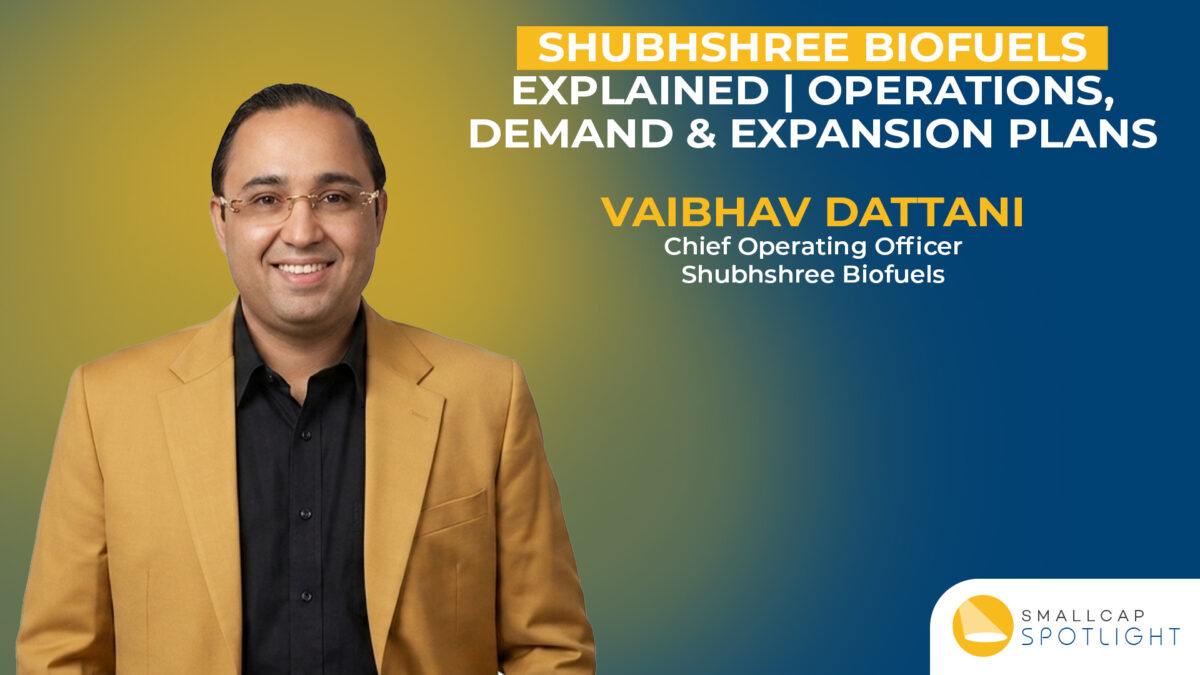
SmallCap Spotlight speaks with Vaibhav Dattani, COO of Shubhshree Biofuels Energy Limited, on the evolving biofuels landscape amid ongoing gas shortages. The conversation highlights biomass as a cost-efficient, sustainable alternative and explores the sector’s growth potential driven by policy support and rising demand.
Karunya Rao: Hi everyone, welcome to Small Cap Spotlight. I’m Karunya Rao and today we have a very topical, very timely interview planned for all our viewers. We’ll be interacting with the management of Shubhshree Biofuels Energy Limited.
Now, the COO of the company is with us, Mr. Vaibhav Dattani. He’ll talk about not just what the company does, but given the recent shortage of gas across the board that we’re listening to and we’re watching in the news, we’ll also delve into that and how this company stands to gain or impact it in any way, given the way things are playing out. Mr. Dattani, thank you so much for joining us today.
Vaibhav Dattani: Thank you everyone and thank you Karunya for giving us a chance and opportunity. I’m very grateful to you and your team and our small cap investors and basically what we have done in this sector, Shubhshree Biofuels Energy being one of the largest and biggest players in the green energy space. What we are doing is we are replacing coal and gas directly by our biomass pellets and fuel which is the key to driving any country.
Let’s suppose a country like India where there is 750 million tonnes of waste which we are going to directly replace the gas and coal keeping the energy crisis and you have seen four weeks of war happening in West Asia. So why a company is going to have a very futuristic and a growth orientated possibility? So basically we started in 2013 being one of the largest suppliers to the government and the private sector and we started to develop in 2013 by giving these MNCs companies a green fuel. So we started by Coca-Cola and we replaced their gas boilers into this biomass briquettes and again many companies started to feel the heat by having a carbon credit and going for a green fuel.
Karunya Rao: Okay, interesting. So let’s come to the current situation that we are witnessing across the board in the news as well. So given this ongoing gas shortage concerns that we’re facing here in India in several cities across the country, what kind of a turning point is it for domestic biofuels and biomass based energy and you’re also a big player in that space.
So how do you stand to get impacted with the way things are going forward in the long run?
Vaibhav Dattani: Let’s talk about hotel industry, let’s talk about industrial sector. So where you see like brands like Haldiram, Home Sweets, Beccano, they are using this eco-friendly biofuels in their boilers, in their heaters and we have lakhs of lakhs of hotels and restaurants where they are using gas which can be replaced by these pellets and it is very eco-friendly. 50 percent of their fuel cost can be saved and we don’t have to import anything from the abroad countries.
So why depend on other countries when we have a fuel, when we have a clean fuel. So we should anyways go to these cleaner fuels.
Karunya Rao: So with this current situation have you seen any surge in orders or in your business pipeline as well?
Vaibhav Dattani: So what we are realising is this small kitchen companies like if you say a frozen food packaging industry where they are exporting like prawns or maybe some frozen foods like dal makhani.
So these kind of kitchens are coming up to replace their gas boilers. You see that blanket industry in Panipat, they are using gas. So they are going to shift from gas to pellets.
Why? Because they are going to remove their dependency from gas to these pellets.
Karunya Rao: So do you have enough supply and inventory to cater to this sudden surge in demand?
Vaibhav Dattani: See there is a lot of scope in this sector. Today numbers won’t be that significant but in coming three months, six months you will have to see the change.
Like we saw in ethanol, like we saw in biogas, these changes started to come. Why? Because people innovated. They had the technology.
Even we have a technology that we can replace these gas boilers or gas heaters to these biofuels directly.
Karunya Rao: Okay, interesting. So let’s say in the next three to five years, if I want to ask you to give us some prediction or some projections, are you seeing the biofuel and biomass sector evolve in India? And what are the biggest structural tailwinds that you think will be the most beneficial for your sector that are playing out right now and will play out in the next few years?
Vaibhav Dattani: See looking at the structural changes, I would like to tell you it’s a raw material.
Basically, there is a raw material factor, there is a seasonality factor and government has given a mission of 5%. There is a mission called National Mission of Biomass which government has given a mandate. So all the government where they are using coal in their boilers for generating electricity and government is going to keep from this 5% mandatory clause, it will go up to 30%.
So coal and gas will be replaced up to 30%. So looking at the demand which is going to maybe go up maybe 10 times. Today demand is for 2 lakh tonne at 5% level and we are only generating 10,000 tonnes per day.
So gap is 1,90,000 metric tonne per day. So gap is huge. Where we are lacking is the infrastructure.
Many industries will come up who will try to develop this biofuels and accordingly it will grow.
Karunya Rao: So how are you planning to scale up your supply and your production? What is the plan forward? Are you earmarking any expenditure towards this?
Vaibhav Dattani: So we are strategically planned out. Our advantage is that we are going to have a good order book and we are going to place our manufacturing plants near to the customer base.
So benefit is we are going to increase our margin, reduce the logistic cost and in turn have a raw material base where we can supply to the power plants directly. So it will be strategically located. Let’s suppose we have a plant in Andhra.
So we are going to cover Karnataka, we are going to cover Tamil Nadu. From the same plant we are going to have a multi-dimensional approach. Okay.
Karunya Rao: Typically Mr. Dattani, what is the level of acceptance of these products at power plants and what regulatory limits govern the procurement?
Vaibhav Dattani: So Karunya, I would like to tell you that 72 power plant had a test fire in 2025 and there are more than 280 power plants in India. So only 72 have test fire. Once government gives a push towards this power plant, again the limit of 5% which is mandatory from the government, it will go up to 30%.
So automatically there is going to be huge demand. Okay. And about the raw material, we already have a lot of waste in the country.
Karunya Rao: Got it. Can you also break down your revenue mix across products and customer segments and kind of who are your key clients, what kind of revenue is from which segment, if you can give us the colour?
Vaibhav Dattani: So we have like three kind of segments. Basically one is the private segment where we are dealing with the FMCG, textile, pharma companies and one is the government sector which is the power plants.
So these kind of two sectors we are targeting basically. And what is the revenue mix? Revenue mix is like 50% is coming from the government sector and 50% is coming from the private sector. Okay.
And over the medium term or near to medium term perhaps, what is the kind of demand visibility you are seeing in terms of top line? In terms of top line demand, these government power plants will be, will bring in the more revenue to our organisation. Okay. Okay.
Whereas the private would come on to 20-30% of the, okay, keeping the government push towards the sector. And the crisis also. Got it.
Karunya Rao: Got it. So we’ve talked a lot about the positives. Let’s also talk about some challenges.
So typically what are the biggest operational bottlenecks in scaling a business like a biomass-based fuel business here in India? What are the challenges or bottlenecks you’ve seen?
Vaibhav Dattani: So I would like to reframe the question. The challenges is also the opportunity for any organisation to grow. So let’s suppose we are a medium-term organisation.
To go towards a larger organisation, we would face, we would face like to develop a good manpower. We would create opportunities in the sector. In a rural sector where we are going to base, what we create is a village-level entrepreneurs.
In one district where we go and set up a manufacturing plant, we make a village-level entrepreneurs. That they all bring all the raw materials to us. So initially it would take time to develop a district where we are collecting the raw material.
So we are collecting the raw material from the farm and these village-level entrepreneurs bring the raw material to us. And we have the technology to make these pellets and move towards these pellets to our customer, which is the power plants. So basically, looking at the opportunity, looking at the evolvement, maybe it will take time to set up a plant, maybe six months, nine months to set up a plant to make a village-level entrepreneurs, to have a raw material, to manage the manpower, to manage the technology.
We have a professional team to do this, all the activities.
Karunya Rao: Okay, interesting. And if one wants to track your company or track the industry, what operational metrics do you believe best reflect the true business quality? If today I want to see the performance or do a research on Shubhshree’s performance, what are the metrics you think I should be focussing on?
Vaibhav Dattani: See, there can be two approaches to this.
One approach is that it is in a green energy space. It is the only company which is doing this kind of work where we are collecting the waste and converting this waste to become an energy compliant organisation. So we are passing the energy to the government and the private sector and we are saving carbon credits.
We are solving the pollution problem, which is the basic of any country. So if you talk about pollution, today Delhi NCR face a lot of pollution from Punjab and Haryana because this Parali problem was a long-term problem for the government. But initially we had the equipment, we took time and we solved this problem for the government.
So again, if you want to look at the numbers, revenue would be another approach to see any organisation growth. Okay. So looking at the number from last three years, we have done a fantastic job from last three years and these numbers will maybe go up to five times, ten times.
You never know in the next four years what is going to happen.
Karunya Rao: But do you have any internal projection of growth?
Vaibhav Dattani: See, definitely talking about the number, it can go up to five times, ten times. By the way.
See, we have given a target of maybe 1000 crore in next three years. Okay. Before going to the main board, this is our target of maybe giving an opportunity to us, to the organisation that we will try to fulfil all the compliances, we would try to have a good revenue mix and to be a very profitable company.
Karunya Rao: Okay. So what according to you is your biggest competitive advantage? Is it processing? Is it sourcing or logistics or anything else?
Vaibhav Dattani: Karunya, basically our advantage is we are strategically placed. Keeping strategically places, we put manufacturing plants near to the customer base.
We have a low logistic cost. We have the technology mix. And with all those kind of factors, we try to be a profitable company.
Karunya Rao: Okay. Okay. Got it.
In terms of your margins, your working capital, risks like raw material availability, seasonality also you said is a factor to watch out for. So how are you managing all of these together along with price fluctuation and while ensuring that the margins don’t get hampered?
Vaibhav Dattani: To manage the margins, we keep an adequate cash flow in hand and we try to manage the customer basically. Whatever customer we have got, we try to double that revenue from them.
So let’s suppose we have got an order from NTPC. So we try to complete the order timely and increase an order from that part. So basically from that, we try to capture more on the same customer and grow from there.
Karunya Rao: Okay. Okay. And finally, you talked about going to the main board IPO eventually after breaching your thousand crore revenue milestone.
But tell us about how life has changed for you post-listing in terms of governance standards, customer confidence, access to capital, etc. How have things been ever since you got listed?
Vaibhav Dattani: Post-listing, we have got a growth governance, we have got transparency and customer confidence has also increased. Credibility is also there with the customer that it is a listed organisation.
They have a policy, they have a framework and access to growth capital has improved significantly because it has helped to make new manufacturing plants and we have got working capital in hand to execute those projects.
Karunya Rao: Okay. Interesting.
And finally, if you could also give us some sense on who the core team is, what is the leadership team look like at Shubhshree Biofuels, who all is managing what part of the work and departments, etc.
Vaibhav Dattani: We have a professionally managed team. So I and Mr. Sagar Agarwal, the two promoters have a compliant team of key manufacturing professionals who are managing the organisation and we have a core team of 10 people who are doing this kind of day-to-day managing the operations for us.
Karunya Rao: Okay. All right. Before we let you go, just one quick view on the sector that you’re operating in.
What is that one aspect of the Biofuels business that investors tend to underestimate but is actually critical to understanding your Shubhshree Biofuels long-term potential? What would that be?
Vaibhav Dattani: Karunya, if you look at today’s crisis and look at today’s situation, what is the demand? What is the key current? We are looking at an energy crisis and the next four years and the whole world is talking about this. The petroleum products dependency and government push towards this biofuel, looking at the sector, it is going to be the most positive sector in the coming years. And looking at the crisis, we are going to have our own ecosystem where we are going to use these biofuels in their boilers, heaters and all the companies are going to be self-sustainable.
What we are doing is increasing farmer income. Whatever biofuel we are wasting on the ground, we are using that income to give to the farmer which is the government’s basic motive. What we are saving is, we are saving dollar reserves of the country.
We are not importing. Suppose if we are not importing crude or we are importing less of coal, so we are giving that money to our farmers. And again, carbon credits, we are saving carbon.
What we are saving is human lives. So, you see, there are a lot of positive aspects to this biofuels. Why our organisation is credible? Because we have also the motto of moving in line with the government mission.
Karunya Rao: Got it. Great, Mr. Dattani. All the very best for your future endeavours and your plans to expand the business from here on.
Thank you so much once again. Thank you. It was lovely talking to you.
And I hope your investors have a positive mind towards this. And basically, this sector is going to be the most, most, most profitable sector. Well, here’s hoping.
Thank you so much once again for joining us. Thank you. Thank you so much.