
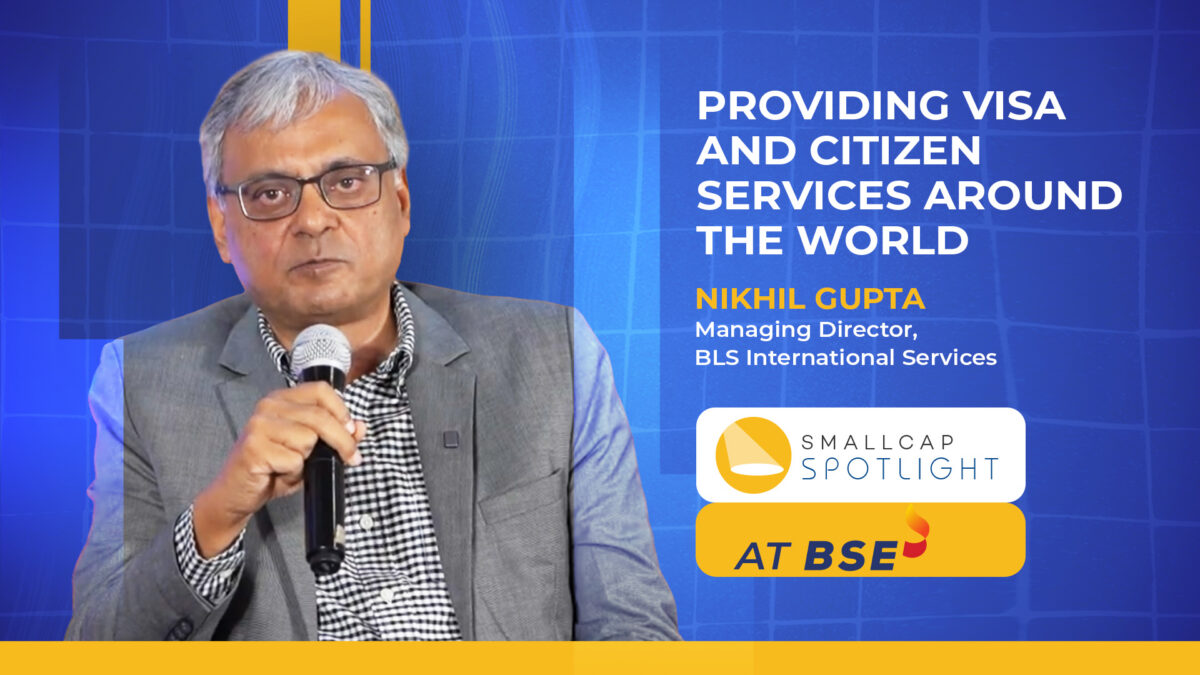
BLS has grown from processing around 500 visa applications in 2005 to about 5 million annually, expanding its presence across nearly 100 countries. Nikhil Gupta highlights the company’s focus on citizen services, technology, and expansion into adjacent businesses to support its continued growth.
Nikunj Dalmia: How many of you know about BLS? Visa lagate hain, ab garbar ho gayi. Can anybody observe the garbar ho gayi hai jo? I am on the wrong side of this visa company already. I am sitting on his left side actually.
So, we will talk about what this business is. How BLS has become a build to last franchise. What it takes to create a franchise like BLS.
And where is this entire services business headed. So, thank you very much for joining us.
Nikhil Gupta: Thank you for having me over.
Nikunj Dalmia: First, aapki kaani, aapki zubani. How did this idea come up? What was the starting point? And what have you done to make this unknown name an unforgettable franchise?
Nikhil Gupta: Firstly, thank you very much Nikunj for having me over. And also Rishi for having us over here. I am going to talk to you about BLS where I spent last 10 years. And we have gone through some very interesting and exciting period. The company actually started way back in 2005.
And the reason for starting this business was because the promoters And I find that these are learnings from what you observe. What you see in real life. So, he saw large long queues.
And then outside the Portuguese embassy in New Delhi. And so he went and approached the ambassador. And he said that look there are so many people waiting outside.
And there are mistakes being made and then corrections being done. So, it takes a long long time for anybody to apply for a visa. And to get a visa.
So, why don’t you transfer some of this work to some outside company. Who can do lot of the routine part of the work. And therefore, you only need to do the judgemental part.
Which is to decide on whether to give the visa or not. Based on the accurate documents that have been submitted to you. The ambassador liked the idea.
He said that let’s give it a shot. We started from there. And there was as little as a couple of hundred applications coming in every month.
Which is a small number. And from 2005 we have grown to 2026. Where we are getting about 5 million applications every year.
From people who want visas. So, it started in a small way. We expanded to Ministry of External Affairs of India.
And then we have gone overseas. And we are now present in nearly 100 countries across the world. Catering to about 50 different client governments.
And doing a business of something like 1800 crores in visas alone in a year.
Nikunj Dalmia: So, how many visas did you process? That’s the right word. In 2005.
And how many visas are you processing now every year?
Nikhil Gupta: So, it’s gone from something like I said about 500 visas a year in the year 2005. To something like 5 million applications in the current year.
Nikunj Dalmia: So, 500 to 50 lakhs.
That’s correct. Are you sure? Let’s count the zeros. This has become a multi-bagger.
Nikunj Dalmia: Yes. You are an Indian company.
Nikhil Gupta: That is correct.
Nikunj Dalmia: Who is processing visa for Indians who are moving out of India. But you said that you also have partner countries. And these are 50 plus partner countries.
Where an Indian company is giving services to their citizens who want to move out. So, this is like the pride of India. That an Indian company is going global and doing visa for their citizens.
Nikhil Gupta: Yeah, absolutely. What kind of services are we providing? So, we provide one is consular services, visa services. We also provide attestation services, digital certificates.
We have expanded to a lot of governments, state governments and central governments in India. Where we provide various services from the birth of a child to the death of a human being. So, all the different certificates or things that he requires from the government.
We provide a lot of that services.
Nikunj Dalmia: What is the most distinctive feature about BLS? What is your moat which nobody else can copy? It’s very simple. You are making it sound very simple.
People want to get visa. You want to give them visa. Governments, they want more inbound tourism.
You are the bridge. But there are only two companies in India of your size.
Nikhil Gupta: Well, actually only one. One is a global one called VFS. And there is a French company called TLS. Between us, we have about 80% market share.
Nikunj Dalmia: So, in India, there are three companies. Between them, there is 80% market share. That means a tough business.
Not everybody can copy it. So, what is that thing which is so distinctive about your company?
Nikhil Gupta: So, the moat, as you said, Nikunj, is to do with the trust which the client governments must have before outsourcing this work to any organisation. As well as the speed with which you can do that work.
And the timeliness in being able to provide the service. Simply, like I said, getting to where we are, it took us nearly 10 years to get any large contract. From 2005 to 2015, we were looking at small businesses which was giving us experience and adding to our knowledge.
And adding to technology that is required to run the business. And the first large contract which we got was in 2016 from the Spanish government which gave us the work to do the entire visa processing across the world in 48 countries. This was being run previously before by VFS.
And there were some issues which were raised by them. And as a result of that, we got that contract for the first time. And because VFS was already running the show across the world, we were required to establish all these centres in 48 different countries in a period of 3 to 6 months.
So, which means that we had to open offices in all these countries. We had to register ourselves legally, have auditors, have lawyers, have employees. And train those employees and put up systems over there to be able to run the operations in a period of 6 months.
So, we learned all from there and based on our learning, we are now ready to be able to do these kind of rollouts across the world in different languages, different cultures, etc. It’s been a big learning over this period.
Nikunj Dalmia: Last 2 years have not been exactly perfect for geopolitics.
Especially last 6 months. A big war which challenged outbound tourism. But if I look at your growth, first, the data what you reported for the quarter gone by, the forward-looking guidance which you’ve shared, and also the growth in last 2-3 years, high dollar is not impacting you, geopolitics is not impacting you, inflation is not impacting you.
So, how is this happening?
Nikhil Gupta: So, even more difficult period was when the COVID was there, when all travel across the world had virtually frozen. And those were really tough times for the company because our entire business is based on people travelling. So, we did go through a difficult time.
We needed to take a lot of harsh decisions at that point in time. Because the company is promoter-driven today or earlier, we were able to take quick decisions. This is something which differentiates, I would say, us with a larger company like VFS, which is probably 4 times our size, is simply because they have layers and layers of management before any decision can be taken.
In BLS, decisions are quick and we are able to take those decisions to be able to get back to the business quickly. We also used that opportunity to get into new businesses in India. We also used that opportunity to acquire businesses in adjacent fields.
All of this resulted in not only the business remaining the same or even improving over this period, but rapidly growing at over 30-35% CAGR over the last 10 years.
Nikunj Dalmia: What’s next for BLS? Visa is one. You also are doing digitisation of Aadhaar.
You know, every government wants to make their services more digital. And governments do not have that large budget, which is where, let’s say, role of a platform like BLS comes in. So, what’s next for BLS?
Because right now your identification is Visa. What’s next now?
Nikhil Gupta: So, as I said that we got into this space of… first got into Punjab, where the government came out with a tender for outsourcing a lot of the services which were hitherto being provided by different departments of the government. And citizens had to go to different, different departments to get their services. There was corruption, there was delay.
It took a lot of time for people to do that. And the government in 2016 took the decision to roll out what they called Punjab Seva Kendras. And I have started those Seva Kendras.
We had to start 2150 Seva Kendras over a period of six months in the state of Punjab. We did that successfully. We ran the project for eight years.
But this is what happens, unfortunately, when we don’t believe in L1 business. Okay, we don’t think L1 kind of business is something that we can do really well. Right? We believe in offering quality services.
We believe that offering products or services at the lowest price always brings you to the lowest quality also. So, we ran the services for about eight years. Some company came in and offered the services at half the price.
For the last five years or three years, they have been incurring losses of hundreds of crores a year. And they have applied to the government to exit that contract. So, I think the learning from there has been that and from there we have expanded into different states.
We are providing services in Uttar Pradesh, we are in Karnataka, in Gujarat, in West Bengal. And recently we got the All India tender for providing Aadhaar Seva Kendra services across the country. So, we are setting up now about 270 centres across India.
And the government has given us a time of about 11 months which get over in September. We will complete all those 270 centres by the month of September.
Nikunj Dalmia: So, what you are also telling us is that whatever we have seen in terms of geopolitics, largely it has not affected your business.
Nikhil Gupta: Yeah, because we found alternate revenue streams one way or the other.
Nikunj Dalmia: So, where are all the people from Dubai? Dubai? Where are all the people from Dubai who were not going? Where are the people going?
Nikhil Gupta: We have acquired a company for example, I was there for the last one year in Turkey. And we acquired a large company there.
And I was running that company for a while to be able to understand because as you know languages are different, cultures are different, currencies are different, inflation is 40% a year in Turkey. So, a lot of things need to be understood and to be able to quickly learn, correct whatever needs to be corrected and then start looking for growth. So, last two years we spent in understanding the business.
Now, we are starting to look at big growth. So, we keep finding revenue streams.
Nikunj Dalmia: Are you in a high growth phase? And will your future growth be in and around the historical growth rate? Will last three years be equivalent to the next three?
Nikhil Gupta: Well, without getting into speculation.
A broader trend. But I must say that the objective of the promoters is to continue the growth which we have seen over the last many years into the future.
Nikunj Dalmia: How would you define growth? One is current business which is growing.
Second is adding new businesses. Third is using the cash which you generate.
You generate about what? 800-850 crores of cash every year?
Nikhil Gupta: Approximately 800 crores a year.
We have at this point of time about 1500 crores available for investment. And we keep generating that kind of cash. So, we have a pipeline of opportunities which are available or which we are all the time looking at to see what we should invest in, where we should invest.
But mostly we are looking at adjacent spaces. We are not looking at going into something totally esoteric etc. We are looking at, for example, we went into banking which was to do with business correspondence.
Some of you would have heard of something called business correspondence. Basically what’s happening is that the government wants banks to have branches and offices in the rural, in tier 2, tier 3 cities also. The banks were finding it very difficult to be able to set up their establishments in these smaller towns.
So, they decided about 10 years ago to outsource a lot of this work once again to people who would provide those services. In 2012 I think, no, 2022 I think it was, we acquired a company called ZeroMass which was the largest company in this segment. And from there we have learnt over the last 3-4 years what is required and what is to be done in that business.
And last week we announced another acquisition in the same business called Atyati.
Nikunj Dalmia: What is similar about, you may want to know, banking and visa, what’s the connection.
Nikhil Gupta: So, I’ll tell you a couple of things that are really connected to it.
One is that we are good at providing citizen services. So, anybody who wants any kind of service comes to us. We don’t go out and sell those services to anybody, they come to us.
So, in the visa space, people come to our offices to avail of services. We manage the crowd, we manage the applications, we have systems to ensure that people get timely services, etc. The same thing happened in the business correspondence space also where people are coming to our centres to either withdraw cash, deposit cash or transfer money or open bank accounts, close bank accounts.
Basic services which the bank doesn’t think it’s important for them to provide those services but which can be provided by anybody. So, now the bank is talking to us about providing KYC services. So, once a year, once in 2 years you need KYC approvals.
And lot of people, particularly in the tier 2, tier 3 cities don’t have that ability to do it themselves. So, they come to our centres and they provide the documentation that we want them. We give it to the bank, banks approve it and the KYC is done.
Now, this is pretty routine work as far as bank is concerned. They need to decide on who to give loans to, what loans to give, what to finance, etc. There are lot of other things bank can do and which requires important decisions to be taken.
So, they want to do that and outsource the rest of that work to somebody else. And I must say that every country, every ambassador that I meet, one of the first questions I ask them besides whether they are having any difficulties with the services that we are providing is what else can we do for you to help you to be able to take the decision on whether to give the visa or not. For example, we have approached some people to say that people have to give their hotel addresses where they are going to stay.
They are going to have to give the flight details on when they have to travel. Now, we can easily, using AI, can actually find out whether such a person has a seat on a flight, has booked a hotel and the hotel that he is claiming that he is going to be staying in and be able to give this information to the consulates and the embassies. So, that part of the work they don’t need to do to recheck.
So, same thing with banks. We are saying there are lot of things that you are doing which are routine things. You don’t need to do it.
Allow us to do it. And the other important thing in our model of all our business is that interestingly we collect all the cash upfront. We don’t have any receivables in our books, etc.
We don’t wait for anybody to pay us our money or follow up with governments to give the money to us. But we collect it upfront. So, we never have to worry about it.
And that’s the model that we are following in most businesses that we are doing currently.
Nikunj Dalmia: My last 2-3 questions. One is visa on arrival.
More and more countries today are aligning with the whole idea of visa on arrival and the Indian passport is becoming more and more powerful. Is that a risk? Because if there is visa on arrival, then intermediary like BLS will not be required.
Nikhil Gupta: Let me open this question to the house.
You want to travel to Germany. Germany randomly. Germany decides that we will give you visa on arrival.
You land up in Germany at the counter and you ask for a visa. And you don’t have a proper document or you give an improper response. And your visa is rejected.
What do you do? You go back to your home country. The whole money that you spent on taking a flight to the place and coming back, etc. is all down the drain.
So, even though many countries are offering e-visa and visa on arrival, etc. A lot of people still prefer to take the visa unless they’ve travelled several times to the country and they know what document is required and that they have everything available with them. Very often they are just happy to get the visa.
It will cost a fraction of the costs that they’ll have to pay if their visa for any reason is rejected out there. So, I don’t think it’s going away in a while. The other thing is a biometrics.
Remember that many countries insist on biometric to be taken before you travel. So, that’s something which has to be done while you’re in India. It can’t be done overseas.
Nikunj Dalmia: My next question to you is really about AI. You use certain examples to say that how AI is becoming a tool. But today AI is also making life easy for an embassy to perhaps decide the true identification of a traveller.
2005, there was no concept of KYC. We did not have an Aadhaar. The digital ecosystem in India was bad.
But today, click of a button from a driving licence to your Aadhaar card, just about everything is available for the embassy. Do they really need a intermediary? Can AI really have an impact on your business?
Nikhil Gupta: Yeah. So, AI currently as the visa at least business stands, as I mentioned earlier, one of the important things every government is asking for is some kind of identity recognition system.
It could be either a biometric system or some countries are thinking of moving to a facial recognition system. Now, these are things which are necessarily have to be captured within the country before you travel out. Right.
So, therefore, and they recheck whatever your biometrics when you land in the country which you’re travelling to. So, this is an important part of the visa processing system and which is unlikely to go away over the next 5 to 10 years. European governments are talking about changing to a different kind of a system by 2030.
First they announced 2030, then they would change it to 2032. One government has tried to do it. It’s been a failure so far.
So, it will happen, but it will take many years before anything like that happens.
Nikunj Dalmia: How many calls do you get in a day? Sir, please get a visa. Help me.
Get an extension. How many calls do you get in a day?
Nikhil Gupta: So, the people do get calls. Alright.
I also get once in a while calls. The thing which has happened with most European governments at least and US is that there is an appointment system which is online which you have to take. Alright.
And there is no bypassing that system unless the embassy itself tells you that, hey, you know what, please give Maradona, give Messi a visa because he doesn’t have a visa to travel to Europe. Sir will say that I know you. How will I get the benefit of knowing you? I am sorry.
I cannot promise that. All I can do is to make sure that your visit to our centre is supportive and we provide you all the necessary guidance to help you to be able to get your visa.
Nikunj Dalmia: Jugaad chalta hai na? Not with the embassies that we work with, unfortunately.
Guys, it’s an extraordinary company. Just think about it. 2005, the promoters, they go outside the Portuguese embassy.
Lamba line tha. Bola yaar yeh toh lamba line is a business. They started with 500 visas in 2005.
And today they are possessing 50 lakh visas. 500 se 5 lakh ki kahaani. And everything has happened in just 20 years.
Nikhil Gupta: I have to add one thing to you. In addition to what Nikunj has told you, we are getting 9 lakh people every day. 900,000 people every day in our centres in India.
Nikunj Dalmia: 9 lakh people?
Nikhil Gupta: Every day. So imagine the kind of system processes you must have to be able to cater to that kind of requirement. Just for Aadhaar, just for information, it will be about 300,000 people coming every day.
India’s population is growing at 1.5% of 1.4 billion. We are getting about 25 million people every year. Those people are growing up.
Every one of them requires Aadhaar, etc. So the possibilities are enormous. What we are looking at is that if we are getting 10 lakh people a day, can we not sell them something of 10 rupees to them? We are talking about a crore of rupees a day.
Can we get that kind of money additional for the company just by giving 10 rupees more worth of some service?
Nikunj Dalmia: So samosa, kachori, bachcha mile?
Nikhil Gupta: No, no such thing. It’s kind of things like your PAN cards. It could be IRCTC.
It could be even DMAT accounts opening. We are looking at various things. Possibilities are enormous.
Nikunj Dalmia: Last question. Keep your hand on heart. Be honest.
Remove your hand from everything except the truth. Has your visa ever been rejected? Mine? And what did you do when it was rejected? Tell me. For example, your passport is expiring.
Nikhil Gupta: So you got 9 months for the passport to expire. And you are applying for a visa to Europe. They say that you need a minimum of, for example, 6 months validity of a passport.
They will give me a visa for 9 months. It’s happened with me. They have only given me a visa for 9 months.
Because my passport is expiring. Now, not mine, but I have hundreds of cases of people whose visa has been rejected. There is a Member of Parliament, I know, who requested me for a visa.
And I said, sure, we will help you with whatever, what we can in terms of paperwork. He and his family, 5 people applied for the visa. One of them got it.
His visa got rejected.
Nikunj Dalmia: Do you see that line at the back? That is for the book with Ms. Devina. But if you say that I will give you a visa, you will get a bigger line.
Thank you very much. And I just want to summarise the company. You know, seldom we realise the importance of companies like BLS.
500 visas to 5 lakh visas. 9 lakh individuals every day. 3 lakh Aadhaar enrolments every day.
And everything is happening without realising it. We go to visa centre. We just put in an application.
We get an SMS. But all that work which is happening, from processing the application, to ensuring that the SMS reaches you on time, the fact that a pickup is organised, everything is actually done by a company like BLS. And that’s what India is, how it’s changing.
How Devina spoke about sitting in India, she was able to write a report on Amazon. And Jeff Bezos wrote her an email back. BLS and the kind of functionality they have.
I’ve had personal experience of going to the Singapore office. I’ve had personal experience of going to the German office. State of art.
And it’s quite incredible what Indian companies are doing. So thank you very much. Wish you all the luck.
Keep the visas going, as they say. And thank you for just giving us this whole new dimension of what the whole thought process of a new Indian tech company is. Thank you very much.
Nikhil Gupta: Thank you. Pleasure being here.