
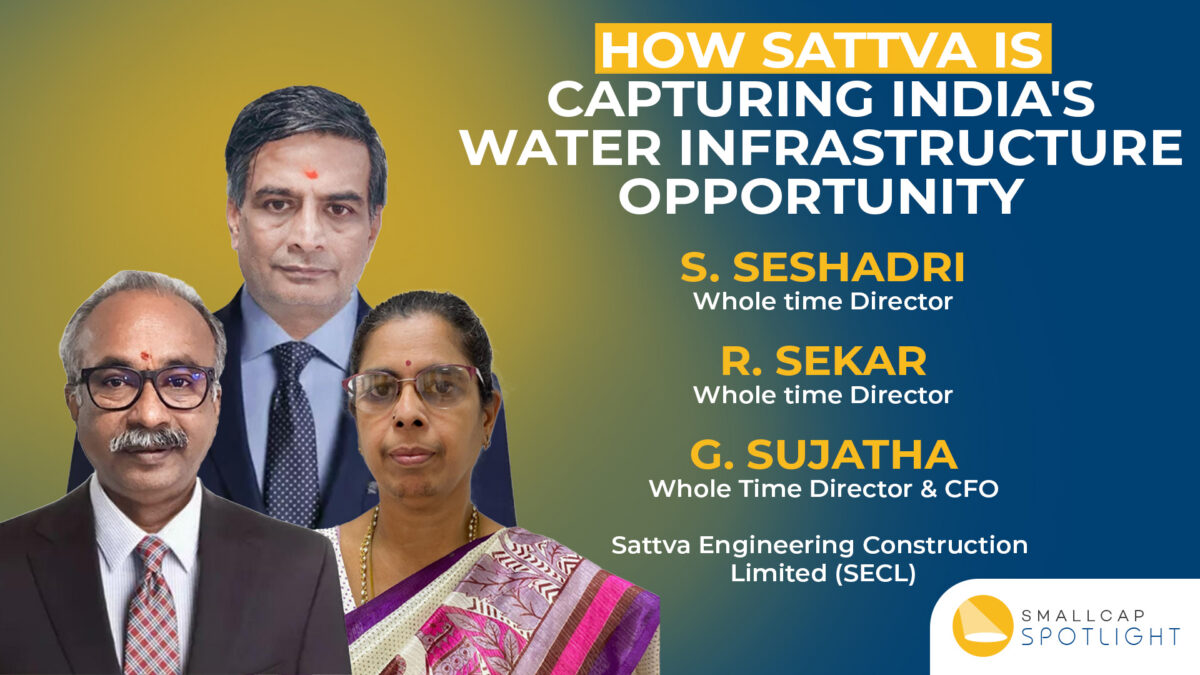
Sattva Engineering Construction Ltd. discussed its growth strategy centred on water and wastewater infrastructure, supported by geographic expansion, a growing order book, and emerging opportunities in odour control systems. The management also highlighted its disciplined approach to project execution, working capital management, and sustainable long-term growth.
Mubina Kapasi: Hello everyone and welcome to SmallCap Spotlight. I am Mubina Kapasi and today we have with us a company that’s in the business of EPC and focusses around water infrastructure, Sattva Engineering Construction Limited. I have with me the management, Mr. Seshadri, who is a Whole-Time Director, Mr. Sekar, Whole-Time Director and Mrs. G. Sujatha, Whole-Time Director and the Chief Financial Officer.
Thank you so much for joining us today. Mr. Seshadri, to begin with, if I could ask you to explain what the company does, the key services it provides and what have been the key milestones since the 20-odd years that the company has been in existence? How has the company evolved over the last few years?
S. Seshadri: We, Sattva, established in 2005 with focus on water infrastructure projects in Tamil Nadu. Over the years, we are evolving to the integrated EPC player across water, waste water, infrastructure, including water supply, sewage systems, sewage treatment plants, water treatment plants and operational maintenance.
Successfully delivered 50 plus projects and executed infrastructure projects worth over 500 crores. The key milestone of listing NSE in 2005, which marked the beginning of new growth phase for the company. Today, we are expanding into a new geographics into Karnataka and strengthening our presence across water infrastructure value chain.
Mubina Kapasi: Could you tell us a little bit about your own personal journey? I mean, were you always in this business and what motivated you to start Satva Engineering?
S. Seshadri: No, Sattva Engineering was established in the objects of building the company focused on quality infrastructure exhibitions. Over the years, we have expanded from water supply projects to the broader portfolio covering water and wastewater infrastructure. Scaling the business required continued investments in people, capabilities and system.
Our growth has been guided by three core principles, execution, excellence, financial discipline and customer trust.
Mubina Kapasi: You know, sir, I mean, I think what’s important to understand here that we are at a critical juncture, India at least is at a critical juncture when it comes to water. There is scarcity, there is, of course, focus on sanitation infrastructure, there is a lot happening on urban development.
So how do you see this growth opportunity for water and the sewerage sector? And how are you positioning Sattva then?
S. Seshadri: No, see, the focus today is no longer just supplying water as water is about creating complete water and wastewater infrastructure ecosystems. Cities increasingly investing in sewage networks, sewage treatment plant, water treatment plant, reuse and environmental compliances. This expanding the opportunity beyond the traditional water supply project into multiple related segments.
The position useful to address broader range of opportunities as urban infrastructure continues to develop.
Mubina Kapasi: So keeping that in mind, how do you see Sattva, let’s say in the next five to 10 years, how do you see the company involved? And also, what is your vision in terms of the services that Sattva provides or also maybe in terms of the financial profile, any goals that you have, long term goals for the company?
S.Seshadri: Yeah, obviously, our focus is building Sattva into a larger and more diversified infrastructure company with water and wastewater management remaining as its core. In near term, we are focused to executing our growing order book and scaling newer business segments such as WTP, O&M and water control systems.
We are also expanding our geographic presence with Karnataka being the important steps into our journey. Our growth plan for financial year 27, 28 are centred discipline execution, operational excellence and sustainable scaling. Over the long term, we aspire to be recognised as a traditional infrastructure partner with capabilities across the water and wastewater value chain.
Mubina Kapasi: Mr. Sekhar, I’d like to ask you the next question from a competitive point of view, because look, there are other EPC players, not just in water infrastructure, but in general in civil construction. So I’d like to understand what gives Sattva the edge and how are you competing and ensuring that your growth trajectory remains?
R. Sekar: See, we as Sattva having got extensive experience for more than 20-25 years in the execution of projects in the line of water, wastewater and construction business. So we focus our growth only in this area.
We don’t, you know, like EPC contractors always work in all the segments. So we, you know, set our goal to the segments where we have extensive experience, which is built for more than 20 and odd years, like water and wastewater and construction works related to this. So we also, you know, diversify related to this, like O&M and other areas like water control.
So we always keep ourselves, you know, steady in the area where our expertise is strong. So we don’t, you know, plan, you know, to diversify or put all our hands in the places where all larger places are doing that. Okay.
So we measure and do our projects. Also we ensure our projects are funded and money is ensured. That’s how we plan our strategy.
Mubina Kapasi: Are there any plans to, you know, go beyond water infrastructure and perhaps look at some other areas as well?
R. Sekar: So not immediately, but we restricted, you know, to the related works, like the segments of O&M and then the water control systems. And also we are planning to, you know, set our goal towards the industrial sector and utilities slowly. All right.
Mubina Kapasi: Understood. Let’s also understand a little bit on what exactly is your plan to leverage some of these government schemes, because there is this national water mission, there’s Jal Jeevan, there’s Amrut. Is that something that’s helping you also expand your order book? Is that helping you secure more projects? Could you tell us a bit about how government initiatives has helped grow your order book?
R. Sekar: See, as you all are aware, Jal Jeevan, even the recently central government has released the projects of more than 70,000 crores, which was under pool.
So pan India, the opportunities are growing and, you know, the road is very long and wide. So we will concentrate in the area of the projects where our expertise is strong, like water, wastewater and related works, like, as I mentioned, O&M and water control. The water control is an emerging business in the country.
Okay. As a separate package, also now the recent, you know, the new projects which are being floated for, I mean, STP and wastewater treatment for always added the water control unit also nowadays. So we find a good market in this.
Okay. So whether it comes to Jal Jeevan or Amrut, so we ensure the funds are placed for all the projects we target. And we also focus on the areas where our expertise is strong, like wastewater treatment plant, water treatment plant, waterline distribution, networking, construction of all those things.
That’s how we strategise.
Mubina Kapasi: Could you tell us a little bit about, you know, working capital? Today, every small business we speak with, they say working capital is something, the management of that is always tough. And you being an EPC player, I imagine it’s tougher, you know, you have these execution timelines to meet.
And then, obviously, because you work a lot with municipalities, state governments, etc., they have certain timelines. So how do you manage this very difficult task of working capital management?
R. Sekar: Yeah, it’s a good question when it comes to this realisation of funds, the working capital. So as I said, we ensure that we are, you know, quoting the projects which are already funded.
So we ensure that the day we get the order, we draw a schedule, which is realistic in line with the contractual obligations and ensure it is delivered on time, or at least we will try to compress the time schedule at least by, you know, five to six months so that at least you will end up with the contractual period. And we ensure the billing cycle is properly drawn and ensure the bills are made on time, irrespective of the difficulties we get on, you know, field. And we have a separate team for collections.
We have a separate team to coordinate the projects, which ensures the timely completion and, you know, timely submission of bills and collection. So we ensure funds are collected on time so that our cash flow is maintained broadly in a realistic way.
Mubina Kapasi: Mrs. Sujatha, I’d like to ask you about expansion because I think right now you’re primarily catering to Tamil Nadu and Karnataka.
So are there any plans to, you know, cater to other markets across India?
G.Sujatha: Yeah, mainly we focus on Tamil Nadu. Basically, our core business is on Tamil Nadu and Tamil Nadu itself is a big market, in fact. And now we have stepped into Karnataka as a geographical expansion and all.
And further to that, we may expand to the other states also in the nearest future. That also we are just trying to explore. And it may be a next step ahead like that.
Okay. And we want to be very choosy on taking up projects in other areas also. So we are very cautiously taking up.
Mubina Kapasi: Any reason for that? Because I mean, see, like we were saying, right, that there are a lot of big EPC players and you obviously do want to maybe compete with them. So any reason why we are being choosy and what are the factors we are looking at?
G.Sujatha: Yeah, we wanted to ensure that whether it is a funded project or the funding agency and that we are moving to the new geographical areas. So we wanted to be a little bit cautious in moving there.
It is not just like that we want to have immediately jump into a pan-India presence like that. We wanted to move in a structured way and so that it will be a sustainable one.
Mubina Kapasi: Got it. Fair enough. All right. I would like to know a little bit about your order book.
What’s the order book right now and how do you see it growing? What’s the revenue visibility like?
G.Sujatha: Yeah, as on 31st March, we had an order book close to 323 crores. And after that, we have taken up some new orders in Karnataka as well as in Tamil Nadu also. And at present, by the mid of June, our order book position stands at 553 crores.
And which is to be catered in the next 24 to 30 months. And so there is a good visibility for the revenue. For the next two years, revenue growth is there.
We have got visibility on that.
Mubina Kapasi: All right. Okay. I’d like to know a little bit about the market product that Sir spoke about and that’s order control systems. It’s relatively a new business segment for the company as well. Could you tell us a bit about the opportunity you’re seeing over there?
G. Sujatha: Yes. Recently, already we have taken one project in Bangalore in that order control system for 4 crores and another project in Chennai, Chennai Metro, which is covering around 46 locations. And for around 40 crores, we have taken up the order. And in the nearest future, this business will grow.
And see, order control will be a part of the future STPs and as well as future pumping stations. And many of the pumping stations, earlier built pumping stations also, is getting revamped with this order control system. As per the environmental norms, there should not be any foul smell like that at all.
For that, this equipment helps us in removing the foul smells. So, as per the environmental norms also, in every municipality or every government agency has to comply with that. So, it is a good emerging business.
And with that, we will be having more orders and more revenues will be there. And that order control is also backed with some operation, O&M portion is also there. So, we will have a sustained revenue with related to that area also.
Mubina Kapasi: Okay. Okay. That’s definitely very promising.
So, you’re entering, I mean, you’ve entered Karnataka with this order control is a relatively new segment. Now, you have, of course, an employee base of, I think, more than 100 people. What I’d like to know is a little bit about the team that’s working with you.
Not just the professionals who are on ground with the execution and engineering, but also the leadership team, because you have certain goals that you would like to achieve. So, who’s helping you and how are you expanding your talent base?
G. Sujatha: So, actually, both the directors are technically qualified and they are into the business for more than three, four decades. And with their advice, and also we have got other directors on board who are independent directors with vast industry experience.
And they are also guiding us and some of our advisors are there to guide us on financial side as well as on the technical side also. So, with their guidance, we are growing up. So, I think we can achieve our targets and everything and we can grow in a better and sustained manner with all this infrastructure and with the guidance of these experienced people.
With that, we are all done.
Mubina Kapasi: Thank you so much for your time in talking to us about Sattva Engineering Construction and we wish you all the very best. Well, there you have it.
That’s the management of the company. Don’t forget that this is not to be construed as investment advice. Please conduct your own research before making any investment decisions.
Thank you so much for watching SmallCap Spotlight and don’t forget to hit subscribe on our YouTube channel. We’ll be back with more such company interviews.