
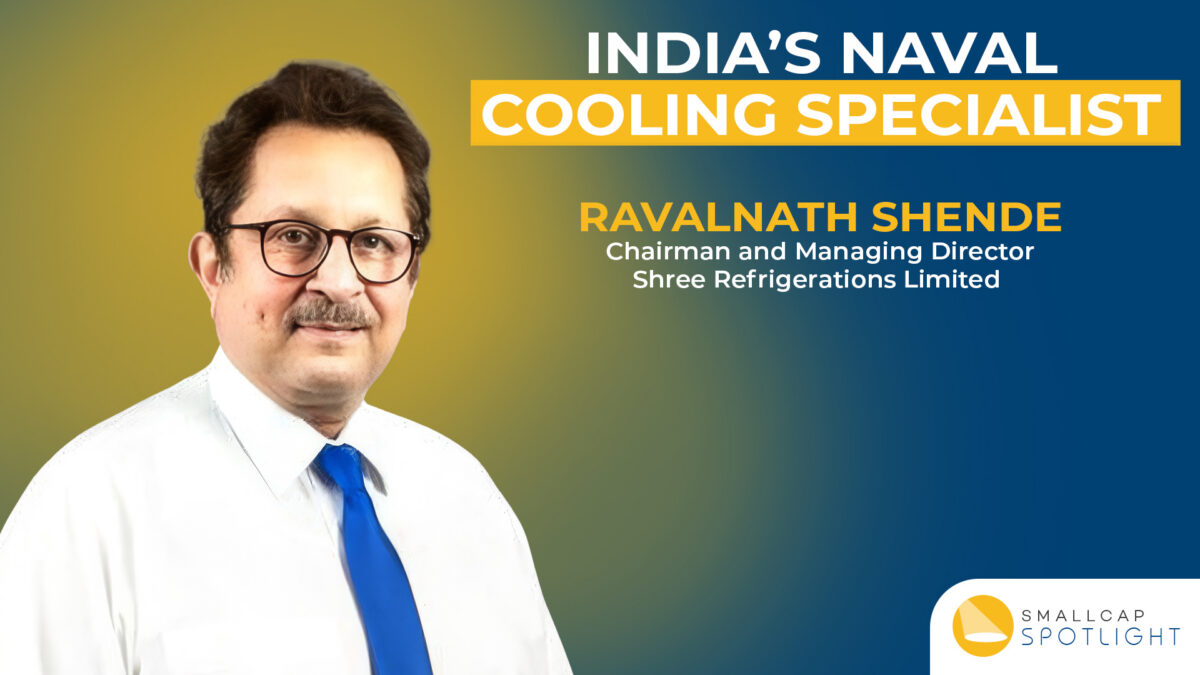
Ravalnath Shende, Chairman & MD, Shree Refrigerations Limited (SRL), highlights the company’s specialised HVAC and refrigeration solutions for Indian naval warships and submarines, backed by high entry barriers and in-house technical capabilities. He also discusses the company’s growth outlook and expansion into data centre cooling.
Karunya Rao: Hello and welcome to SmallCap Spotlight. My name is Karunya and today we’re being joined by the management of Shree Refrigerations Limited. I have with me the chairman and managing director of the company, Mr. Ravalnath Shende.
Hi, Mr. Shende, thank you so much for joining us.
Ravalnath Shende: Namaskar. Thank you for getting me on this platform.
Karunya Rao: Welcome. So first things first, you know, your company is essentially a defence-focused HVAC and refrigeration systems maker. Tell us exactly what is it that you do, how are you serving the defence-focused segment and how did the company come about?
Ravalnath Shende: Well, what we do is essentially we take care of air conditioning of Indian naval warships and submarines as well as the food refrigeration requirement.
So how we came into this is a long story, but essentially what we do is we make the chillers that produce the chilled water, which are generally based in the lower deck of a warship. Then we take care of the piping and heat exchanger units that use the cold water to do the air conditioning inside a warship, something similar to your five-star hotels. And then when the chilled water comes back, it is cooled again and recirculated.
How it is different from a conventional air conditioning is conventional air conditioning, the whole equipment is steady, it doesn’t move. Warship is subject to movement quite a lot, is expected to undergo shocks during the course of its operation. So the equipment has to be that much more rugged, that much more reliable, because you don’t get a next-door service guy to come to you when you’re like 3,000 miles out in the high sea.
So the equipment reliability has to be that much more. More importantly, since the modern warfare is more about electronics. So what happens is electronics generate a lot of and that needs to be air conditioned or cooled.
Electronics not performing would suddenly make the ship visible to most of the enemy countermeasures, being enemy radars and the countermeasures will become unavailable. So air conditioning on a warship or a submarine, of course, definitely a must. And this is a high critical area where reliability, the goodness, plus the equipment has to pass through a whole lot of military grade tests and trials.
And the entry barriers to that extent were very high. We were back in 2012, saw this as an opportunity because only a very handful, very limited number of players were operating in the segment. Multinationals, large Indian corporates.
And it was kind of closed door competition. So we thought there is an opportunity for an OEM who will be able to offer a compatible equipment at a competitive price, being SMU has certain advantages. But the commitment required to crack that code of getting into the exclusive club of naval HVAC supplier was highly demanding.
But I think that would be coming in the latter part of the questions. So we do air conditioning. To summarise, we do air conditioning for warships and submarines and also the food refrigeration units.
Karunya Rao: Submarines, again, is an entirely different ballgame because you are in a highly congested space where you fight with the shipbuilder for every centimetre. And your equipment again has to be that much more reliable to operate. So many feet, so many metres under the sea.
So your client base is largely the defence services, the Indian government directly or do you supply to companies and OEMs who make these submarines and who build these systems?
Ravalnath Shende: Actually, good question. When we say it’s a naval air conditioning, the customer base is generally multifold. The first one is the new builds, which are built by shipyards.
So we supply to the shipyard. Only the limited companies who are nominated by the Navy. And this nomination is a very important vote for my company because we are the company, the company, only company, which is nominated by three different directorates of Indian Navy, Directorate of Marine Engineering, Directorate of Naval Architecture.
This is for AC plants and air conditioning. And the Directorate of Electrical Engineering so that we can make our own control panels for our equipment. So these registrations are a must.
There are three ways we service this requirement. One is, as I told you, new builds to the shipyards where the government orders on the shipyard and the shipyard comes up with our equipment for air conditioning, refrigeration, etc. That is a new build.
Sometimes the equipment on the old warships is upgraded with the new technology, which I’ll come to my presentation in the second half, is where we work with the naval dockyards. The Indian Navy runs ship maintenance and repair facilities. Sometimes this repair and maintenance is also handed over to the private dockyard ship.
And PSU shipyards also. These are the two main customers that we are servicing today. Very rarely we service some subcontract requirement or subcomponent level requirement from suppliers to the shipyards and dockyards, which is some very critical niche technical equipment, which is a small part of a huge complicated equipment.
So we are not registered for the entire equipment, but we can still supply the component level equipment, which is again built to the naval standards. So again, the process is the same. The new builds, the repairs, the subcomponents, and the last and most important is the service and spares.
The equipment that we supply has to be serviced by us. The equipment that we supply needs to be stocked with enough spares by the Navy and the shipyards and the dockyards. So this is how we, when we say Indian Navy, it’s like multiple customers built within the Navy.
Karunya Rao: Okay. You know, as you mentioned, the space you operate in has very high entry barriers and talk to us about how the company has evolved. What were the big milestones that transformed you into a trusted partner for India’s strategic defence sector? What was the turning point or a big milestone that you would like to highlight for us?
Ravalnath Shende: Actually, it has been a very interesting journey.
Going a little backward from your question, I did my graduation from VZTI in Mumbai. I did a year with Atlanti and another six years with Kirloskar, where we used to make compressors. And that was between 1983 graduate to 1990, where Shree Refrigeration got started.
And we went on doing domestic air conditioners, which was a high-margin business at that point of time, but that was not going to be there for long. So Sri as a company always tries to reinvent itself every five years. So then we went into supplying milk chilling system to the dairies and the companies like Alpha Level.
We started making chillers for printing industry through OEMs. And this business was highly seasonal. It used to vary with the market sentiments.
Like, if the newspaper is not selling, we won’t get the order for the newspaper. If the milk has imported powder, we won’t get the order for that. That kind of purpose there.
So we also, being technically skilled, level above the rest of the pack, we used to make testing equipment for compressors and air conditioners. The energy labelling that you see on your air conditioner or your refrigerator is done after testing in the equipment supplied by us. So this critical refrigeration technology had the potential to get deployed somewhere.
And the best opportunity I saw was in 2012, an opportunity which was looking at everyone, that Indian naval requirement is going to grow up and there is a dearth of qualified firms who can take up the new and new technical challenges and come true to the expectations of the customer that is Indian Navy. So in 2012, we started our entry into the naval segment with a decent confidence. I used to have a favourite two line catch for my team.
What they can do, we can do better. They is the competition. And then what you can write is I can make.
That comes to the naval tender specification. You say equipment has to pass through A, B, C and D test. We will make sure that the design is incorporating all the requirements which will make the equipment pass the necessary tests.
So these are the two critical things because Navy gives you a whole list of standards to which the equipment is to be built. Even more detailed list of the standards to which the equipment is to be tested. Once before dispatch before that every equipment has to go through something called a strife test, which is like a thorough ragda.
Every equipment has to go through, first equipment has to go through tilt, shock, noise, vibration, emission, everything. And we had the technical wherewithal to handle this kind of scenarios. So from well, the players in your industry also would be going through very high levels of checks and balances and R&D and tech processes.
Karunya Rao: So what is setting Shree Refrigerations apart? What are you doing differently or what gives you the edge over peers?
Ravalnath Shende: Perfect. So the peers would be like only limited to two or three companies before we entered into the market. The entry barriers were high, they continue to be high, very, very high today, even more so.
So what we did differently was we created capacity first. We demonstrated our technology first. Like and we took what you would call in a conventional language, build the cat.
When the Scorpene submarine air conditioning systems were to be degenerated, we were the ones who raised our hand. Oh, come on, we can handle that. It needs a very steep tilt test.
It needs a very strenuous shock test. It needs to pass through a lot of vibration, EMI, EMC test. This is the most challenging platform.
Power supply in submarine is also very challenging because it’s a DC and your compressor runs on AC. So you need to put a small AC-DC converter within a 400 by 400 or smaller kind of panels that may be required. These are all technical challenges and my company said, yes, we will do it.
It went on to the level when we sign a contract with the Navy. It invariably includes a risk purchase clause. If we are not able to supply, Navy will buy globally and we pay the difference in the price kind of story.
But I had my confidence in my team. The same story, if you can write it, I can make it. What they can do, we can do better.
So we took the challenge and we delivered the air conditioners to the Scorpene submarines, passed all the tests. It went to a level that the last of the Scorpene submarines is completely fitted with refrigeration equipment as an OEM equipment. And now we are in the process of replacing the old imported air conditioners on the Scorpene submarines.
So this is what differentiates Sri. We are able to take up the challenge, meet the expectations and make a business out of it. The second case was when Navy was looking to upgrade the compressor technology on a chiller system, which conventional screw compressors.
They use a lot of oil for lubrication and this oil causes subsequent degradation in the chiller performance. It gets coated on the heat exchanger surfaces, the compressor equipment wearouts and efficiency drops. Oil not coming back to the compressor can cause a lot of failures.
Oil management becomes another technical challenge. So Navy were looking at inducting oil-free compressor technology, which is a magnetic bearing levitation compressor. So there is no metal to metal contact, so there is no oil.
The efficiencies are much better. But the challenge was only two or three companies in the world were having this technology as a compressor. One of them was a competitor who had proven the technology on board of our ship.
And Navy wanted that we participate in the technical challenge and prove with the help of another OEM called Danfoss Turbocore, who makes the compressor only. So we built a case and said, okay, sir, we will do it. Just tell us a ship where we need to instal this equipment so that we can prove the performance of my equipment, my technology.
Navy was gracious enough to give us this opportunity and we make it happen. We installed an equipment on a warship, which was used almost one year before they got us permission to compete in the tender. And then after six, seven years, when the ship went into refit, that equipment was serving perfectly well.
So we, in a part, had contributed in upgrading a particular technology in the naval segment. Again, the same story, what differentiates me from my colleagues, from my companies in this same segment, most companies refuse this opportunity. We will not participate in the demonstration.
And the result is only two companies left in the competition. We won the contract, handsome 150 crore contract, beating a multinational in the process. And that transformed the company big time.
It was our willingness to accept challenges. Because our confidence in our technical skillset, it was in our confidence in developing required electronic subsystems, maybe equipment management, shock noise, vibration, and our in-house testing capability, which is unique. That differentiates us actually.
And this differentiation sees in the market size.
Karunya Rao: Yeah, so I’m also curious to understand, you know, like many of our viewers, even I’m not an industry insider. So I would like to understand this better.
What is the product cycle or the life cycle? You know, you, you do you create a product, you deliver, then what happens after that? How is the maintenance happens? How often do you have to upgrade these systems or change them? Because obviously, you know, because your client is purely concentrated in the defence services space in the naval space, we want to understand how often are new orders placed? And how does your revenue really work your revenue cycle?
Ravalnath Shende: And actually a great question. Thank you for this opportunity. The revenue stream for my company comes from three different channels.
First is the fresh equipment that gets installed on the warship under construction. Second is an equipment to be installed on an existing warship by removing old equipment. And the third is doing service and commissioning and sales and support for the equipment that my company has installed on board the warships.
These are the three streams. And in terms of life cycle, when the government issues an RFQ to a ship builder, they issue a back to back RFQ for the component level. And then we participate in the tender, like depending upon the complexity of the platform, it takes anywhere between eight months to one year when we start supplying the equipment after winning the contract.
Depending upon the number of ships in that contract, it goes on for like one year, two years, two and a half years. Now since we are participating in all the three tenders, our work schedule gets that much more extended. Like we do supply air, like in the case of the latest contract with fleet support ship being constructed in Hindustan shipyard.
It’s a big ship which carries the fuel, ammunition, food for the entire flotilla. So since we are doing all the three, our work will continue to go with. And after supplying the equipment, we have to demonstrate it to the Navy on board.
We have to demonstrate it through the harbour acceptance trials, sea acceptance trials, and then it gets handed over to the Navy. So this is one product cycle. Second is a retrofit where we take out the old equipment, instal a new equipment.
That is pretty quick because the rest of the infrastructure is already in place. We just have to remove and demonstrate. And these two things, and thanks to the current geopolitical scenario, the current government’s focus on between India and Atmanirbhar Bharat.
We see a lot, all this information of course, nothing secret. It’s available on the internet for one to see how many new platforms are getting built, how many new acceptance of necessity, a document approves the requirement from a service arm that I need so many of this type, so many of this type. I need so many frigates, so many destroyers, so many aircraft carriers, so many submarines, so many platform support ships, everything.
So we see the main advantage of coming into this business was a long-term visibility. Today with the names of the project, I can tell you what the Indian Navy is going to manufacture for the next five years. So we have a clear cut idea on the total addressable market.
We have a clear cut idea on SWOT analysis of ours vis-a-vis our competitors and being a more nimble, more dynamic organisation. We keep acquiring latest technology. We keep doing upgrades to our own equipment internally so that we retain our competitive edge.
And more importantly, we are the company which believes in making everything in-house. Like my dream in my company is sheet metal in and final product out. We make our own fabrication, paint it within our own new factory.
Then we do control panels on our own. We do heat exchangers on our own and then we do assemblies on our own. Test it in an equipment which is again made by us.
So all this puts us in a total control of the QCD, quality, cost and delivery, which enables us to retain our competitive edge. That was your main question. It helps us improve our presence in the market in terms of market share.
That simultaneously improves our buying from the market which gives us a buying advantage. And it keeps my team busy, trained and ready for the new challenges.
Karunya Rao: Interesting.
Talk to us about the investments you’re making in R&D. You said you have visibility for the next five years of how the naval services requirements will shape up. So keeping that in mind, what is the kind of investments you’re making in tech, upgradation in R&D and other such areas?
Ravalnath Shende: Thanks to the recent IPO that we concluded in 1st August 2025, we have gone on to build our new 50,000 square feet set of that factory which has all the CNC sheet metal equipment.
We have got a robotic building set up, our own paint shop, our own heat exchanger shop. And the research and development today, I’m sorry, I’ll not be able to dive in much on that. But if we were not a research and development orientated company, we would not have been here talking to you today.
We developed the Scorpene sub-burden air conditioners, we developed the oil frame magnetic bearing compressor based chiller. And the newer and newer challenges are being thrown at us by the Navy or the market. And my company is all set and all geared up to meet those challenges like very large capacity refrigeration plants with screw compressor or something which only we, my company, offered it to the Navy.
So we did a lot of back-end work on that. We did a lot of consultation with the OEMs. We did a lot of validation internally.
We have a complete 3D modelling software-based component selection designing. So what I say is what we can build in a computer is what we actually build in the ground. So R&D has been one very important initiative.
Of course, the naval R&D requirements are slightly different. Navy does not give you a lot of credit for energy efficiency because the generators are already up and running. So that does not sell much.
What sells more in Navy is reliability. I was the one who took a Danfoss turbo compressor and made it pass all the naval grade tests first time in India. And my research and development technical skillset was so strong that today Sri Refrigeration is an authorised service partner for Danfoss turbo to repair compressors in India.
There are only a handful of such establishments where Danfoss entrusts somebody to repair that technically complex compressor. We have signed an agreement with Danfoss and any compressor that fails either in the naval or in the land-based application, it has to come to us for repairs. So that’s the kind of R&D, that’s the kind of strength.
And we are making the equipment on which the compressor is going to get tested. We are not buying anything from Danfoss and put a compressor and test it. We will build our own equipment which we can run a compressor without being installed on a chiller, monitor all the performance, make a corrective action, revalidate the performance and give it back to the customer with a seal and now this is repaired and it’s good.
So this is the strength of R&D. In terms of budget, it’s good.
Karunya Rao: Since you can’t reveal that, can you tell us a bit about your core team? What is the kind of talent that’s working on such critical projects? Who are the key people, key personnel running the show apart from you?
Ravalnath Shende: Apart from me, I’ve been very lucky to be blessed with my family supporting me in this endeavour.
All of them are engineers, like my wife takes care of the operations. I keep travelling a lot. Two of my daughters, one has done MS in business management from Glasgow.
She’s taking care of the sales and marketing side of the business. The younger one, having done post-graduation in thermal management from New York University, is a heating ventilation design expert, who has recently said bye-bye America and joined my company as a head of HVAC design. That’s my core team.
Like if I’m operating in the naval segment, I have a very powerful team of ex-naval officers who have retired at different grades in the service. They work with us and they take that because you want to work with Navy. Navy has a different lingo.
Navy has a different way of operation. The ship operating conditions are very different than the land-based conditions. So I take a land-based guy and put him on board a ship to do something.
I’m setting him up for a failure. So I harvest a lot of retired naval engineers, retired naval master chiefs, retired naval commanders and a full lot of team that takes care of my naval business. In terms of technical team, we have been building a very strong team.
This team is capable of creating a hermetic compressor test equipment, which is like one out of three companies, maybe globally three or four companies. Some interesting product my R&D team has developed is a cabin leakage tester. We being the only company in India who can supply this, which enables the car manufacturer to exactly quantify the car, the air inside the car leaking out of the air getting into the car, depending upon the temperature settings.
And that increases the efficiency of the heating and cooling system. It’s a very complex software-based system, but my team is able to do that. Names don’t matter, you see.
Karunya Rao: Interesting. Talk to us also about the outlook for business. You said you have a good visibility from the naval services with respect to order inflow.
So tell us in the next three to five years, what are the big targets or goals that the company has set for itself? Or what is the run rate you expect to deliver in terms of top line or in terms of bottom line? Because your investors, you know, who’ve signed up for your, who had signed up for your IPO and who continue to remain invested in your company, what are the key metrics they should be watching out for in terms of performance and in terms of from an investor standpoint?
Ravalnath Shende: This is sensitive information, but I’ll stick with what we have already published on the stock exchange website. One is we are giving a guidance for 40% CAGR growth over the next three to four years. That is backed up by the order book that we have.
That is backed up by the pipeline we are looking at. That is backed up by the team’s confidence of winning that many orders to support. Because last year we did 150 odd crores of top line.
This year we end up in doing 220, 220 pipeline. So this 40% CAGR is what we expect to continue to grow. And now we are deploying the same oil-free compressor technology on land-based applications.
And the next big business segment for Sri is the data centre cooling. Okay. And data centre needs a lot of cooling.
A lot of data centres are coming into India, sheer numbers are in gigawatts. Like when I say I make a big refrigeration chiller for Navy, it is like less than one kilowatt. Sorry, less than one megawatt.
Here we are talking is five gigawatts, three gigawatts, two gigawatts. It needs a lot of chiller because in a data centre, you put in a lot of energy to do the calculations. By the law of thermodynamics, what energy goes in has to come out.
You cannot destroy the energy. You may use a chip to do 10 billion calculations. That power taken by the chip has to finally get out as a heat.
Karunya Rao: Have you already signed on any deals in this space? I’m coming to that. What we are trying to do is
What we are trying to do is introduce the same oil-free compressor technology, which is more energy efficient, more reliable with built-in redundancy, a whole lot of challenges, but it comes with a small premium on the basic price. So here we are trying to do a concept selling in India. Globally, it’s an accepted technology.
So we have partnered with a Canadian company called Smart, it’s an ARDT killer company. They have got six factories globally, and we are their partners here in India. I was already started making, we signed an agreement officially with them for agency agreement.
Now we are meeting the data centre customers trying to sell. The challenge is we need to get this technology in the data centre in the early design stages because this compressor enables data centre companies to technically size their electrical subsystems correctly for a low power guzzling chiller. My chiller draws less power, so it needs less current, so it needs lower equipment upstream for the power supply, which actually combines the savings.
But if the equipment is already selected and I’m trying to sell something more, it’s like trying to fit a slim fit guy in a 48 waist pant, so it doesn’t sell. So we are trying to do that, hope to sign our first deal very quickly. We are in touch with a whole lot of data centre, basically colos, and we are confident because we as a company always enter into a business where we have a reasonable confidence of getting into the top three, top four suppliers in that area, because otherwise people won’t buy from us.
Karunya Rao: And capacity wise, you’re ready or you need to amp up capacity?
Ravalnath Shende: Capacity like we are in terms of data centre air conditioners, we are presently going to import it from the collaborators factory and instal and commissioning is to be done. That installation commissioning infrastructure is my company’s is the biggest. Luckily, because my naval team, which is expert in handling all pre-magnetic bathing compressors, is located in areas where the data centres are coming.
Because the ships have to land and the data cable also has to land. So the focus is in Navi Mumbai, Vizag, where my team is already present. Both of them come from abroad, to sea.
International data cable lands in some place, the ships also luckily land at the same place. So we have a team of trained engineers who can handle a complex technology right there, waiting for an opportunity to rise. And that’s our single biggest mode in this segment.
That’s why a company like SMART, who are global leaders, have partnered with Shree Refrigerations.
Karunya Rao: That’s an interesting point that you highlighted for us as well. Thank you so much, Mr. Shinde, once again for talking to us in such great detail about what the company has been doing and what the future looks like for Shree Refrigerations.
It was great having you with us on the show.
Ravalnath Shende: Thank you. As a parting shot, I can tell you if all the SME entrepreneurs that may be listening to this podcast or this Q&A, today India is poised at one of its biggest industrial leap time.
2047, the date announced by the Prime Minister to make India in the top three nations in the world, requires a whole lot of manufacturing to happen, a whole lot of enterprise to come. And the government is making a whole lot of effort to make the infrastructures where you can, an entrepreneur with an idea is not left short of anything. So anything that stops you and your real dream, imagination, like Robin Sharma says, everything is created twice, once in the mind and then in the reality.
I always thought my company to be a leading supplier of HVAC equipment in my mind, then in reality. I always thought my company to be having a fantastic 70,000 square feet of factory in the mind and then in reality. So all the SME entrepreneurs really need to tighten their act and come forward to meet the challenges offered by the, and the growth opportunities offered by the government’s new expansion plan.
It’s like now or never kind of scenario and is a great potential for Indian entrepreneurs to really come, showcase their technical strength, which I know there’s a plenty. Just they have to imagine that they will contribute big time into this new push and make the country rich and great. Thank you.
Karunya Rao: Great. Thank you once again for joining. Thank you.
Ravalnath Shende: Thanks a lot. Bye.