
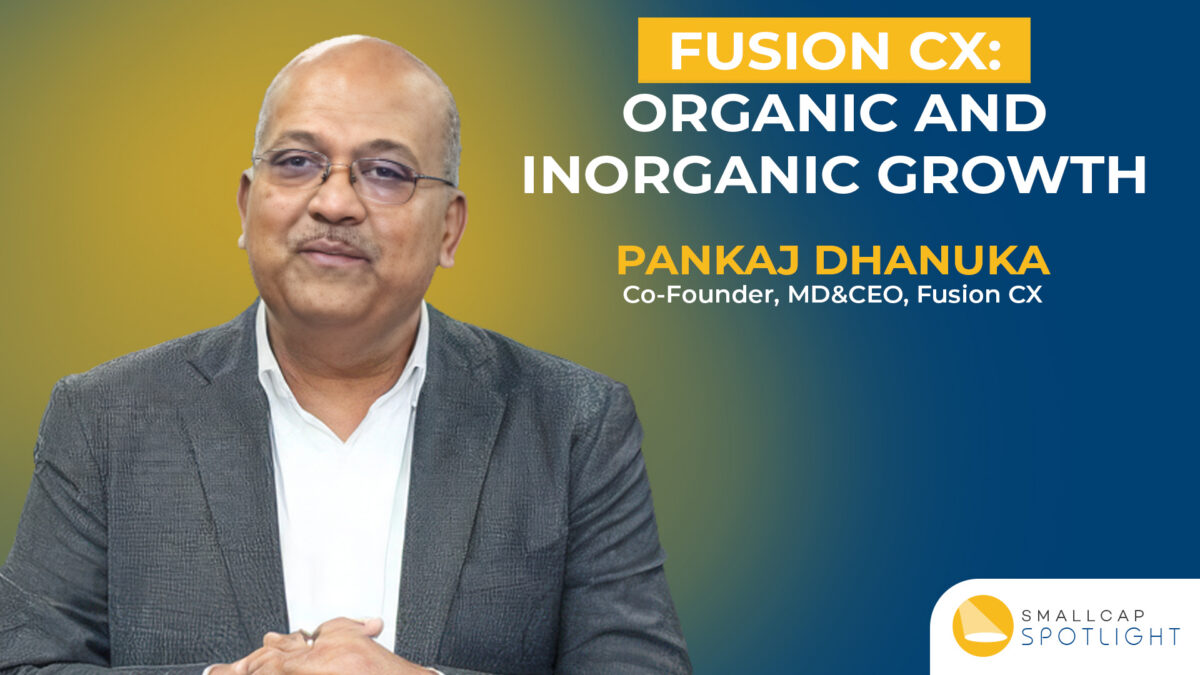
Pankaj Dhanuka, Co-founder, MD & CEO, Fusion CX, outlined the company’s evolution into a global CX player, highlighting its presence across 13 countries and focus on in-house AI solutions. He also discussed the company’s acquisition-led and organic growth strategy, along with efforts to improve operational efficiency and employee engagement.
Karunya Rao: Hello and welcome to SmallCap Spotlight. I’m Karunya and today we will be chatting with the management of Fusion CX Ltd. Now, the company was previously known as Fusion BPO Services.
It’s a BPO and customer experience solutions provider and today we’ll be chatting with the management, the co-founder, MD and CEO of the company, Mr. Dhanuka is joining us today on the show. Thank you so much for taking time out and chatting with us today.
Pankaj Dhanuka: Great, thank you Karunya for having me here.
Karunya Rao: It’s my pleasure. Alright, so Mr. Dhanuka, first things first, if you could talk to us about Fusion CX’s journey. The company was incorporated in 2004 as ExplorTech Services and then it evolved into becoming a global CX player.
You have a solid, you know, you’ve seen a solid revenue growth as well. So, give us a sense of how things began, how you evolved, what has been the growth trajectory like, what were the big milestones for you?
Pankaj Dhanuka: Absolutely Karunya, I love to do that. It’s been a passion going on for 22 years.
So, I along with Kishore, both of us similar background, chartered account and company secretary. After 10 years of job, we started this company from Calcutta in 2004. So, it’s been 22 years now.
So, in the initial days, we were only based in Calcutta and then we expanded. 2007 is our first expansion happened outside of Calcutta, when we bought a company in Canada. And since then, by way of acquiring a company which had operations in Canada and they had customers in the US.
So, that was our kind of a first major milestone if I say, in terms of becoming a global company. And since then, we have expanded in terms of, we have done a total of 15 acquisitions and that has taken us to many, many countries. And then through the journey, we also did organic expansion in terms of setting up new countries.
So, a total of eight new countries, we have set up operations starting with the first one in 2009 in Philippines. All this together, we are now present in 13 countries and having 15,000 people across these 13 countries. The countries we are present in, I’ll start from the East Philippines.
And Philippines, we are having four different locations. So, we are in the tier one city of Manila and Cebu. And then we have got tier two and tier three cities of Legaspi, Ceylon.
India, we are present in seven different locations. Then in Europe, we have operations in Albania, Kosovo. Northern in Africa, we are in Morocco, France, UK.
In the US and Americas, we have operations in Canada, US, Mexico, and Latin America. We have operations in El Salvador, Belize, Columbia, Jamaica. So, that is the global footprint we have.
The company continues to grow. 85% of our business comes from customers based in North America, that is US and Canada. Around 10% of the revenue comes from our customers in India and 5% from customers in Europe.
So, that has been the journey so far. It’s been a very exciting journey. As I mentioned in 2004, me and Kishore started this as a kind of a bootstrap company.
And then we have grown it to this level. And we continue to grow.
Karunya Rao: Okay, great.
You know, I also want to know a bit about your personal entrepreneurial journey, what inspired you to create this company in the BPO and CX space? What have been the most challenging moments when you were scaling up this pure play BPO vendor to a differentiated CX transformation partner? How did you exactly navigate the space?
Pankaj Dhanuka: Great. No, it’s a great question and love to go back to the journey. So, going back, as I said, me, I grew up in Calcutta, completed my education background, CA and company secretary in 1993.
And then I joined a job. My first job was in Mumbai with Unit Trust of India. Being from a business family background, there’s always a desire, okay, let’s go and get some experience in a big corporate, see how things work big and then do set up something of your own.
Obviously, time flew very, very fast. After four or five years with Unit Trust of India, I came back to Calcutta, again, job, worked in investment banking. And then the last company I worked with was a CFO of a software company.
In that company, I set up a call centre. That time, we used to still call it a call centre. And you know how call centre became BPO, BPO became CX.
So, I set up that company for that. I ran that company for around one and a half, two years. And then the realisation was coming so strong, okay, it’s already going to be 10 years.
And if I don’t jump into an entrepreneurship journey now, then maybe it will be too late. So, again, pulled in whatever savings I had. I still remember, between me and Kishore, we pulled in 85 lakh rupees to start this venture.
And that time, 85 lakh rupees was roughly around $200,000. Way back in 2004, the exchange rate was like that. And so, why this industry is, the simple answer is, because I had relevant experience of setting up a greenfield call centre project, and I ran it.
And this was a booming industry, because it was only seven to eight years since the outsourcing and call centre had come to India. And so, it was still on upward trend. It was a very new concept.
Not many such units were there, and a lot of people were experimenting it. Another factor was important why this industry was kind of a game was, that time there was a drastic change in the technology. Earlier, like even when the company I set up, where I was a CFO, we used to depend for international connectivity on a very complex thing called IPLC.
VUIP had just recently come. So, that made things simple. And the capital required for entry was much less, because we did not have that kind of a capital.
So, that were the kind of three factors which led me to kind of start this journey. And then, the rest is history. I still remember we made a business plan on a piece of paper sitting in a cafe.
And we thought, okay, this will be good if we achieve it in five years. And believe me, we achieved that in nine months. And then, rest, we kept on growing and kept on taking risk.
And so, that’s the kind of a good part of it. Now, obviously, every journey has the risk, has the down also. So, not very far in our journey.
So, 2004, March is when we started this company. And then, very soon, I think, must be 2008, Jan or Feb, we really hit a rock bottom. What happened is, 2007, we acquired a company which was four times our size.
This was a company which has operations across Atlantic Canada. And they had their customers and their management sitting in the US. It went very well.
Through that, we got some tier one customers like AT&T, Apple. But then, the front end operations in Canada, we did not have a clue. Because we came from India, we did not understand how the labour laws work.
We did not understand how you have to be particular from a payroll perspective. And in Jan, Feb, March, because of our oversight, or we are unable to know what’s happening, we suffered a massive loss. It was a big, big loss.
And it was just through our sheer determination and our sheer resolve, we came out of it. It took us around eight to nine months. So by December 2008, we were back.
We were able to overcome all the financial difficulties. We fixed all the problem, operational and other kind of manpower related issues in our operations in Canada. And that time, the Indian operations helped because they continued to make good money.
And those cash flows, we were able to use to deploy in Canada. And since then, there has been ups and downs. But those we were able to navigate ourselves relatively with less disruption.
But this one disruption of January, February still resonates in my mind very much. And yeah, so that will be the thing. Other than that, I think, as I mentioned, we continue to grow by way of expanding our global footprint, by way of setting up Greenfield projects, and also by making more acquisitions.
We have done 15 acquisitions across Philippines, India, Europe, Northern Africa, UK, Canada, US, and Latin America. So that’s been our journey.
Karunya Rao: Quite, quite interesting.
And it’s a very niche space to be in. And if I look at the wider ecosystem, the wider sector, you have competition from a lot of large players. There’s FastSource, which has 5,500 crores plus revenues and very strong growth, 19.8%. There’s eClerks, again, 2,500 crore plus revenues, they’ve clocked in.
There’s Agility, several other very, very large players who have been delivering good double digit growth. So what is it that really differentiates Fusion CX beyond your impressive revenue gaggle? I think it’s close to 24, 25% revenue gaggle. You’ve delivered 71.6% growth.
I saw your investor presentation as well. So apart from this solid run rate, tell us what, in terms of products, in terms of services, what is it that differentiates you from the existing peers?
Pankaj Dhanuka: Absolutely, no, very, I’d love to deliberate on that. So first of all, you chose all the right names, in terms of who are our peers from an Indian stock market perspective.
While we have a lot of other peers internationally, but yeah, if you look at the Indian listed peers, these are the four names. Maybe you can add one more name, Hinduja Global Services, but only part of their business is kind of common to us. They have a lot of other businesses within that listed entity.
So that’s, and keeping the number aside, and this year, we are trending at a revenue of around 2,500 crores, with the EBITDA of around 20% and a PAT of between 13 to 14%. Now, these are numbers and, but how, what is the, what are the four different differentiation we have? So the first differentiation is Karunya. We have a very high level of adoption of AI into our operations.
So across 13 countries, 15,000 people, we have five different products, which we have developed within our AI company. So unlike our other peers, our AI products are in-house developed and housed in a company which is separate, but all within the same management called oMind.ai. We have five different products, the first one being Mind Workplace, second one is AIQMS, third one is Voice, AI Voice and AI Chat, the fourth one is Accent Harmoniser, and the fifth one is Tranex. And I will talk about each one of them, a few lines to give a perspective of what they are.
These products have an adoption of between 30 to 700% in our space, and they bring in better productivity, better efficiency, more better quality of delivery to our customers, and also cost savings. From a cost saving perspective, around 60 to 70% cost savings we pass on to our customers to give them also the flavour of how AI is a benefit, and 30 to 40% we keep. And this has worked very well.
And being all in-house products, we have the flexibility to change it, flexibility to adopt it, flexibility to pivot it, based on how the technologies are changing. As you know, the base technologies of AI are changing so fast. So this is giving us the flexibility and the dynamism of adapting to the ever-changing need of the business.
In terms of these five products, the MWP is a tool which we use for recruitment and mapping the entire agent lifecycle. AIQMS is a 100% automated quality tool, which provides so many features like real-time feedback, voice of customer, and so on. AI voice and AI chat are where 100% of the transaction is handled by a machine.
Then Accent Harmoniser is a product where it helps you to modulate the voice of an agent to sound like the customer. If you’re talking to an American customer, it will sound like you are somebody who is living in the US. And it also comes with a noise cancellation.
So you don’t get a call centre environment when the customer is talking to you, you get more like a studio environment. Like the way we are talking now, there is no background noise. So it creates, leads to a better conversation, and better conversation is better customer satisfaction, and so many things improve.
And TrainX is an AI-driven automated training module through which you can train hundreds and thousands of agents using these modules and also personalise the training. Now, so this is one of the differentiation where our own in-house AI products are being used to improve service. Let’s talk about the second one.
The second one is our M&A engine. I talked about 15 companies we have acquired starting with the first one in 2007. Our M&A engine is unique because we are able to buy companies between 10 to 30 million, and we are able to put them into our platform within a six months time.
And because these companies are either suboptimal or they don’t have a kind of, a lot of these companies don’t have any profitability. So this helps us to not only grow our top line, but it helps us to also improve our bottom line. To give a perspective over the period, we have acquired 15 companies, and even this year, we are looking at acquiring two companies.
So when I told you about our revenue of 35%, around half of it, I will say more like 60% of it is coming because we have been able to constantly acquire these assets. So that is another differentiation and the acquisition and also the integration of those assets into our platform in a very fast and kind of a swift manner. The third differentiation I will talk about is our organic growth.
Till around FY25 and 26, we were struggling. Our organic growth was in 25, 6.2%. And FY26, it was 7.5%. This year, the current year, we are targeting organic growth of 15.6%. And next year, FY28, we are targeting organic revenue growth of 16%. This is backed by the new business that we won last year, that is FY26.
We signed up new contracts worth total contract value of 1200 crores and an ACV of 300 crores. And in the current year, till July, which is still like another 10 days for July to close, we already had a total contract value of 700 crores and ACV of annual contract value of 175 crores. So these tailwinds are taking us towards achieving more organic growth because the industry standard is something like 6 to 8%.
And some of the Indian peers which you talked about, they are growing organically at lower double digits. So with the work the team did over the years, now we will be in a position to overachieve, be better in terms of organic growth, starting from this current year. So after pandemic, huge amount of investment has gone into AI from a physical infrastructure perspective, like data centres, computing power, power centre.
And then another huge investment has gone into building the LLM models, like building the models which are creating these AIs. And the world realised some of the big frontier AI labs and all, these models need tonnes and tonnes of data. So last 18, 20 months, all the frontier labs and many other companies who have made these models, they need to feed data.
So, and this industry, which is known as AI data infrastructure is growing at around 40% per annum. And they will continue to grow the projections from many research firms and consultants, it will continue to grow till 1935 at around 40% per. So, and we were lucky because we had some legacy clients for whom we were doing this kind of work for last four years.
So we were able to use that as a base to grow this business. As present, we have got 22 customers in this space only. Interesting.
And that will continue to lead to alpha growth over the next two to three years time. Well, we will all look forward to how you achieve that. And thanks for laying out the plan.
But you know, beyond differentiation, I also want to talk about diversification. Now, if we look at your business, you’re currently operating across different sectors, there’s telecom utilities, BFSI retail, but telecom and utilities makes for a large chunk of it. If we look at geographical diversification, or geographical mix, rather, North America, and you know, is a primary source of revenue for you.
Karunya Rao: So talk to us about how you plan to diversify and what are the plans? Are you going to stick to these segments, these markets? Or are you looking to, you know, spread out a little bit more? And maybe the mix could change going forward as well? Are you looking at anything like that?
Pankaj Dhanuka: Yeah, no, good, good. And I think I was wanting to cover this, but that good that you have asked me, I will be able to cover that. So first, let me talk about how our business mix will change from a industry perspective.
So you mentioned we have got five SBUs, where the utility and telecom is the largest at around 45, 48. And then the rest are all four are all within the range of 13 to 15, 13 to 16%. So all sectors under 30, 35% exposure each.
Yeah. So there will be the dependency on telecom and utilities will kind of is already as we are talking is already happening, you know, the thing is, as then when we have our over the next 24 months, this is what what we see, you know, you will largely be an exporter of services you want to you foresee the exposure, reducing further going forward. Yes, yes, Indian exposure.
See a couple of reasons, you know, it’s a it’s a very low, though the margins are okay, whatever the margin in India and what we for other businesses, okay, because cost structure, but the revenue is very low. And to give you a benchmark, when we do service from India, for customers in the US, we earn around $1,000. The same resource when we deploy to service a customer, Indian customer, we are on around, say, $350.
So from that perspective, and more or less, the effort is the same to manage it. The effort, the risk, the compliance is all the same, you know. So so so that is the and is not that we are trying to downsize our India business.
We are not that’s not the message. As we are growing, we are not growing our India to India business. Okay, we have a lot of opportunity to grow our India to India business.
But then we kind of a restricted with a very limited scope of work where we want to do like, like we are very good in India to India in e commerce. So out of the top 10 e commerce companies, six are our clients in India, with the likes of Misho, Ajio, Geomart, Sheen, Arvind Mafatlal, and all so and so forth. But we want to continue to be in that space and not and as we grow as a company, the percentage of revenue coming from India will come down.
Karunya Rao: What do you think, you know, would be your drivers for this profitability? And what are the operational levers in place that you’re betting on? Because, you know, as you flagged that your pack anger is quite strong, has been very, very strong over the last three, four fiscal years. So tell us about what are these operational levers, which are supporting growth, and which will continue to be growth pillars for you going forward?
Pankaj Dhanuka: Good, but no, very good question. So I’ll answer that in two categories.
So back, when you do back, it has two components, it has the operational efficiency component. And then it also has a component of your managing your SGA and your other interest cost and all. So let’s talk about the first one, the operational efficiency.
So I talked about when we talking about AI, that we can by deploying AI, we are getting cost benefit, 60 to 70% we are passing on 30 to 40% we are keeping it to ourselves. So that is what is increasing our gross margin. At present, we our gross margin was between 42 to around 44%.
And I’m talking about a weighted average gross margin.
Karunya Rao: Just one more thing I want to ask is that, you know, in your presentation, I saw that you have strategic R&D investments in JNI, Copilot, Arya, then there is Mindvoice, there’s Mindworkplace, which is again into workforce engagement. So are there any government incentives, whether it’s PLI, R&D tax credits or innovation subsidies that you’re leveraging to fund this tech stack?
Pankaj Dhanuka: No, we are funding it all.
We have not come across any such scheme or even if the scheme is there, somehow we have not been able to provide that kind of attention or detailing. So even whatever investment has been done till now is all internal. And even going forward, it will be our own money.
And as part of the IPO object clause, we have around 10 million or something like 80 or 85 crores earmarked for further investment into this.
Karunya Rao: Okay, okay, interesting. You know, employee attrition, again, is another aspect I want you to touch upon.
It’s around 29.4% for CX workforce versus only 5.31% for field workforce. So as generative AI commoditises routines, CX tasks and larger players like, you know, FirstSource, for instance, they acquire rivals. How do you retain talent while managing headcount efficiency? What’s the plan there?
Pankaj Dhanuka: So when we talk about attrition, of course, this is like, if you ask me the top three things which keeps me awake, this is one.
And the way it is like, you have to go very into detail, you have to go location-wise, like country-wise, location-wise, site-wise, in terms of seeing what works where, you know. So it’s not that you can just have one strategy, which will work everywhere, because we are spread across 13 countries and all. So this is all about years of structure, culture, and the processes that you have developed, which includes not only a fair pay.
Fair pay is only one part of it. A big part of it is the culture. Big part of it, not only how you treat your people, but how each one below you treat their people, you know.
That is the main driver for attrition. Another driver for attrition in our industry is, are we supporting our youngsters, boys and girls, in terms of doing their job? Attrition, whatever, we talked about 29% attrition annualised, which is around roughly, what, less than 3% per month. Only 10 to 15% of that happens because of somebody’s getting higher pay.
All others happen because of either they were not treated properly, they were not educated, or they were not trained properly to do their job, or they, a family environment could not be, they did not feel like working, coming to work and having another family kind of accounting. So we do a huge amount of focus. We don’t want to be the top payers.
We are never, in any of the geos we are working, we are never the top. Maybe we are more at the, in the mid category. But then the other three things we do very well, and now we are using a lot of technology for doing that, you mentioned.
They, a family environment could not, they did not feel like working, coming to work and having another family kind of accounting. So we do a huge amount of focus. We don’t want to be the top payers.
We are never in any of the geos we are working. We are never the top. Maybe we are more at the, in the mid category, but then the other three things we do very well.
And now we are using a lot of technology for doing that. You mentioned about, I mentioned to you about mine workplace, which is our tracking and engagement tools with our employee. So we deploy, we do use a lot of that.
So to bring around standardisation at some level and with these efforts that we have been doing and with the agility that we have as an agile organisation, I am confident that we’ll be able to maintain or improve on our attrition rates. And competition may come in. Yes, there is a possibility for some disruption, but then as I said, the competition can disturb you, bring disruption only by way of paying more.
There’s nothing, the other leverage is, is, is not there at all. And we feel the other factors are far more important than the, than being able to pay higher.
Karunya Rao: Wonderful. Thank you so much. Once again, Mr. Dhanuka for talking to us in such great detail about your company, how it started and where it’s headed. It was lovely having you on the show with us.
Pankaj Dhanuka: Likewise, Karunya, thank you. I, I hope I did not disappoint you with my answers and they were detailed and precise and it, I love to, if there’s any feedback you can give to now or offline, love, love to do that. Love to have that.
Karunya Rao: Great. Thank you once again.
Pankaj Dhanuka: Okay. Thank you.