
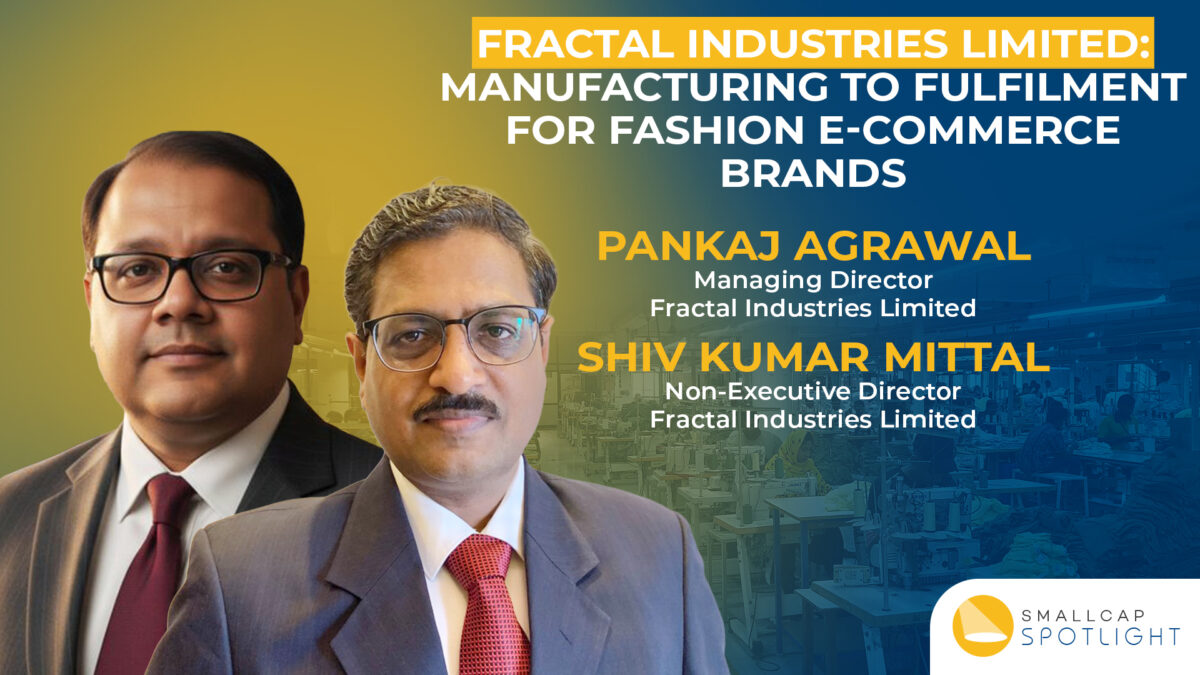
On Small Cap Spotlight, the management of Fractal Industries outlined its role as a technology-enabled, end-to-end supply chain and apparel manufacturing partner for leading fashion e-commerce platforms. With integrated warehousing, strong fabric sourcing capabilities, and a growing D2C brand, the company aims to scale through operational efficiency, marketplace expansion, and technology-led execution.
Mubina Kapasi: Hello everyone, welcome to Small Cap Spotlight. I’m Mubina Kapasi. Today the company that we are talking to is the engine that powers e-commerce websites like Myntra, Agio, etc.
They manufacture garments as well and essentially are supply chain providers and solution providers rather for e-commerce and particularly in the fashion industry. I have with me Fractal Industries and joining me are Mr. Pankaj Agarwal who is the Managing Director as well as Mr. Shivkumar Mittal who is the Non-Executive Director. Gentlemen, thank you so much for joining us today.
I think first off, we always love to hear from the management themselves as to how best they like to describe the company that they are operating and the industry that they are operating in. So Mr. Agarwal, I’ll let you kick start and how would you best describe Fractal Industries to our viewers?
Pankaj Agrawal: Hi, I’m Pankaj Agarwal, the Managing Director of the company. I’d like to introduce like Fractal Industries Limited is an end-to-end technology enabled supply chain and apparel manufacturing company serving for fashion e-commerce ecosystem.
We basically work very closely with leading fashion brands and online marketplaces, managing the complete life cycle from design, manufacturing to warehousing, fulfilment, returns, everything is into integrated system. We handle high SQ, high volume operation at scale. Basically, our journey is from past two decades has been about building execution capability starting from contract manufacturing and involved into full stack supply chain partner with growing presence across B2B, B2C and D2C channels.
Mubina Kapasi: This is a small introduction about the company. I’d like to hear the genesis of it. I mean, what inspired you to get into the industry? No doubt, it’s very high growth, I’m sure of that.
But apart from the prospects that a company and an industry like this would have, if you could share a little bit about your background, has it always been something to do with textiles?
Pankaj Agrawal: Yeah, basically, I have spent over 25 years in apparel manufacturing and supply chain management. So this business is very close to me. So what motivate me is the increasing complexity of fashion e-commerce, shorter cycles, high SQ accounts, return intensity and the clear need of partners who could manage this complexity with discipline and system.
Fractal was built with the belief that execution compliance technology would become deceive differentiators in this industry. So basically, go ahead. So the key challenges and how that is navigated, I want to explain something about that.
Go ahead. One of the biggest challenge has managing the scale, especially in this industry, where the return rates are very high, like 30 to 40 percent, and the working cycles are very tight. So we address this by investing early in warehouse system because the infrastructure is first required.
The backbone is like infrastructure e-commerce industry. So the reverse logistic capability and multi-level quality control, financial discipline are most important. Rather than chasing growth of any cost at any cost, we focused on building predictable cash flow because if the cash flow is not good, then the company will land into problem.
The strong customer relationship has scaled our process.
Mubina Kapasi: Okay. So, you know, I think today if you ask any fashion company or e-commerce company, one of the key things that does come about is warehousing costs, and you’re solving for that.
Now, I want to understand what’s your model for that. Is it leasing? Is it ownership? Of course, if it’s ownership, then you won the game right there when it comes to this entire e-commerce model. So I just want to understand how do you manage warehousing and the costs associated with it.
And along with that, if you could also share any day-to-day challenges or operations that you face when running the business.
Pankaj Agrawal: So basically, we are having eight warehouses. In that, three warehouses are leased and five warehouses are owned.
So in this, the major thing is like the infrastructure, what we have created in past three, four years. And the important is like warehouse management system. So we have taken a software with Unicommerce, which manages the warehouse because in day-to-day we get like 10,000 SKUs order every day.
And it’s very difficult to pull out that 10,000 SKUs from that 10 lakh pieces. So the important is like you must be managing warehouse very nicely, cleanly, and fulfilment will be like 100%. Because the customer expect that the orders, what they have placed must receive in time.
So we have installed the warehouse management system, which stands that all the pieces which are picked and packed are technology driven. And the order which comes, which clearly says that in which bin, which aisle, the order is placed. So it’s like, if you don’t have this warehouse management system, the fulfilment will be, can go lapse and customer will not get the right product.
Mubina Kapasi: Yeah, I think tech definitely plays a very important role. One more follow up question on the warehousing bit. And of course, Mr. Mittal, please feel free to chime in as well over here.
What determines the decision on lease versus ownership?
Shiv Kumar Mittal: When you lease, the cost of rent is recurring cost for the company, which adds cost on my retailing part. So when we own the facilities, it is reducing my fixed cost. And that’s how my margin is heavy.
Mubina Kapasi: Okay. So how do your, you know, contracts work with your customers? You mentioned your B2B, B2C, D2C, all of these customers are, or clients rather, you’re catering to all of them. I wanted to know how do, how would it work? You know, when they approach you to solve for their logistical challenges, how exactly does the contract work? Is it long term? Is it, you know, short term? If you could throw some flavour on that.
And the reason why I ask you is because we love to know about how revenue predictability works for a model like yours.
Pankaj Agrawal: Basically, earlier also, when we are working with Mantra, that time also we are having a warehouse, which we serve as a Mantra service warehouse. So this model is really a very tough to manage because in day to day, the challenges and the type of fulfilment is like two hours.
When a customer put the order, place order, then it comes into our system. And it shows clearly to customer that when it is picked from the bin, packed, and when it is dispatched from the warehouse. So this model is very challenging.
And we are enjoying, we are enjoying this model because we are used to now and from past three years, we are doing this. And slowly our volume has grown up from thousand pieces to eight to 10,000 pieces on daily basis. So we are executing right now, 300,000 units every month.
Mubina Kapasi: Wow. Excellent. Okay.
Who would your, you know, who would your competition be? I just want to understand that. And also, where do you think Fractal’s competitive edge lies?
Pankaj Agrawal: Fractal is very much competitive, because we are into fabric sourcing from past 20-25 years. And the major chunk of like investment comes from the fabric, which is like 45-50% contribution in a garment belong to fabric.
So we are having connection and backbone of from past two, two and a half decades with good fabric supply and good fabric mills, like Vardhaman, many of the like Shreeji, Shahi, they are all best mills of India are working for us. So fabric sourcing is quite strong for us. Though in this industry, the repeat order are like coming 80% of the total orders on daily basis.
So fulfilment becomes a challenge. So we have to keep the inventory of 60 days. And without factory and fabric backbone, this fulfilment will not be possible.
So fabric is the major role where we are very much competitive, though we are having long last relationship with the fabric mills, so they give priority to us, because they understand our business. Apart from that, our contractual labours are all like how we are doing at the village area. If we are doing at Karnataka contractual factories, all the factories are at remote location like Bijapur, Gadakh, and all where most of the factories 95% workers are women’s dominated.
And that makes us like competitive because fabric cost is less. And though we are available at village area, even our factory and warehouse, Vapi warehouse is at village area. And there also we have 90% women’s working with us from the village area whom we have trained with the e commerce system and the technology and they are not very helpful for us.
So that is the reason we are very much competitive.
Mubina Kapasi: All right. Okay, great to hear that.
I’d like to know, where do you see growth coming from? Again, you mentioned that there are several you know, sub industries of sorts that you cater to. So if you could give us roughly what is the breakup like and also where where do you see growth coming from? Or what do you think are going to be the growth drivers?
Pankaj Agrawal: Yeah, basically, both will be driven by three clear levers. First, deeper penetration across existing marketplace, with a high share of value added models like PPMP.
PPMP is pure play marketplace. Second, gradual expansion of our own D2C brand, which is in name of 789, which allows better margin to control and funds to connect with direct customer consumer. And third is operational leverage through automation, better capacity utilisation and technology led efficiency improvements.
So these are like three levels where I can see that growth is driven out.
Mubina Kapasi: So currently, what’s the revenue breakup like from all of these business, I imagine your own D2C 789, since it’s new would still be a smaller pie, but I’m sure it will keep growing. And that’s a high margin business.
So as that grows, I’m sure it’s going to contribute also more. But roughly, if you could give us a revenue breakup.
Pankaj Agrawal: Right now, the revenue breakup of 789 has recently started.
So the numbers will come at later stage. But you know, the 789 availability will be at marketplace on mantra platform, as well as to our website. So in very soon, we’ll get the numbers.
But right now, the major number is with myntra fashion brands, the brands like how we are having seven, eight nine licence, and we are selling that and creating the revenue from there. Apart from that, we are getting revenue from Ajio as well. And Flipkart also we have the same business like how we have at mantra.
Mubina Kapasi: All right. Okay. Could you share any expansion plans that you have? And I’m sure you have big plans for 789.
So with that, if there are any other plans on the anvil, whether it is for new warehouses, new tech or anything?
Pankaj Agrawal: See, definitely there is an expansion plan and we have a reason for five to seven years ahead. Over the next five to seven years, we can see Fractal becoming a more integrated fashion supply chain and brand led organisation means we will we are going to be stronger at DTC where our presence will be deeper into marketplace and which will give our more profitable growth, high return ratio and building the you know, the silent platform that can scale across geographies and categories. So I think in next five to seven years, the contribution of 789 will be more.
And the reason is very clear to make it a big brand, a good brand silently.
Mubina Kapasi: So who in your team is helping you out with this? Because in a way, now you’re, you know, going to have to tap and appease the customer directly. So could you tell us and introduce your team to us and the leadership? And you know, in the C suite level, when your team is helping you achieve this vision that you have a fractal?
Pankaj Agrawal: See, in my team, my experience definitely counts.
Apart from that, I have my brother, his name is Vikas Agrawal. And he’s like, it man and all the technology and it and infrastructure was supply chain is handled by him. I mostly handle like administration and production part.
We have our CFO, Mr. Smith, who’s looking after the finances. We have like our brand head or 789 Mr. Sharma Sharma with a team of four people, which leads the brand 789. And apart from that, we have a production head supply chain manager, Vijay Shinde, Aarti Verma, Mr. Anoop is the account head.
So these all people are playing the key role and partners to the company.
Mubina Kapasi: So right now, as you mentioned, you’re processing over 3 lakh orders, if I’m not wrong, which you mentioned. Yeah.
So how do you see this scaling, you know, say in 27-28?
Pankaj Agrawal: So we see a growth of nearly 20 to 25% year on year, but we see that the next year is going to be almost 1.5 times.
Mubina Kapasi: Okay, gentlemen, we leave it at that. All the very best for all of your future plans.
We look forward to seeing what Fractal does. And thank you very much for giving us your time on Small Cap Spotlight. Thank you.
Pankaj Agrawal: Thank you very much. Thank you. Thank you.
Mubina Kapasi: Okay, well, there you have it. That is the management of Fractal. Please remember, this does not comprise any sort of investment advice.
Do conduct your own research before taking any investment decisions. Thank you so much for watching. And don’t forget to hit the subscribe button.