
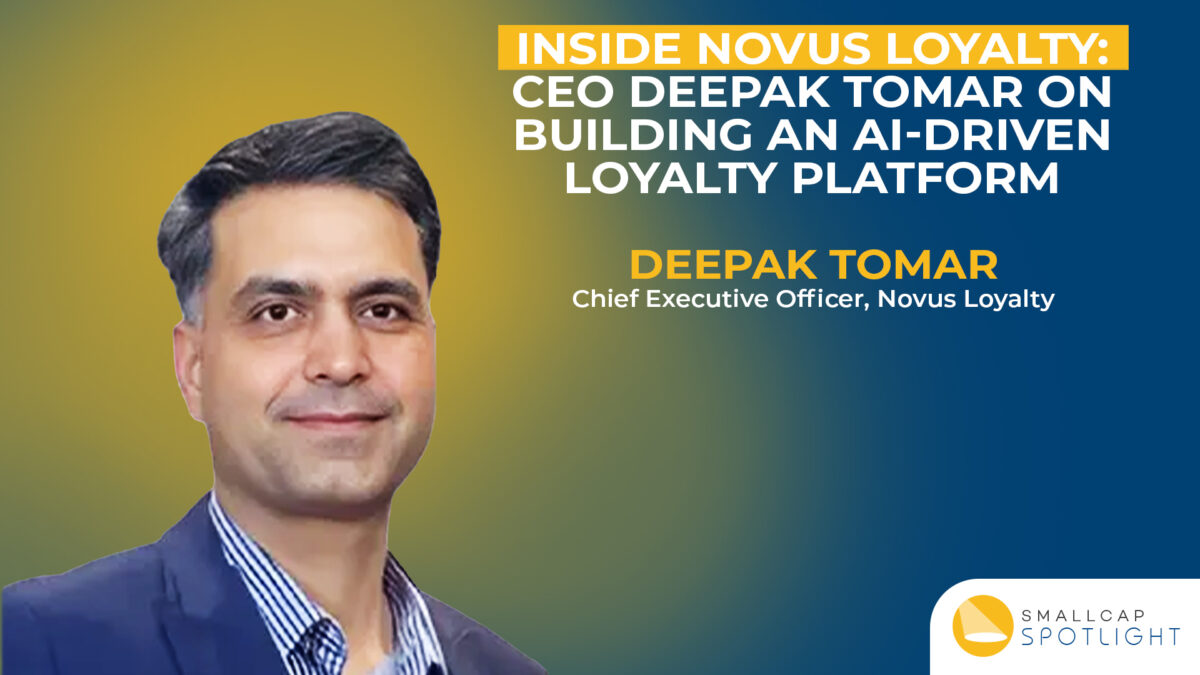
Novus Loyalty, led by Deepak Tomar, operates an AI-driven platform managing end-to-end loyalty programs for BFSI and enterprise clients. The company focuses on data-led personalization, fast deployment, and long-term contracts, with plans to expand across sectors like healthcare, employee rewards, and global markets.
Mubina Kapasi: Hi everyone, and welcome to SmallCap Spotlight. I’m Mubina and today the company that we’ll be speaking with is responsible for managing loyalty and reward points that all of us love to accumulate, especially when we swipe our credit card. I have with me the MD and CEO of Novus Loyalty, Mr. Deepak Tomar
Hi, Deepak, thank you so much for joining us today.
Deepak Tomar: Thanks. Thanks for having me.
Mubina Kapasi: So to begin with, I of course, gave a very rough sketch of what novice loyalty does. So could you give all of our viewers an introduction into the company, the products, the services it offers?
Deepak Tomar: Yeah. So in as a brief introduction, Novus Loyalty is AI driven technology company. What we do, we manage end to end loyalty program, whether it’s accurate engine reward, engine fulfillment, engagement programs in each and everything, whether it’s a retail sector, whether it’s a BFSI sector, most of our clients are BFSI. But yeah, that’s what we do. AI driven loyalty, that’s our platform and we do it for all the enterprise.
Mubina Kapasi: So in a way, would you also be then advising the Bfsi sector on what kind of points they should give out? What’s the, uh, you know, value that customers are arriving from deriving from it?
Deepak Tomar: Yep, yep. We do complete end to end. We’re going to connect to all different banking channels, collect all the data by ourselves, all the data points gets into our system. It make all the decisions on the basis of the data. What customer is going to, what kind of customer may like, what kind of things, right? So system design, the whole program and we do all the consulting behind it, and we do management behind it and we provide complete technology end to end. The only thing that we expect from our customer is all the data point. Besides that, everything is taken care by us.
Mubina Kapasi: Okay. Um, tell me a bit about yourself. What brought you into this entire, um, this fintech? I mean, it is largely fintech, right? What you’re doing. So I would love to hear a bit about what your background is like and what drove you to start a loyalty management company.
Deepak Tomar: So I always been a tech guy. I’ve done B.Tech Computer Science in two thousand and two from Kurukshetra. Like from a very, uh, my family, like everybody love math. So and I used to love math as well. Right? So, uh, and then I started one company when I, in two thousand and five, run it for seven, eight years. Took an exit, then started a small loyalty platform, sold it to a US company. But Loyalty always been, uh, like my dream like, and I had lot of issues in my previous platform that I built. It was not that scalable. The thought process was more on the subscription level instead of making it like big, like how you make it a transactional platform.
We were just doing technology, bit of it, but was not being able to create a whole transactional business around it. About myself, I build real time, transactional, scalable platform. I also build a auction engine, which I sold to another company in US, which got further acquired by more than a billion dollar company, and then so made some money out of those transactions.
But coming back to the Loyalty, like I always wanted to do a platform which kind of work for a mom pop shop as well, and then enterprise as well. And then it’s going to it’s going to solve all the use cases of loyalty right away. So you should not take. Like say, days or weeks or months to configure and launch the program. It should take like a minutes or hour to launch the program end to end. That’s, that’s what we build with. So, um, basically, as I understand, banks or financial institutions will let it be up to novice loyalty to manage their entire loyalty program.
Mubina Kapasi: So tell me about the kind of contracts you enter then with them. Because if I imagine if a bank, let’s say, is issuing a new credit card, they will hand over the entire program to you. And now this, I imagine, is not something that will just get done in, you know, one, two months or something like that. So tell me a bit about these contracts.
Deepak Tomar: So we are a B2B company. So we make do each and everything. But you’re right, the front ending or the front interface is going to be the bank. We’ll be down there as powered by nervous loyalty on the program, but like whole interface is going to be the bank interface. So customer may never going to hear anything about loyalty. It’s only going to hear about the bank loyalty program or whatever the name of the program going to be. Right. So we’ll, but we’ll manage top to bottom each and everything. Either it’s the customer side of it, the backend side of it, whole UI and experiential side of it, each and everything.
But yeah, you’re right. We’ll stay in the back end of it to come to the next question are duration of these contracts. On an average, these contracts are like three to five year contract. And then there most of like ninety nine percent of the time they’ll be renewed again for three to five years. So it’s like six to ten years is the average contract. The very first time when we connect with the banking system, every bank works differently. All the data points we’re going to capture from different systems work differently, right? So right, the integration takes some time.
Most of the time, not much time at our end, but at the bank side of it, the security team, the compliance team, we have to go through a rigorous process. They see. So we’re going to have like one hundred different documents required, which make our platform fulfill all the requirements. But like audit compliance, everything is built into this. But it’s a process. Like it takes anything between three to four months to onboard the bank and get started. Right? So yeah, so these are long term contracts on an average six to ten year contracts.
Mubina Kapasi: So let me ask you this. What do you think if this is a if this is a question you can answer, what do you think your market share would be roughly if like, let’s say we have hypothetically fifty banks and financial institutions with which you could potentially work with. How many are you working with?
Deepak Tomar: So in any percentage in India, like from, uh, I would say if you consider market share, not by the revenue side of it, uh, but if from the number of bank side of it, we are the second largest, there’s one company like, uh, they have like about seventy percent market share via the second one with about twenty one to twenty percent market share. Then rest eight to ten percent is like, it’s like lot of companies, but they don’t do end to end program. Like one company is doing one part of it. So specific to Bfsi sector, we are about twenty one to twenty two percent market share.
Mubina Kapasi: So as I imagine that once you have gone through the entire rigorous process of, um, you know, becoming an authorized manager, loyalty program manager for a bank or a financial institution, I’m sure they would want to stick with you because it’s just easier, right? You’re already in there, you know, the kind of rigmarole and the compliance and the processes that you need to follow. So in that way, I imagine that twenty one percent would want to continue staying with you. So my next question is, how would you try to tackle that other sixty, seventy odd percent? Because I’m sure that’s your ambition, right? As you grow, you would want to break in and acquire more clients. So how would do you have any ideas or thoughts of how you would want to tackle that?
Deepak Tomar: So there’s twenty one and twenty two percent like so this was with other companies before. So we already acquired it. Like these are not the customer who are not doing loyalty like these. They were doing it with other partners and now they are doing it with us. What was the difference. The major differentiator for them. One thing most of the people or most of the competitors like it, take them. If you got a. I’ll give a very basic use case like banks want to launch new cards like every month these days, like. And then they want to do it specific to their customer need.
If somebody is doing, uh, more travel, they’re going to have a travel card for him. So the benefits attached to the travel card are going to be very specific to that customer. Our platform, you can add a new card in minutes. You don’t take. We don’t take like our competitors take two to three weeks to have that new card in their system. Start running loyalty on top of it. Our system is built in a way you can just with a click, and it’s done with all the compliance in the back end. One thing the speed, right? And everybody is getting used to it. Like we like when Amazon came, like we all want to have our products in a week and then we were happy about it with blanket.
We want everything in ten minutes, right? So that’s and then speed is the key. Like bank used to do like five, ten, fifteen campaigns in a month with different merchants. Now they want to do two hundred, three hundred campaigns, right? That’s where platform like Novus come into the picture, right. So it’s, it’s built with that layer that it’s easy to integrate it, give them complete ecosystem. We bring merchant, we bring technology, and they can launch three hundred, five hundred thousand campaigns in a month instead of doing five, ten, fifteen.
Then data points how it connects our AI engine, take down all the data points and then suggest a lot of campaigns to them. So their marketing team already ahead of other programs which are there, right. So it’s, and it’s a, it’s driven by the data as well. So it’s easy for them to make a decision like, oh, these are the ten suggestions. I just need to choose one of them. That is one side of it and the second side of it. I’ll give one example, like in India, like redemption is like if you got points like, and then you may not going to know like how many points you have with different apps.
If you’re using some retail, like Zara points, this point, loyalty is there, but there is no loyalty discovery customer don’t know and then they don’t. And it’s not easy to use those points, right? So one thing, giving a technology to banks so they can do what they want to do in a very speedy way and with all the use cases. Second, make it so user friendly and experiential for customer. So they just use it right away. That’s that’s our thing. Like say, give them small or give them very targeted amount, whatever you want to give them, but let them use it right away, right?
As we say, like so. And then that’s the experience customer want to have you give them something. You let them use it right away, right? So that and that create an experience, not just a, like a point sitting in your wallet, which you may never going to use. So that’s been our key differentiator. How we able to get these twenty one, twenty two percent market share, to be honest, like very soon. And now it’s coming up, Indian customer understand loyalty, Indian businesses understand loyalty. They start realizing how important it is. So with all those key points in place, like I think we’ll easily be able to capture about fifteen to twenty percent market share every year from now on.
Mubina Kapasi: Okay. I want to understand a little bit about how you value these contracts. What is it dependent on if. Does it depend on the number of cards or does it depend on. Perhaps the number of offers each card is offering. There could be one card that offers all kinds of different, um, offers. You know, it could be an airline and restaurants and petrol and everything. So what is it dependent on the value of these contracts?
Deepak Tomar: So it’s, it’s like two or three parameters that decide it. Like one is like how many customers will be participating? Okay. Right. And then when we do it, and then what’s the current engagement on that? So I’ll give you one example. When we start a nationwide card scheme across all the banks, they are our client. I cannot name it, but like it’s one card scheme getting most famous in India these days. And we do program across all the banks. When we start their program, like they were like about thirty million cards were out there, right?
So the contract look really big like. And then, and the second point was they want to spend like they’ll say, okay, I’ll give five hundred rupees to each customer. So it’s like thirty million five hundred each. It’s a good size contract, right? But when it comes down to engagement side of it, what we notice, like it’s hardly ten thousand cards holders are active on their program, hardly ten thousand. And then so number of customers slash cards. Yeah. What’s the spend then it comes to the engagement.
How many not actually spending on the card. How many customers are engaged in loyalty program. That’s the third key factor for us. And that’s what we do. Like say if it’s the cards slash customers spend, both are checked. Then the third is in our control that we can increase it. But like still, if we get a good head start Because we did it for this particular customer from ten thousand. It’s more than a million. Engagement on the loyalty program now, right?
But to start with, how much customer wants. How much our clients want to spend per customer per card and how many cars. These are the two factors. We start with and then loyalty program engagement active program. How many points are getting redeemed every month? How many points are getting earned every month? Like those are the secondary factors that come into play at later stages of the program.
You know, RBI or government that, you know, market, you know, the consumption sentiment is not good or inflation is very high. Basically, these are all indicators that maybe, you know, Indians don’t want to spend too much right now, right?
Mubina Kapasi: Does that in any way impact your contracts?
Deepak Tomar: Yeah. But it may impact a little bit, but not majorly. What happened when customers are not spending. Then banks slash fintechs. They are like, they’re going to find more ways. So they’re going to spend. Right. So they’ll give more points. They’ll give more benefits out of it. And they do have a certain budget. Their budgets are more aggressive. Right. Now we are seeing like every bank that we work with, right.
So it’s they always going to come and not just the sentiments are on this side as well. So what’s happening? RSUs, PSUs, like they had that tendency. Uh, they should not be this much redemption because we have to pay for it and say, oh, just it has to be maxed out. The slack. Time. And that was their mentality. But now it’s like, do it aggressively. Redemption, redemption. And then they are very aggressive on their side.
To answer your question it may going to any impact eventually, but like, if it’s not in a smaller way, like if it’s like something huge happened, like, say corona happened, right? People not being able to get points, use point loyalty is kind of on the, on the back side of it. It’s not nobody is thinking about doing a transaction or running a business. Everybody is worried about their health. In fact, nobody wants to pay credit card bills. Also, there are moratoriums and all. So if it’s like if it’s a huge thing, which may impact the whole ecosystem, that will impact the loyalty program as well.
But if it’s just a little bit financial here and there, that actually may going to be a bit more positive, right? And also on the sometime, what happened and that happened like RBI comes with some norms, like the data need to be maintained with this, it has to be P2 compliant. How you holding card information should be in a certain way. It has to be PCI, DSS compliant. Those compliance also sometime slow down the process as well. That’s why what we made sure like we made all the compliance and audit within the system.
So it’s not going to slow us down, but unless until it’s a huge event. To answer to your question, like it’s not going to impact our business. But yeah, if it’s something major that’s going to impact that, I mean, that’s something that will anyway impact literally everybody, you know, not just, yeah.
Mubina Kapasi: Um, you know, you brought up a good point with respect to regulatory compliances. I’m sure there are a ton of compliances with respect to tech with respect to data privacy, etc., that you have to maintain. But if you could summarize some of that, what kind of government related compliances maybe that you have to take care of, it could be RBI related, or it could be any other government body, anything that you have to take care of.
Deepak Tomar: Yeah. There’s no direct compliance from RBI about reward points. Okay. No direct compliance here. There are some taxation. Uh, is there like, if somebody gets more than ten thousand rupees has been redeemed by that person. So we need to do, uh, his taxation. It should be filed on his twenty six years worth. But like there is no direct compliance from RBI side on the reward point of it.
There are compliances from bank side on the data privacy and all those kind of thing. Like it has to be, uh, like whatever the platform we launch, it has to be certain certified. It’s, uh, PCI, DSS compliant, like how we, uh, store the data, uh, when it’s in motion, when it’s sitting in our databases. Like all those compliance, if it’s a P2 compliant information where the customer, uh, data points are there, they need to be encrypted as well.
So some compliances from the bank side of it to make sure the data is all secure, but there is no direct compliance from RBI as of now. When we’re talking, we don’t know what’s going to happen tomorrow. But like as of now, right now, there is no direct compliance from RBI on loyalty programs.
Mubina Kapasi: Okay. I want to ask you on the challenges you face on a day to day basis, uh, because I would imagine that keeping your, you know, your tech secure from cyber threats, uh, is extremely important. Yes. The banks, of course, have a very stringent set of norms that you have to follow. But if you could tell us a bit about how you as well fend yourselves from these kind of threats, because invariably we read about how, you know, this company’s data has been leaked and the next thing you know, the phone numbers are being sold on the dark web and what have you. So how much are you spending on keeping that aspect of your technology safe? Because it is the most important part of your entire business, one hundred percent, one hundred percent like and like data compliance and all those things coming into the picture like that.
Deepak Tomar: Security is at most priority for us as well. So we built a three layer system for it. Like one thing, our engine actually we have created some thresholds in there. Like so it’s like, and the thresholds are that’s like level one security on the application side of it, which is like not any single user or account cannot, can have more than like that threshold in a day, in an hour, in a month. Like, so nobody can breach that. Like it’s a, it’s an application level thing.
So it’s to make sure that like one person is not getting, uh, is not tricking the system is not getting too many points or getting redeemed at once. Right. So that’s the level one. We. It’s not even a actually automatic thing. It’s like different threshold built into the system. So nobody trick it and nobody one is taking advantage of the complete system. That’s level one. And then application security firewall. Those are the IT level things.
But from the platform level, like one is threshold, then we do a lot of risk analysis of the profiles as well, customer profiles as well. Like if we analyze the data, like if this customer is redeeming frequently, oh, he only redeems on vouchers, why he is redeeming on flights today. So that got flagged in our system and that redemption stop right there. And then somebody manually review it and then release it and then make sure like it’s it’s like his account is not hacked, right? So we have both levels like where it’s like system application, make sure it doesn’t happen.
And then it just flag it and then comes the manual layer just to make sure it’s not being A tract. The system has not been tracked.
Mubina Kapasi: Could you tell me if your loyalty program service is also being used by other products? Other sectors?
Deepak Tomar: Yep yep yep. So debit card now, like almost every other bank do. Points on debit card as well. They do it on mobile banking internet banking. Even if somebody is taking a gold loan from the bank. Bank is giving them points. Somebody is using ATM card on the bank machine instead of using on another bank. Then also bank is giving point. Also UPI and then we call it micro reward because like banks don’t make huge money on UPI, but they still want customers to be engaged on that particular channel as well.
So all those micro rewards being there for UPI as well. We do. Uh, and now it’s. Now there is a product, uh, it’s a credit card. Getting swiped on machines is another one, but like now you can add your credit card on your phone app, like whether it’s Google or Google Pay or phone pay or Paytm, you can add your credit card there. And then whenever you are making those small payments you can make using RuPay credit card, we do it for all the banks as well.
Okay. Right. So that, but again, those programs are not like a not very, not exactly similar to the credit card programs because like banks are not making as much as money they are making on the other POS machines. Right? So now it’s like you credit card and UPI, it’s not actually just credit card, the whole engine, how it works is different, right? So it’s like, and the reward need to be done in a different ways, right? So you’ll see now some banks start launching these programs and separate to their credit cards, but like these are going to increase in next two, three years.
You’ll see like those kind of programs are coming up Specifically for credit card on UPI. So we are already doing POC for a few banks as well. So those kind of products going to increase as well, not just the plain vanilla credit card programs.
Mubina Kapasi: Got it. Um, I know you mentioned one thing that is that, you know, you want to increase your market share. You mentioned fifteen, twenty percent. You’re confident you will be able to increase over the next couple of years. Um, what I’d like to know from you is how are you looking at the talent pool? Because obviously there’s a huge addressable market. I think our credit card penetration is in single digits, if I’m not mistaken. And I’m sure it will only increase our consumption, spending is increasing, so on and so forth. So I’m sure it’s a huge addressable market for you. Also in turn. Um, what do you think of the talent pool available? Since yours is a very technical product, you need specialized individuals who would help you provide this service. I’d like to understand a little bit of that from you. So the kind of talent pool we need, one is on the tech side of it, right?
Deepak Tomar: So tech pool is kind of not a big challenge for us. Like because I’m a technology guy. By myself. My co-founder is a technology guy as well. So we’ve been in technology. We understand technology. It’s, it’s very even if like somebody is not that sharp, like we can just train them in a certain way. So they’ll just gel with the product and then going to work with.
Mubina Kapasi: So right now you’re very hands on in the product as well in the tech behind it.
Deepak Tomar: Yeah. So hands on like, yeah, on the product side of it, not on the coding side of it by myself, but like, yeah, on the product side of it. The other is the loyalty program managers, right? So it’s, that’s where is like a little bit challenging. They’re not like in specific to Indian ecosystem. Like, it’s like there are good loyalty program managers, but like, and then these loyalty programs are maturing so that talent is little hard to find still.
But like, we are still again, creating a lot of AI based programs where system is suggesting a lot of campaigns by itself. We are putting a lot of knowledge into our AI data sets, so we don’t need too many people to do these loyalty program management. And then AI systems are managing those program by themselves, right? So it’s so we’re taking advice from experts on that, but most of the work will be done by these AI agents to configure those programs.
We already we partially achieved it with AI suggests the campaign on basis of the data set, what need to be done. But yeah, that kind of talent pool like. So we may not going to need like say fifty, sixty loyalty managers, but we may need like four or five or six loyalty managers to train the AI agents. Agents? Yeah.
Mubina Kapasi: Got it, got it. So you’re already like fully leveraging AI and you will continue leveraging it, right?
Deepak Tomar: Yeah. We already use like for about fifteen, twenty percent of our system is like all, like how when a transaction gets in, like if transaction gets in, we can just tell like, this transaction belongs to this merchant. It’s actually, uh, it’s an e-commerce transaction or post transaction or is it a travel transaction or it’s a retail transaction. We can just tell when a transaction gets in our system through our AI engine, like now. We also throw campaigns automatically, but that’s still need to be one hundred percent automated, right?
Mubina Kapasi: So is this like a proprietary technology or I mean, is it something that you have a trademark on? And none of your other competitors can use it?
Deepak Tomar: Yeah. The one we are building going to be our IP only it’s our intellectual property of loyalty I want to know your long term vision for novice loyalty. Uh, we already spoke about that fifteen twenty percent market share.
Mubina Kapasi: If there’s, you know, if you’re looking at perhaps catering to more sectors, uh, consumption, uh, FMCG. I mean, the way the B2C market is blowing up, right? So if there’s any ambition that you have to grow in terms of number of clients, in terms of revenue, bottom line, long term plans, basically.
Deepak Tomar: So as I mentioned, like fifteen to twenty percent growth, like going to happen in BFSI sector, then another fifteen, twenty percent what we were expecting because now, uh, we, uh, got into healthcare as well. We do healthcare programs. So healthcare, like you cannot, uh, there are certain regulations, uh, in healthcare, although in India, a lot of regulations been neglected as of now, you are getting points even when you’re buying medicine.
A lot of companies do it, although it’s because it’s not much regulated, But like still, it’s like a huge space, like with OTC products and all those things where you can just incentivize the customer to do all those kind of things. So healthcare is one we are definitely going. Then another big market in loyalty is channel partner programs, where you are a brand and then you incentivize your channel, which is like retailer distributors to sell your product to customer. And then influencer program, like say, if you are like a, you made so like electric switch or something. So you’re going to incentivize the electrician. So he’s going to recommend you recommend your switches.
So that market is huge like that. And then we’re entering into that as well. We already onboarded a couple of clients in that as well. So we are entering health care channel partner program. Then employee reward program is a big section as well, like when you work with corporates and then you say, if employee going to do these things, then they’ll be incentivized with certain things. So that’s a huge market. We are getting into that as well. Another product we are planning to build next year is, is, which is very specific to the e-commerce, which works for B2C as well.
So it just and then it’s like a, like if you have Shopify and all those, like it just connects seamlessly with those, uh, e-commerce platform and then roll out the campaigns for the loyalty as well. Work in retail, work online. So we have already, that’s in our DRP as well that that kind of product we’re going to build in next couple of years. Yep. So to summarize it like, yeah, we will definitely enter healthcare channel, partner program, employee reward programs and e-commerce loyalty in next, next year or so.
Yeah. So that’s going to give us like fifteen, twenty percent from market side, we already onboarded clients in Mena region. We got like three clients in UAE. Now we got two clients in Saudi. We onboarded two banks in Africa as well. So we are expanding region wise as well. And the vertical wise as well.
Mubina Kapasi: And currently how much is domestic? I mean how much of your revenue comes from about ninety percent.
Deepak Tomar: Ninety eight percent is domestic and then only about two percent international. But like international going to grow over time.
Mubina Kapasi: Deepak, thank you so much for this lovely introduction to the company and all the very best for your future plans.
Deepak Tomar: Thank you. Thanks a lot. Mubina.
Mubina Kapasi: Yeah, well, that was the management of novice loyalty. Remember, this interview does not constitute any sort of investment advice. Please conduct your own research or consult a professional before taking any investment decisions. Thank you so much for watching. Don’t forget to hit the subscribe button on SmallCap spotlight.