
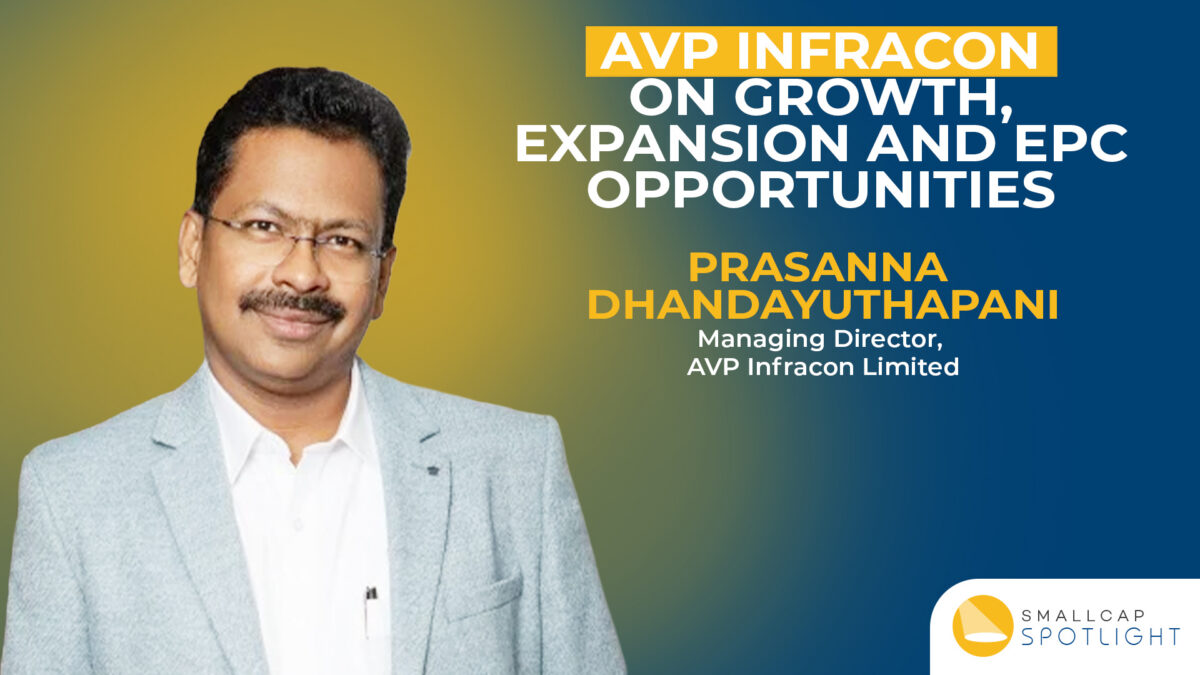
D. Prasanna shares that AVP Infracon has grown from a regional road contractor into an integrated infrastructure company with operations spanning EPC, RMC, and renewable energy. He highlighted the company’s focus on road infrastructure, a ₹500+ crore order book, and plans to expand beyond Tamil Nadu while targeting sustained long-term growth.
Karunya Rao: Hello and welcome to SmallCap Spotlight. My name is Karunya and today we’ll be talking to the management of AVP Infracon Ltd. It’s essentially a Chennai-based infrastructure and EPC company that’s primarily engaged in constructing roads, highways, bridges, flyovers and other civil infrastructure projects across India.
Of course, they have a very, very strong presence in the southern market as well. Mr. D Prasanna, who’s the Chairman and Managing Director of AVP Infracon Ltd is with us today to talk about the company, how it was founded, what the way forward looks like. Mr. Prasanna, welcome to SmallCap Spotlight and thank you for taking time out.
D.Prasanna: Thank you. Good evening.
Karunya Rao: Well, it’s a very interesting business that you have, you know, in the form of AVP Infracon.
If you could start by telling our audience about the business model, how is it that you operate?
D. Prasanna: Of course, it’s an EPC player, you’re in the infrastructure space, it’s something that we know of, but if you could give us some background of how it came to be. Yeah, well, this company is formed in 2009 and it was started in Yattya 2 city in Tamil Nadu, Trichy to be precise. It is started by 3 directors, 3 of us.
We initially started this company as a company which provides road infrastructure projects to the corporation, municipal corporations, forest roads, etc. And after quite some time, we ventured into state highways and then from that state highways, we have penetrated into the national highways, National Highways Authority of India projects. We do take up both state highways projects and as well as national highways projects.
So, this company now is headquartered at Chennai. We are sitting at Chennai there with operations being carried out from Chennai and all projects all over Tamil Nadu. So, at present, our geographical presence is restricted to Tamil Nadu and it is not restricted.
We are just finding our ways how to get out of this Tamil Nadu and expand beyond Tamil Nadu. So, we have around 3 subsidiaries and these subsidiaries are into different verticals. So, one we have RMC, which is Redemix Concrete Company, which we manufacture Redemix Concrete and these we cater to the other markets also for the engineering companies and for other EPC companies and for the commercial establishments, etc.
And apart from that, we have Renewable Energies Company, AVP Renewable Energies Limited. This is how we own the subsidiary of AVP Inflocon Limited. So, this we have started to take up projects in solar EPC sector.
So, this is started last year and we are expecting some good numbers to flow in this current year. So, this is as we know that solar is expanding leaps and bounds. So, we just wanted to expand in those areas as well.
Apart from this, we have Blue Metal Crushing Unit. It is named as Kandan Blue Metal. So, it is a backward integration, which supports I mean our projects and as well as RMC requirements in the form of the raw materials, which is mainly blue metals.
So, this is also a backward integration, except the solar company, the other two is a backward integration of AVP Inflocon Limited. And we went public in the year 2024 March. And it has been a good journey from 2009 and now we are at 16 years after we have incorporated and we are looking positive for the other years to come.
We are in the SME board and we are almost completed 2 years in the SME board and we are looking to migrate to the main board very, very soon.
Karunya Rao: How soon do you think that is likely to happen? Do you have any targets?
D. Prasanna: It is a 3 years timeline to be at the SME board. So, once if you said in SME, you have to be at this SME level for 3 years. After that 3 years, you can migrate to main board.
Karunya Rao: But you are confident as soon as the 3 year threshold is over, you could, you would be in a position to make it to the main board?
D. Prasanna: Yeah, yeah, yeah. We have seen, we have met with all the eligibility criteria.
So, one that is lagging is this 3 years thumb rule, which is the main part of it. Once it is, we are expecting to migrate. Once after this, we will start the process.
Great. Our 3 years is getting over in the month of March 2024. So, in 2027.
Karunya Rao: Great. So, you had also just now highlighted, you know, the key businesses that you are operating in right now. But if I have to ask you, what would you identify as your main growth driver? What is really driving the volumes, the sales, the order inflows for you? What would that be?
D. Prasanna: So, the main driving force is our, I mean, what you call our appetite for business.
We just wanted to do great numbers. So, this, we are behind this roads infrastructure. So, we are mainly concentrating on roads, but the rest all is coming second, or all our concentration are towards road execution.
So, road is the main part where we just wanted to concentrate. And we keep aside all the other things as the secondary force, which is driving. So, we have a great appetite to bid for road infrastructure projects.
Karunya Rao: Okay. And could you also tell me what your current order book looks like?
D. Prasanna: It is a small bit above 500 crores plus and we are expecting, see this, we have been going through this election phase for the three or four months in Tamil Nadu. So, we have started bidding after this election.
And now we will be starting to bid after this election. So, we are expecting somewhere a good number of orders to flow up into the company very shortly. Now we have 500 plus crores.
Karunya Rao: Okay, that sounds good. About the delivery timelines, project delays, if you could give us some colour on that, how do you manage your execution?
D. Prasanna: See, normally, project timelines differs from project to project. It even starts for six months and it goes for 18 months, 24 months and 36 months based upon the nature of the project.
If it is going to be a plain vanilla road, it will be around for 12 months and if it has some complex structures, some flyovers or something like it will be going on for 24 months or something like that. So, that is where it differs from project to project. And we do not face much of delays in projects.
Also, we close projects on time and we execute projects on time and we receive bonus also for early completion in many cases. So, but there are inevitable delays. There may be inevitable delays when it comes to infrastructure, because it is not going to happen within four walls and it is an open to sky thing.
So, any natural calamities or something like rain or flood or something like that may delay the projects.
Karunya Rao: Okay. But talking about unforeseen circumstances, if you could also talk about the raw material cost, the volatility that has trickled in and they are pretty much through the roof as we speak.
So, talk to us about how the rising RM costs have impacted the companies and how are you protecting or trying to protect your margins in such a scenario?
D. Prasanna: So, right question at the right time. This raw material cost has been intact for the several past several years. Now, circumstances where there is a global, where the global conditions are not favouring when the war is on the guard, everywhere the price hike is there.
We have a huge demand for our products itself. See, diesel is raw material for us. Diesel, we are getting nowadays, there are some delays in the loads getting delivered or something.
We need to maintain much of stock. Previously, we do not do that. We just take it on whenever it is required daily or something.
But nowadays, we have to maintain loads of stock and where many inventories has to be maintained. And apart from that, bitumen cost has skyrocketed in the month of March. See, bitumen there was around 45,000 per tonne, 45,000 to 48,000 per tonne.
Now, it is at 90,000 per tonne, it is almost 2x. So, and oil corporations in India have reduced, we have been offered very good discounts for taking the quantum. So, being a marquee customer for these oil corporations, several players like us who take high quantum of bitumen, we have been given a very good discount.
And those discounts were withdrawn in the month of March because of this, I mean, war scenario. So, see when the product itself is available, the product itself is a nightmare. Why will they give discount is their question towards us.
But we are having some problem in because of this and we have some hit on the profit and everything has happened because of this. So, this we are trying to mitigate it and now it is not, see, we will be getting the escalation clause for that. But still escalation clause will be on the basic price of the product.
But with the discount what we were enjoying, we will not be able to get it down from the escalation number. So, that we are facing some problem on everything. But we are trying to mitigate it through other sourcing and we are trying out our best to get that some imported materials or something like that.
Karunya Rao: So, net-net, what has been the impact on margins, if you could give us some picture? And by when do you see things, the margin stabilising?
D. Prasanna: It is, our part has come down by around 1.5 to 1.7 percent for the income to the last financial year and this financial year. It has come to 1.5 to 1.7 percent, which we have never ever expected. And because of that, the impact among the shareholders is also high.
People will have this, see everyone will not have the clean knowledge about what is the impact, why the part have come down, why is this affecting the company? See, but everyone wants the results, no one wants the efforts, no one want to know about the effort, what people are taking or something. Everyone will be concentrated only on the results. If they are getting 12 percent part, the next day they should get 14 percent part, which is not always possible.
There is, when there is some time, a wave may be there, if it is going up, it may come down something. It cannot be a one step, it is not a ladder always. There may be some plus or minus sometime also.
We are just working on it to bring up the part next year.
Karunya Rao: Okay. What about the working capital and cash flow situation? How is that coming along and what is the strategy to manage that?
D. Prasanna: See, we as a company, we went to IPO in the year 2024, wherein our IPO size was around 53 crores.
When that top line was somewhere around 100 crores or something. Now we have crossed a top line of around 440 crores this year. But still our equity is the same, only we have raised around 100 crores of debt to match all this.
And there is a financial cost implicating this also. So, we are looking to raise some equity, but because of the price dip, you should be knowing that price dip has caused us, when it was almost a year, this price has started when the market started to fall. So, our prices also from last June, July started to come down and it is still trading well below our all time high.
So, we are expecting something to come up so that we will have an equity rise. We did, I did on my personal capacity, I did a warrant subscription for 30 crores. So, 30 crores, I have already done some 7.5, 25% of the 30 crores, 7.5 has been invested in the company again.
And I am at this point looking as going to the public for equity market will be tough at this state. I am planning to invest or execute the warrant, balance warrant which has to be done, maybe around 75% I have to pump it. So, I am planning to do that in the due course, maybe as ASAP to support the working capital requirement.
Karunya Rao: Okay. You know, at the start of our conversation, you had mentioned that you aspire to move beyond your concentrated markets and you want to expand in other territories. So, is there a plan in place for expansion in different markets, regions and what are you, what parts of the country are you eyeing?
D. Prasanna: See, it is, we were eyeing 3 to 4 states for our initial expansion as a primary first stage of expansion.
But what happened is we, when we were planning and we were bidding, we got few projects in Tamil Nadu itself. So, when we are getting project at our own state, our own place at close vicinity, so we wanted to go with that flow. And we again thought, okay, we will have this project running.
So, but we are bidding very conservatively at the projects outside Tamil Nadu, so that it will not see, it will not take much heat on my profit margin. We are bidding at, we are planning to bid in Andhra, Telangana to Madhya Pradesh.
Karunya Rao: Okay. Okay. Also, tell us about the technology that you have in place, because clearly when it comes to project execution, efficiency, tech plays a huge role. So, what are the processes and investments that you have in tech?
D. Prasanna: See, we have all high-end machineries with us, we take all latest machineries, we do not go with the old one or the traditional one, we keep updating ourselves with the machineries.
So, we have asset-heavy model in our balance sheet. So, we do not rely on, I mean, what you call the hirers who support us with the machinery or something. So, we keep investing in machineries.
So, this is definitely rewarding us with better profitability. And apart from that, we have accounting standard, we have implemented ERP for to monitor the day-to-day consumption, day-to-day consumption of raw materials and all these things. So, this is how we are proceeding.
Karunya Rao: Okay. At the start, you also mentioned that you are one of the partners of the company. So, tell us who are the founding people behind the company, the brand that you have built over the years, who are your key personnel beyond you, who are also helming the company alongside?
D. Prasanna: It has been started with three of us, we three all are friends.
And it is AVP is that Arun, Venkat and Prasanna, it is AVP. So, I am Prasanna, the managing director of the company, Venkat is the JMD. And he takes care of the operations, whereas I take care of all the administration and finance related things.
And Arun is no more with us, he is not on the board. And he have exited the board few years ago. And my younger brother Vasant is in the board now, he has joined a few years before.
So, he takes care of all this RMC operations and this blue metal operations everything.
Karunya Rao: Okay. And finally, if you could also give us some forward looking outlook for where you envisage the company to be in the next five to 10 years, any long term vision targets? Of course, you said you want to be part of the main board IPO and the main board markets.
But beyond that, for the company’s growth, are there any targets in place for the long term?
D. Prasanna: For five years from now, we are targeting somewhere our top line should be around 2000 to 2500 crores. This is very conservative figure because I’m afraid to commit something in public. If you are achieving, you will be applauded a lot.
But if you are falling short even by a rupee, then your callers are off from you. So, I always try to be conservative.
Karunya Rao: All right. Thank you so much for sharing with us the way the company has shaped up over the years and what lies ahead as well in terms of target and growth vision. Mr. Prasanna, it was great having you on SmallCap Spotlight. Thank you for joining us.
D. Prasanna: Thank you. Thank you, Karunya.