
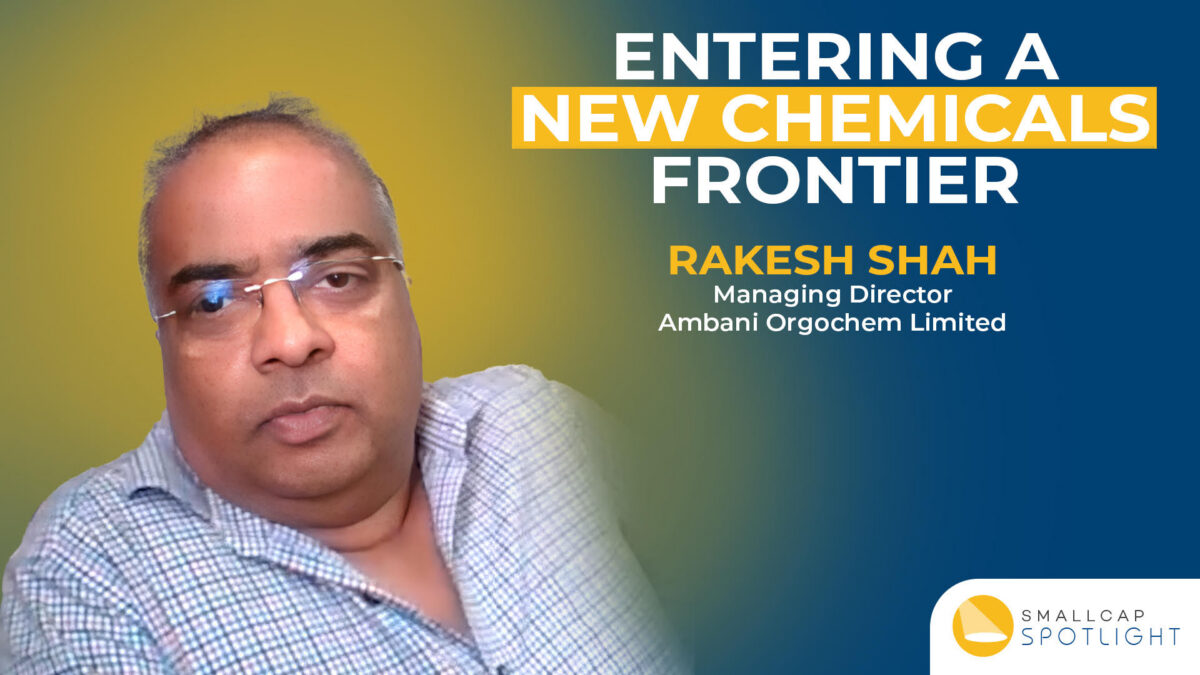
Ambani Orgochem MD Rakesh Shah discussed the company’s speciality chemicals portfolio, R&D initiatives and plans to expand production capacity and develop import-substitution products. He also highlighted its focus on green chemistry and backward integration to support cost efficiency and product development.
Mubina Kapasi: Hello everyone and welcome to Small Cap Spotlights. I am Mubina Kapasi and today the company that we will be interviewing is in the chemicals business and supplies key chemicals to some of our daily products that we use like paints. Let’s understand a bit more about the company in depth, its product portfolio as well as the future vision.
I have with me Mr. Rakesh Shah, who is the Managing Director of Ambani Orgochem Ltd. Mr. Shah, thank you so much for joining us today. Thank you.
I think to begin with, this is the question we ask all of our viewers, all of our interviewees rather, that we’d love to hear about the company and a description of the company from the management’s own words. So why don’t you introduce the company first up to the viewer.
Rakesh Shah: Mubina, this company was taken over by us in 1995. The company was established in 1985. From 1995 onwards, I am the one who is running the company. And for the last five years, there is a next generation, Mr. Ashish Shah, who has joined us and he has opened the new super speciality division, which we have established in the age and which is very much on production now.
We have four facilities in Tarapur, including one R&D facility, where we do all the R&D for the new products, what we are coming out. Basically, the company is dealing in various applications from textile, paint, paper, packaging, carpet industry, construction industry. All this, this is what we do in the Tarapur facilities.
In the facility, we work, we are the third manufacturer in India for manufacturing salicylic acid, which is basically an import substitute. From salicylic acid, we are trying to planning to make all the salicylates, which are basically used in flavour and fragrances industry. So this is our one division in the age.
In second division, we make all peroxide derivatives. As far as peroxide derivatives is concerned, there are hardly six to seven manufacturers across the globe for this particular product. In India, we are the third one to have an environment clearance for this product.
With latest in R&D, we are coming up with few of the products, which are not at all been made in India. The finish, the last products are already been done in R&D. Now we are working on the raw materials of it because the procurement of raw material has a little tricky thing.
So to avoid future hindrance, we are moving on to make raw materials also in us. It will give us a very good cost effectiveness also and on top of it, it will give us a more product line also. This is how the whole company has shaped.
The company started at, I am the first generation entrepreneur, the company started at a very small scale. We had hardly one reactor and one unit in Tarapur. Today, with the grace of God, we have nearly 100 tonnes dispatched per day and now we are expanding it to 200 tonnes per day.
Hopefully, by December, January, that next capacity will be on. And in coming future, we will be doing something huge in Peres also. This is how the whole company is shaped.
Mubina Kapasi: Very interesting and clearly there’s a lot of exciting things lined up as well. So right now, if I have to say what your major sector or product is, which is paints, paper, textile, who’s your biggest sector client right now?
Rakesh Shah: No, no, no, Mubina. From very beginning, we are never focused on any one industry.
Even if we have orders, we see to it that our portfolio has been well divided in all the industries. We are not dominant player in any of the industry. We are basically doing more often speciality job where the people who don’t have a new machinery or something and there is no readymade products available on the market.
That is what we do in our lab and then we give it to the customer. So we are not anything more of a me too kind of manufacturer. As in today’s generation, there are a lot of new machineries are coming, a lot of new base materials are coming on which you have to do a different applications of coatings and everything and everything.
And that is what we are more into it. So we are not dominating any industry, any industry.
Mubina Kapasi: Understood. Okay. Right now, as I understand you all are, and correct me if I’m wrong, I think you’re at 50,000 tonnes of capacity. And of course, I’m sure as you said, you’re undergoing a capacity expansion too.
So what is the utilisation like?
Rakesh Shah: Right now, we are utilising it 200% of the whatever capacity we have. And then that is the reason we are doubling it up because we are unable to meet our in hand orders.
Mubina Kapasi: Well, that’s, that’s, of course, always a good problem to have.
So tell us about what sort of and what’s the amount of capex you’re planning? You mentioned not just capacity expansion and backward integration, but also some R&D too. So roughly what sort of, you know, capital expenditure?
Rakesh Shah: Our idea of expansion at Tarapur, because all the utilities are already been installed, and we have everything over there. So now we are only supposed to add on the machinery part of it.
So the capex is approximately 15 to 20 crores only, whereby we will be adding on around 200 to 250 crores of revenue on a year.
Mubina Kapasi: And these new products, could you give us a sense of how margin accretive they could be? Like you mentioned, super speciality chemicals is the next generation business. So compared to what the product portfolio is now versus after all the capex you’ll do?
Rakesh Shah: Madam, right now we are doing capex at Tarapur, where we are doing our traditional business.
After once December, we will be planning to do all the expansion at Dahej. In Dahej also, we have an excess capacity. Dahej is not fully utilised till now.
Because of the tariff and all this, we are unable to export. It is class 5.2 hazardous class of material. And if any chemical guy, he will understand handling hydrogen peroxide is a highly tricky thing.
And that is what we do there. So we have an excess capacity in Dahej. Once the things are smooth enough, the Dahej will also have, we already have an order, but due to transit issues, we are unable to execute.
Mubina Kapasi: So if in case Dahej comes into play as well, which I’m sure because a tariff, etc. is something that it’s a temporary scenario. So what sort of an addition are you looking at to your capacity? And obviously, then concomitantly to your top line too?
Rakesh Shah: Madam, we’ll be doing a great top line growth also and bottom line growth also.
Let me not comment something till it doesn’t happen. But we are very much sure and very much hopeful of having a great numbers.
Mubina Kapasi: Okay, understood.
All right. Let’s talk about the fact that you also do have that supply problem, which you mentioned. I mean, raw material.
So that’s why you’re doing backward integration. Do you think that’s one of the key challenges you face?
Rakesh Shah: No, madam. In that particular product line, what we are making, so that product is solely imported to India.
And we have already cracked the product. Now, the key challenge was to arrange the raw material at the right price to increase our profitability on that and have a full dependency on our own hands. We will not be depending on anybody or anything like that.
That is the reason we went on for making raw material also. So you have a raw material sourcing problem only for that particular product? It is not a problem, dear. It is not a problem.
But as far as the technical knowledge, what we have, according to us, the cost of the product is too less as compared to what rates are being offered. So that’s clearly business to be made over there. Fair enough.
Mubina Kapasi: Okay. All right. You know, I just want to understand how you manage any sort of pricing volatility because the last few years, we’ve seen that a lot in any commodity you mentioned.
And you also innovate, you are buying a lot of commodities. So how do you manage?
Rakesh Shah: We pass it on. It’s as simple as that.
And people do pay. Everyone understands. If the price goes up, crude goes up, crude goes up, petrol has to go up.
You can’t blame it. If dollar goes up, the price has to go up. So it’s a business pass through.
Yeah. That’s not a problem. That’s not at all a problem.
Mubina Kapasi: Understood.
Rakesh Shah: And we have a reasonably good positioning with our raw material part because being 30-35 years in the trade, we know a little.
Mubina Kapasi: Okay. All right. I want to move on and talk a little bit about the environmental part of it because I understand that the last, you’ve been focussing on something called as green chemistry, low VOC products, APOP rates. So, you know, these are jargons, of course, which my viewers from the non-chemical business may not understand.
So if you could expand on that and what are your plans over there?
Rakesh Shah: See, Mubina, what has happened is in olden days, everything used to be getting used somewhere, solvent or something or something was being used. And we are replacing a lot of places with water system. The system, what we do in Sarapuram, it’s basically an eco-friendly system.
They are biodegradable. They are non-polluting because the media is, instead of solvent, we use media as the water. So the reactions takes place there and we are almost matching whatever the solvent-based systems are giving.
So this is how the whole chemistry goes. Your wastage is not there. Your evaporation losses are not there.
All those things are very well in control. So this becomes more of a green chemistry.
Mubina Kapasi: So let’s say if I were to talk to you maybe five, seven years down the line, with all of the plans that you have in place right now, how different would Ambani’s product portfolio look? And I know you don’t want to share any numbers, fair enough.
So I will not ask you for your revenue projection or profit projection, but maybe if you could just get a sense of how different your products would look.
Rakesh Shah: There will be a huge change in the basic product line. As we are going in for flavour and fragrance, we are only targeting the products which are more of an import substitute or which are the better of bottom line.
Top line we already have with our current status. Mr. Ashe is only handling super specialities and he is giving his full time on the R&D and everything. He is MS from US.
He is by choice, ICT PhD dropout. So technical part has been handled by him and we are doing some unbelievable products which are not being thought by a lot of people.
Mubina Kapasi: All right. I just have one more question and then I want to just get into your journey as well. What stage would you say you are in your capex? Because obviously you have a debt level right now and you are servicing the interest for that. So at what stage of your capex cycle are you at right now?
Rakesh Shah: We are almost done with capex madam because we are increasing ourselves by having a very nominal and we strongly believe not to have a short term into long term.
Our interest levels are remaining the same. Our interest levels are not going to the level of growth the company is showing. Because we have the interest part is because of the LCs and all that what we have to do it for the import part.
Otherwise our working capital is hardly 20-25 crore in front of not even 10% of my total revenue. The H is a new unit that’s why you are finding a little higher interest rate on that. The H we established in 23-24.
Mubina Kapasi: I want to know your own personal journey. Did you have a background in chemicals because obviously it’s a company that you acquired in the 90s. So did you have a background in chemicals or is this something that you sort of picked up on the job? Just your own personal entrepreneurial journey.
Rakesh Shah: I am a become dropout here. I have not cleared my FIB count. So what about the interest in chemicals? It’s a business that is so esoteric and not understood of course by many people.
So what? If we go on this topic it will go very long. So to cut short I was working as a peon somewhere. So from there the salary was not sufficient enough so I started trading and then God was kind enough to me so I became this.
That’s all. I mean we have all the time in the world so we would actually love to know this story because it really sounds good. No no that we will discuss on the coffee some other time.
That’s okay it happened.
Mubina Kapasi: Okay just one last question then from my side. You of course have this big vision.
You are adding more products. You have the next generation Mr. Ashish Shah joining in. Tell us a bit about who else is a part of your team helping you achieve that vision that you have for Ambani Orgochem?
Rakesh Shah: No madam he is the only next generation.
Only one single child.
Mubina Kapasi: Someone in your production team management.
Rakesh Shah: There are a lot of people are there.
We are there together for last many years. In our company there is a very little rotation of the people. We have around 20, 25, 30 years like from 90s there is one guy who’s with me.
He was the first person to join my company and he’s still there with me today. So that way everyone takes care. I’m sitting with you and I’m relaxing.
No issues. A good team we have. There is nothing to worry about.
Mubina Kapasi: Yeah that’s definitely a positive sign of how operations are going when the MD doesn’t have to be involved in every day-to-day a bit. Great Mr. Shah such an interesting conversation. Thank you so much for joining us today.
Rakesh Shah: Most welcome. Nice meeting you. Nice meeting you.
Mubina Kapasi: Okay well there you have it. That’s the management of Ambani Orgochem. I hope you enjoyed the interview.
Please remember that this does not constitute investment advice. Conduct your own research before taking any investment decisions. Thank you so much for watching.