
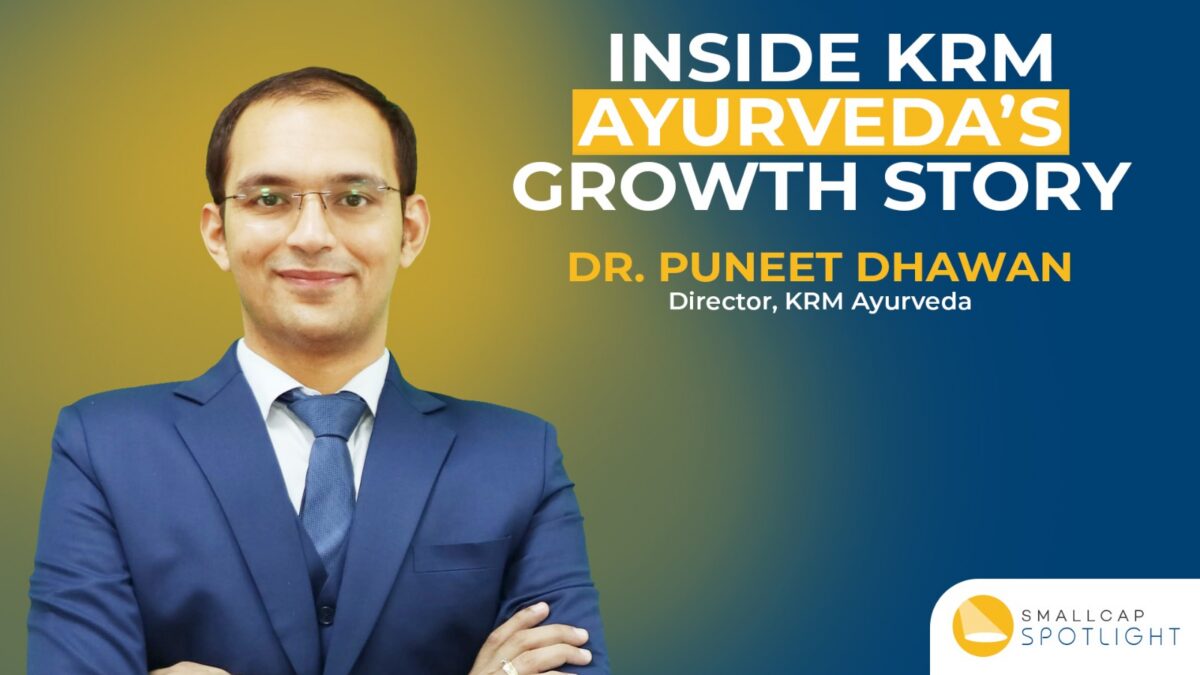
We interviewed Dr. Puneet Dhawan, Director, KRM Ayurveda, at The Growth Exchange 2026 – Investor Connect Series by AKMIL Strategic Advisors. He discussed KRM Ayurveda’s integrated healthcare model, global demand for Ayurveda, and the company’s expansion plans across hospitals, clinics, telemedicine, and manufacturing to support long-term growth.
Karunya Rao: Hi and welcome to SmallCap Spotlight. Today I have with me the management of KRM Ayurveda, the director of the company, Dr. Puneet Dhawan. Hi and welcome to the show.
Dr. Puneet Dhawan: Thank you so much.
Karunya Rao: So, the company was formed in 2019. Talk to us about the journey from being a start-up to now a listed enterprise.
Dr. Puneet Dhawan: See, Ayurveda for me is far more than a company. What does Ayurveda say? Ayurveda says that you should not fall sick. If you are sick, then you should be healthy.
You should be cured. This is what 107 paithis of our world say. But Ayurveda is such a paithi that says that you should not fall sick.
The wellness that we talk about, the longevity that we talk about, that has been told in Panchakarma thousands of years ago. It is necessary to only recognize our own paithi. And this is what I thought of taking Ayurveda all over the world.
We should make people recognize our paithi and make them understand. This is why we are here and we are very keen for this.
Karunya Rao: Interesting. What made you join the company? What has been your personal journey like? And what exactly is your role right now?
Dr. Puneet Dhawan: See, I started off in 2012 when I passed out from Delhi University as a BMS graduate. Alongside, I am the 5th generation in Ayurveda. So, I have seen this right from my birth.
How the progressive results of Ayurveda are there. The only thing which is lacking is letting it go to every home across the world. We call it Vasudev Kutumbakam.
The world is my home. So, let Ayurveda reach every place, every house. Let us be able to spread Panchakarma, Shodhan, Shaman, and Chikitsa everywhere.
Let there be so many clinics, hospitals, and doctors. This is what we are working for.
Karunya Rao: Interesting. So, if we talk about the business model of K.R.M. Ayurveda, you are operating hospitals, clinics. You have telemedicine services and in-house medicine manufacturing. So, which business is contributing the most? What are the different verticals? How are they positioned?
Dr. Puneet Dhawan: All these are contributing to each other. As I told you, I know only one thing. How to treat the patient? How to give results to the patient? The chronic problem of the patient. Kidney, heart, liver, knees.
How to give results in all these things? For that, we have medicines manufacturing. For that, we have hospitals. For that, we have clinics.
The core thing is that the patient should get relief. Where he comes to us after getting allopathic treatment from multiple places. He has become a permanent patient there many times.
When he comes to us, he should get results. The core philosophy behind everything that we are operating is this only.
Karunya Rao: At the end of the day, you are running a business. You have created that ecosystem of different parts that come together to form ERM. How has that ecosystem helped you run the business more effectively? You have everything from a clinic to a hospital to an in-house medicine facility. How has that shaped?
Dr. Puneet Dhawan: We have an in-house manufacturing facility.
The medicines and the oil that we are using in our clinics and hospitals are going from the in-house facility only. This certifies that the quality of the medicines, the quality of the oil and the quality of everything that we are using on the patient is above mark. We are ensuring that the quality of the medicines and the results are in proportion to that only.
For ensuring that, we are integrating the whole ecosystem.
Karunya Rao: Since you talked about quality, tell us about the regulatory licenses and all the permits that you have in place, the QC that you have in place. How does R&D happen?
Dr. Puneet Dhawan: All our clinics are NABH accredited clinics.
We have around 80 Ayurveda doctors on our payroll. We have a team of R&D department in which 6-7 MD doctors are there who are creating the SOPs, driving the R&D. Alongside, our manufacturing plant is a GMP certified plant.
Karunya Rao: This is a very exciting sector. Globally also, we are seeing a lot of interest and a lot of demand for Ayurveda products and services. How do you see that as an opportunity? Globally, what is the kind of clientele that you are right now catering to?
Very interesting. In fact, I would like to mention over here that 25% of our whole revenue is coming from Europe and European countries and the Middle East. People over there are fed up of eating antibiotics. They are looking for a change.
In finding that change, Ayurveda is bridging that gap. In all, if you look at the sector, it is booming. People are looking for alternatives to allopathy.
They are looking for alternatives to their health treatment which primarily used to be allopathic treatment. Post COVID, the awareness among the people has increased many folds.
Globally, you said that 25% of the business is coming from international clientele and markets. Is it primarily from the telemedicine services or is it also some physical presence that you have or perhaps you are looking to expand?
Dr. Puneet Dhawan: It is from both the sectors. Perhaps, we are looking to expand across India and across globally also. Whether we talk about Middle East, United States, Europe or any other African country, we are trying to step in with our footprints.
Karunya Rao: What about India? You are currently operating 6 hospitals, 5 clinics. What is the expansion roadmap like and which geographies are on your radar?
Dr. Puneet Dhawan: We are coming up with a lot of new hospitals across India. We are targeting around 100 clinics.
Karunya Rao: By when?
Dr. Puneet Dhawan: In the next 3 years. Also, we are expanding to increase the number of hospitals that we currently have and increase the capacity of the bed by about 5-6 times.
Karunya Rao: You also did an IPO recently. One of the objectives was to invest in the telemedicine infrastructure and digital capabilities. How much money has gone into that? What is the plan there? How do you want to grow it?
Dr. Puneet Dhawan: Around 20% of the IPO proceeds were meant for that. For the same, we are building up a capacity of around 1250 people in the telemedicine sector.
Karunya Rao: As you scale, what is the growth plan, the vision, any targets that you want to highlight to your potential investors who are watching this?
Dr. Puneet Dhawan: Sky is the limit.
Karunya Rao: Any numbers that they can track the company with or should be watching out for in terms of future trajectory?
Dr. Puneet Dhawan: Watch out for the next couple of years results and you will see the changes. We are planning a lot of things and expanding rapidly.
We are expanding our capacities everywhere whether it is hospital, clinic or manufacturing by multi folds. You can expect the numbers accordingly.
Karunya Rao: You had also said that you work with a strong panel of doctors and management.
Who are the core people running the business alongside you who are helping scale up different verticals? Tell us a bit about that.
Dr. Puneet Dhawan: We are a very good and a huge team of HODs in every place across every sector who are managing their respective departments. Those people are highly trained, highly efficient and highly effective people coming from the respective field zones.
Many healthcare businesses are now heavily reliant on data analytics, AI, tech R&D, digital health records.
Karunya Rao: Are there any tech initiatives specifically that you are taking?
Dr. Puneet Dhawan: Yes, we are having our in-house software, in-house tech team to ensure that whatever data is coming we are able to properly use and properly churn the data.
Karunya Rao: Alright, thank you so much.