
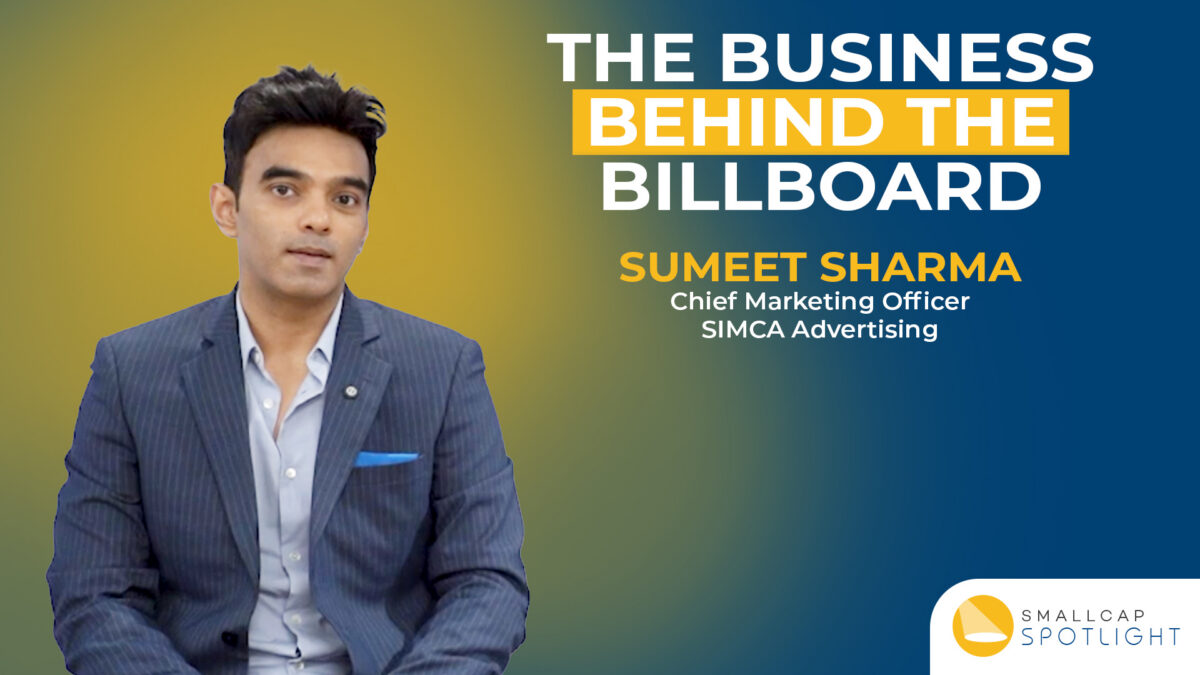
SmallCap Spotlight interviewed Sumit Sharma, CMO, Simca Advertising Ltd. at The Growth Exchange 2026 – Investor Connect Series by AKMIL Strategic Advisors. He highlighted the company’s evolution into a 360-degree out-of-home advertising solutions provider and outlined its strategy to expand digital advertising assets to meet rising demand and drive future growth.
Anjali Palod: Hello and welcome, you’re watching SmallCap Spotlight with me Anjali Palod and today on the channel we are joined by Sumeet Sharma, the CMO of Simca Advertising. Hi Sumeet, welcome to SmallCap Spotlight.
Sumeet Sharma: Thank you, hello.
Anjali Palod: So, the roots for Simca Advertising goes back to 1970, which means it’s been over five decades that the company has been around. Take us through this journey that the company has taken so far, what have been the key pivots that you’ve made, you’ve recently had an IPO also. Yes.
So, take us through everything.
Sumeet Sharma: Right, so it’s like more than a five decade old company as you said, started as an asset management company. So, we were like creating assets and creating assets like I’m talking about billboards.
So, we were identifying the most prominent locations, identifying demands for those locations which would occur in the future. We created assets, holdings and then once we were through with and became experts of direct and indirect marketing, we started an agency division of our own. So, now we are a complete 360 degree solution provider when it comes to overwatch media services.
Right, so out of home advertising, you’re you know very prominent in Mumbai, rest of Maharashtra, especially if you look at billboards, be it the digital assets that we’re seeing around.
Anjali Palod: So, how is your business model different from the competitors that you see? What is the kind of competitive intensity that you see in this industry? How do you stand up?
Sumeet Sharma: So, as I said we are like one of the oldest companies. We have a foothold since more than five decades.
So, we have already established you know a market leader kind of a position in the market. We have and then there is a government law, you know you cannot flood the market with number of XYZ number of inventories. So, once you have erected an asset, there is a government law that you cannot have a second asset in the periphery of more than several lesser than 70 metres.
Okay. So, I’m already secured and I’m already there at the most prime locations. So, I have this competitive edge of the quality that I’m talking about because the most of the premium locations are owned by us.
Right. So, mathematically obviously I’m more economical plus I have the quality. So, these are the two competitive advantages which helps us you know get the campaigns and to you know come out as on the top.
Right and if you look at the trends that are evolving in the out of home advertising, digital is one trend that is being picked up by the entire industry.
Anjali Palod: You’ve in your recent IPO also have said that you will be utilising these funds to expand on the digital assets. So, help us understand the expansion that you’ve planned and also how does this contribute to your revenue or over the next 3-5 years.
Sumeet Sharma: Sure. Let me give you an overview first what OOH advertising is. You must have seen the traditional formats of billboards that is a static.
So, over here I’m only able to sell it to one single point of contact could be a direct client or an agency. When I convert my hoarding into digital, I have the potential to sell it to six different clients. Right.
So, my revenue is multiplied by six times. So, that is the growth potential. So, just like a real estate the entire advertising industry of OOH revolves around demand and supply.
Right. So, Bombay there is constant increase in demand because of the new startups coming into the picture, new redevelopment projects coming up. So, there are like hundreds of billboards but there is demand for 200 billboards.
So, how do we supply? So, by converting the existing static hoardings into digital is the only solution. So, this way my revenue is also increasing plus I’m also able to meet the demands. Right.
So, supply problem is what digital solves right at its core. In MMR because you can only have some limited number of hoardings, you can’t just put up a hoarding anywhere and everywhere. Right.
And I mean advertising arguably is an industry that works with any and every other industry. Right. Real estate, insurance, banks, consumer products.
Anjali Palod: Right. So, what do you think are the biggest industries that are advertising right now, the biggest growth drivers for you? Do you see one or two becoming the prominent advertisers in the next three, five years?
Sumeet Sharma: The drivers at the moment are the OTT for sure. They are coming up really big, followed by real estate, then comes the FMCG and then the BFSI sector.
Okay. What I’m seeing or forecasting next is like the airline sector because they have been having a lot of struggle. Tourism is increasing because a lot of people have now started spending a lot of money on holidays.
Right. So, a lot of you know new, you know you must have recently seen Maharashtra tourism campaign. So, even the states have started investing in promoting their own you know cultures and everything.
Yeah. So, they are investing heavily into out of home advertising all across India and not just even in India. They are participating in trade shows internationally and they are marketing about India all over the globe.
And even like other countries have realised that India has is so densely populated. So, they are investing heavily into OH marketing and making their countries you know popular so that people travel more in their countries. And this is so OTT and all other newer industries that are also coming in and digital to a large extent solves the supply problem also for you.
Anjali Palod: So, with all of this over the next five years, what are the biggest strategies that Simca is going to be using to capture most of this upcoming demand and also stand out as you know one of the largest players in this space?
Sumeet Sharma: As I said, we are already focussing on converting our existing static sites into digital. Right. So, our immediate plan of action is to identify five prominent sites, convert them.
A lot of capital is required for which we have also come up with our IPO. So, our major focus will be to converting those strategic sites into digital and meeting the demand. So, it is not that every location has a demand.
For example, there are prominent junctions which has a lot of demand. So, I will be converting those identified spots and converting those into LEDs like the Bandra reclamation stretch. I have only already converted two of my prime sites over there into hoardings.
Still, I am operating at 100% occupancy. So, I have a scope of converting another 4-5 assets over there, meeting the demand. So, one slot I am selling at 20 lakh rupees, one static site I am selling at 25 lakh rupees a month.
So, I have the potential to increase my revenue by converting one site up by 80 lakh rupees a month.
Anjali Palod: And if you offset that with what is the capital required to set these up, how soon do these LED digital screens break even by themselves?
Sumeet Sharma: Within 2-3 years. Optimistically, if I have to say 3 years.
Anjali Palod: Alright, with that, thank you so much Sumit for joining us here on SmallCap Spotlight and giving us a glimpse into Simca advertising. It’s been a pleasure. Thank you.