
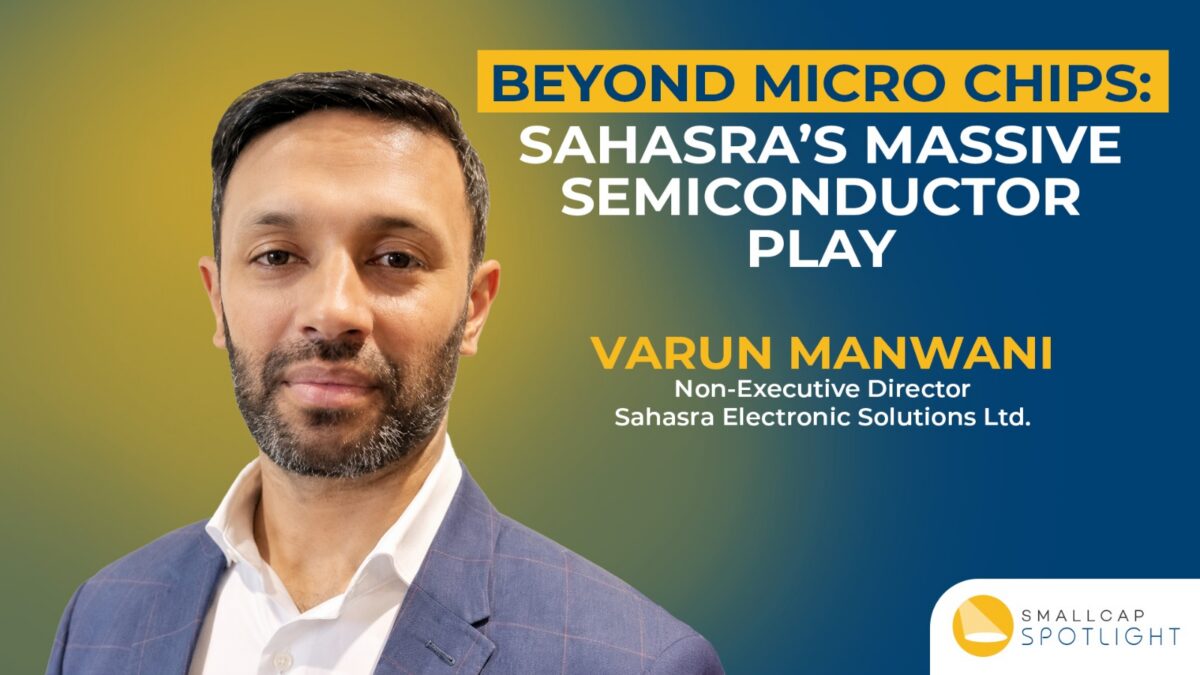
Varun Manwani shared that Sahasra Electronics has evolved from an export-focused EMS player into a diversified electronics manufacturing group spanning EMS, PCB fabrication, memory products, IT hardware, and semiconductor packaging. He highlighted the company’s plans to scale its semiconductor business, expand into new electronics verticals, and target ₹700–800 crore in revenue over the next 3–5 years while supporting India’s self-reliance in electronics manufacturing.
Karunya Rao: Hello and welcome to SmallCap Spotlight. I’m Karunya Rao and today we’re being joined on the show by the management of Sahasra Electronics Solutions. The non-executive director of the company Mr. Varun Manwani is here with us. Hi Varun and welcome to SmallCap Spotlight.
Varun Manwani: Yeah, hi Karunya. Thank you so much for having me on this programme and hello to all the viewers.
Karunya Rao: Well, you know, it’s a pleasure to have you here with us today. First up, I want to understand what exactly does Sahasra Electronics do? What are your offerings and which segments of the market do you operate in?
Varun Manwani: Sure, so Sahasra Electronics is, basically we are in the business of electronics manufacturing and this is electronics contract manufacturing. However, this specific industry is termed as the EMS industry, which stands for electronic manufacturing services.
We have been in operation over the last 25 plus years and actually we were born basically in the year 2000 and Sahasra stands for millennium in the Indian language Sanskrit. So that’s why instead of calling it millennium electronics, we called it Sahasra Electronics. And so we’ve been in this electronics domain over the last 25 plus years.
Within the electronics business, we initially had started catering our products and services for the export market and we remained an export player for a very long time till about 2015-16. And then, you know, as we saw that the Indian market was also growing and the demand in India was also starting to pick up, we also started to look at the Indian market to some extent, but not fully. However, we moved towards the Indian market in terms of giving our products and services just about a couple of years back.
And this started from the listed arm, which is Sahasra Electronics Solutions Limited. So just in the last couple of years, we’ve really moved towards doing domestic supplies as well.
Karunya Rao: Okay, that sounds interesting. How long have you personally been associated with Sahasra Electronics? And how has your journey been with the company?
Varun Manwani: Well, I’ve been actually associated with the business for the last 26 years as well. So when this business was born, Sahasra, I had joined the company at that point of time as well. My father and the chairman, he founded the company and I joined in the very same year.
We had some legacy business, which was the PCB manufacturing arm. But once we gave birth to Sahasra and this business started, this clearly became the mainstay of the entire group. And we had a reasonable amount of rapid growth.
And therefore, as part of my journey, as I said, I have been in this business for 25-26 years. I have worked in several roles across these many years. And today I’m in the management position as a non-executive director.
Karunya Rao: Okay, all right. And what about the vision for growth? Before we talk about that, if you could also tell us in brief how the journey of growth has been so far since inception and what lies ahead? What is the vision that the management has envisaged?
Varun Manwani: Sure. So actually, the very first company that was found was this company by the name of Sahasra Electronics Private Limited, which is also in the same business as the EMS industry that I just mentioned.
However, the first company that we gave birth to or which was formed, there are two other partners in that business. And primarily the operating partner sits in the US. And the responsibility that lies with them is to be able to solicit business for the company back in India.
And so that’s why I said we started with exports. Now, over the last several years, we formed different companies moving into different areas of the manufacturing supply chain, or rather the manufacturing value chain. So as I said, we got into PCB fabrication.
Then we also got into solid state memory business in the year 2016, when we joined hands with a company in Taiwan. This was a strategic technology alliance. And so the solid state memory business is what means building memory solutions like USB drives, micro SD cards, solid state drives and DDR modules.
Thereafter, in 2017, we also had a joint venture with a company in Taiwan called Mitac. And through that, we got into the IT hardware business. So over the last several years, we’ve been able to diversify our portfolio.
However, it continues to remain centralised to our core value of being in electronics manufacturing. As I said earlier, we have always focused on the export market, which has given us a tremendous amount of growth, access to technology, being able to work towards the latest standards in terms of quality requirements, in terms of certifications, etc. You’ll be able to offer to the market.
And now with that, we are looking at much larger plans that we have, whereby we are wanting to expand our operations, not only within India, but also operations across the globe. The last point in terms of vision also. So along with the other businesses that I mentioned, back in 2020, we also started a greenfield business called Sahasra Semiconductors, which is a subsidiary of our parent listed company.
And Sahasra Semiconductors was actually born even before the semiconductor shortages hit the market, before the government came up with the policy on the strategic semiconductor working. And this ISM was started, which is the India Semiconductor Mission. So as part of this journey, we’ve now also moved into the semiconductor space.
And within the semiconductor packaging space, we had a combination of an OSAT and ATMP, which basically means that we are not only packaging products for some customers, but we’re also packaging solutions of our own brand or other products which we develop and we own. And that is what we are offering to the wider market in terms of the memory market. So again, coming back to in terms of vision, we’re looking to play our role in the self-reliance that our Prime Minister has called out, especially in the electronics manufacturing and memory product space.
And yeah, so there are big plans to be able to expand our operations and be able to provide products and services to our customers.
Karunya Rao: Interesting. But as of today, which segments or business segments do you think are the main contributors to your growth at the moment? And going forward also, if you’ve identified any key growth drivers in terms of revenues?
Varun Manwani: Yeah. So if I split it between the two main entities, one is the semiconductor operation, the second is the EMS operation. So under the semiconductor operation, as I said, that main product offering from our side is the memory product portfolio. So there we are focussing on storage memory products.
And therefore, this is consumer products which are used by all of us, you and me, everybody put together. And so we are primarily targeting the export market. As of last financial year, our exports were the tune of about 64-65% out of the total revenue.
Coming to the EMS side, we serve again a pretty wide variety of markets. However, industrial electronics is our majority focus area. Other than that, we also serve IoT electronics, medical, railways, aerospace, defence, strategic electronics, etc.
But looking at the future, we’re also looking at energy solutions, metering, automotive in a big way. We’re looking at some consumer-related products as well. Again, electronics today is being used everywhere.
Every product that you pick up, there is some level of electronics being used. So there is a huge demand and scope. And in India itself, there is talk about electronics demand going up by about 5x.
So it gives us a very wide opportunity. However, we don’t really focus on the mass market products. We are not in the mobile phone segment.
We don’t do wearables, wearables. So that’s the only segment that we stay away from. But other than that, we’re looking at many other newer verticals.
Karunya Rao: Okay. So if I were to ask you what makes Sahasrara different from other EMS players in India, what would be your answer?
Varun Manwani: Well, I’ll summarise it into three or four points. Number one, so we typically tend to focus on mid-to-large size players, rather than only looking at very mass volume products.
Number two, we have always focused on exports. Even today, at the end of the last fiscal, 55% of our EMS revenue came from exports. 65% of semiconductor revenue came from exports.
So that’s our second point which differentiates. The third is that we are, again, a diversified organisation. The core being electronics, but we’re diversified with having interest in PCB manufacturing, having interest in the EMS business, having interest in semiconductor packaging, having interest in RFID, the memory products, IT hardware.
So while it all relates to the electronics core, but it also derives us from being focused on a specific market. So, and again, you know, being in the semiconductor, we’re looking at technology solutions. And that’s where our focus is, that to be able to, you know, be able to focus on technology areas, and again, try and ensure that, you know, we can make ourselves and India also self-reliant.
Karunya Rao: Interesting. Can we also understand what the market and the opportunity size is right now for electronics manufacturing in India? How big is the opportunity? If you could give us some sense of the addressable market size?
Varun Manwani: Yeah, so it is said that, you know, India will be able to go to about $300 billion within the next three to five years. So about, let’s say about 2030.
Currently, you know, the capacity or the market is about 70-80 billion. So therefore, there is clearly growth of 3x, 4x. There are for sure new players who are coming into the market, but established players and who have been there in the business for long, you know, for example, like us, the addressable market becomes a lot easier to be able to focus on.
Because within the electronics industry, you know, you have to have a lot of experience, be able to understand how the market works. There are a lot of certifications, compliances, etc, that one has to meet. So at this point of time, I think, you know, the sky is the limit.
If you get your strategy right, and you get all your ducks in a row, I think everybody can have, you know, a good amount of growth in the years to come. As has been clearly said, you know, the next decade, or as they say, the decade belongs to India. With the geopolitical environment, with the policies in place by the Indian government, everything seems to be very conducive.
Yes, there are global challenges that are there, as we can see, you know, with, you know, unfortunately, you know, wars going around us. But it also, you know, if you see that the Indian middle class is growing so much, and that brings in opportunities of the massive demand that is in place. So there is a huge opportunity available for all of us.
Karunya Rao: Interesting. You had also briefly mentioned about the semiconductor packaging business. Can you tell us how big it is right now and help us understand what exactly are you doing there as of as on today?
Varun Manwani: Yeah, sure. So as of today, our current facility is spread over a two acre piece of land. We have 6000 square metres of manufacturing space and 6000 square metres of clean room space. At present, our capacity is 6 million units. And in the time to come, we’ll be able to increase this to about 10x, so to about 60 million units. At the moment, we are focussing on the consumer memory segment. And as we scale up, we will, you know, start focussing on industrial segment as well, which is definitely more lucrative.
And there is a massive demand within the storage and memory industry due to the AI boom. However, our product offering currently is still very limited. And in the next two to three years, as we scale up, we will be increasing our product portfolio.
As I said previously, we are currently focussing on micro SD cards and USB drives. But we will start getting into higher end products and packages like EMMC, UFS, EPOP. And this means we will be adding both capacity and capability.
And recently, the central government had announced the next, you know, chapter of the ISM, which is ISM 2.0. So that perhaps should, you know, be out in the next couple of months. So we will definitely apply for that. And also to our good fortune, our semiconductor facility is based in Bhiwadi, Rajasthan.
And just recently, about a month back, the state government of Rajasthan, under the Honourable Chief Minister, Bhajanlal Sharmaji, they came up with a specific state semiconductor policy for Rajasthan. So with us being there already, it gives us a good flip to be able to participate in that semiconductor policy project and be able to expand and scale up our operations.
Karunya Rao: Okay, that’s good to know. What about, you know, since you’re talking about scaling up, I want to first understand what is the current manufacturing capacity looking like? And when you say scale up, what is the expansion plan? What is the capex that you have earmarked for that?
Varun Manwani: Right. So as I said, our current capacity is about 6 million, we are looking to scale up to about 60 million. However, out of the 6 million, our current, let’s say, capacity, which we are using is just about 6 to 8%.
Now, this is because of two reasons. One, there is a shortage of the key raw material, which is called the wafer, which the access has gone down for that because of the huge global shortage due to the AI boom. So as, you know, more and more fabs come in place, which manufacture semiconductor wafers for the memory business, there will be better availability of those wafers.
And so we’ll be able to, you know, scale up a lot more. The second is that, as I said, when the product portfolio enhances, our capacity utilisation numbers will also increase. And so, you know, we’ll probably reach a much higher capacity utilisation.
In addition, the current market that we’re addressing is again limited due to the consumer portfolio. As we go up the value chain, which is, you know, getting into industrial solutions, etc. We will at the back end work on developing a very sustainable and sizable engineering team, because that will be one of the keys to success, whereby we can have control on our designs, control on our supply chain.
And so for that, we will be investing heavily. So just to give you rough numbers, we would be looking at an investment of anywhere between $50 to $60 million in phase two. So at today’s exchange rate, this is anywhere between 500 to about 600 crores.
And through that, let’s say about 50% of this will go into the R&D and engineering space. And the balance will get into the manufacturing, equipment and facility expansion, etc.
Karunya Rao: You were talking about scaling up on the people front. So tell us who are the founding members, the core team members right now, of course, it’s good to know that you want to onboard more, you know, technical talent, but right now, who are the key people running the show?
Varun Manwani: Difficult question, because I think everybody is key. We currently have a small team of about 42 people. So at the semiconductor operation, so let’s say at this stage, everybody is key because while we are bootstrapped, but I would say we are also like a startup.
And so everybody has got an important role to play. However, if I would still, you know, have to name the four, five, you know, extreme key people. We have obviously our chairman, Mr. Amrit Manwani, whose whose, you know, his vision is helping us, you know, go to the next level.
I’m involved in the operations side of the business and in terms of the business planning. Then our CTO, Mr. Parvez Khan, who’s also the CTO for the EMS operation, he’s got a very heavy role to play. Then our business unit head is Mr. Jerry Enriquez.
He’s a Filipino. And so he’s working at our operation in Bihari and he came and joined us about a year and a half back. And then there are a couple of others under him who are helping the operation, but also a couple of key salespeople who are driving the business.
So Ankur and Vivek. So let’s say we five, six people are the core team who have been there right since inception. And so as I said, everybody else has also got a good role to play.
But in the time to come, we will expand primarily in the engineering and R&D space. We’ll be looking to onboard talent in that space to a large extent. As well as add manufacturing and quality talent as well.
Because as we scale up, as we get into more advanced packages, we’ll need a lot more knowledge and a lot more contribution from all the other people that we will onboard. Okay. That’s interesting to know.
Karunya Rao: And at the start of the interview, I asked you about what is the vision of the company for growth? Are there any targets, anything empirical that you can share with us, any five-year, 10-year plans in terms of the revenue or the profitability or margin figure that you have perhaps set for yourself, for the company to achieve over the longer term?
Varun Manwani: Well, we’re targeting to be a 7 to 800 crore company in the next three to five years. We have always been very focused on our margins. And so as of today, we are at a 15% PAT margin based on the last numbers that we’ve had in the last fiscal year.
We’d like to continue to maintain that kind of profitability. We currently operate two manufacturing facilities for our EMS operations and one for the semiconductor operation. We are also going through a merger process whereby our three other companies, which include the non-listed EMS company, also the PCB manufacturing company, all of these businesses will also get subsumed into the listed entity.
And so therefore we will have a total of six manufacturing facilities. So this is supposed to, if all goes well, should happen by the end of this fiscal year, so by FY27. And then that gives us a good base to be able to expand further and be able to achieve these targets.
As I said, we will be focussing on the newer markets that we’ve not looked at so far. So automotive, further in the metering consumer segments as well. And so again, with the support of government policies, I think we would hopefully be able to achieve these targets that we have in place.
Karunya Rao: Great. And we wish you the very best for that. Thank you so much, Mr. Manwani, for joining us once again on SmallCap Spotlight and sharing with us the company’s growth story and what potentially lies ahead for Sahastra Electronics going forward.
Varun Manwani: Thank you very much, Karunya, for having me on this call and this discussion. And we would love to have all our stakeholders remain together with us. The merger as well will bring a lot of value unlocking for all our investors, stakeholders, be it our customers, employees, suppliers, as well as the environment.
So thank you very much. Thank you once again.