
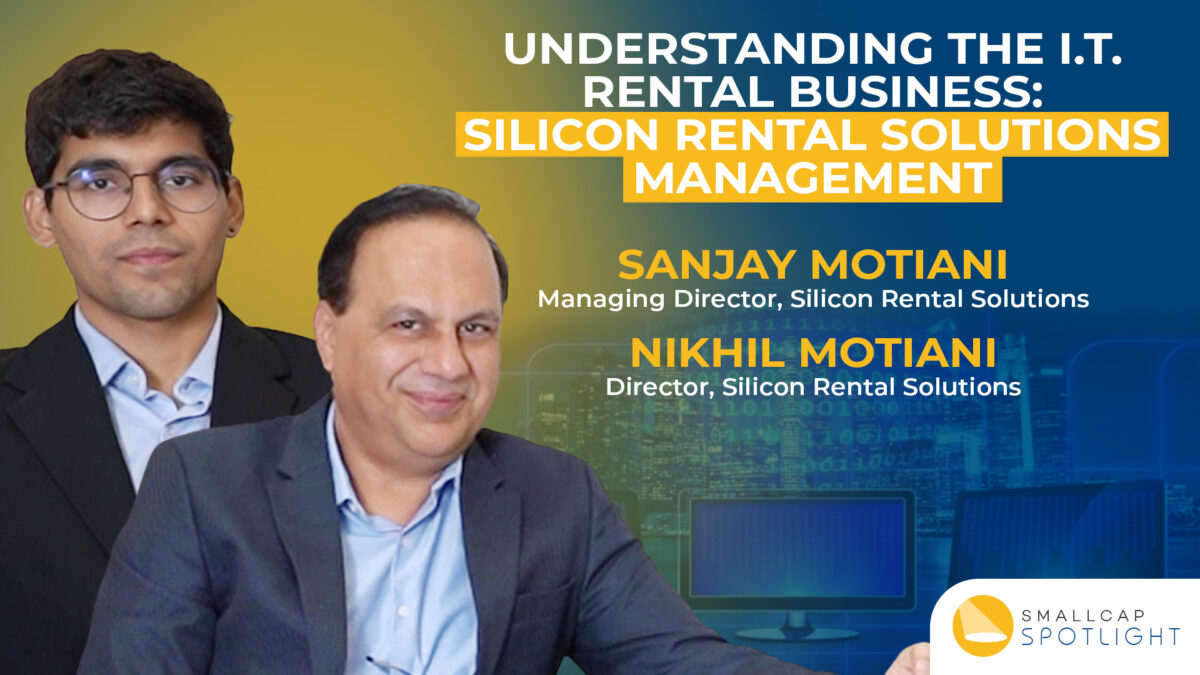
Silicon Rental Solutions Limited offers end-to-end IT equipment rentals, helping businesses avoid upfront capex while ensuring seamless service and maintenance. With a strong service-led model and pan-India presence, the company maximises asset utilisation across diverse customer segments. It is now expanding into new verticals while targeting 35–40% growth and broader tech solutions positioning
Richa Jain: Hello and welcome, I’m Richa Jain. In focus today is Silicon Rental Solutions Limited, one of India’s first listed companies in the IT rental space, boasting a 30 plus year legacy. Let’s welcome on board the company’s Managing Director, Mr. Sanjay Motiani and Director, Mr. Nikhil Motiani, as we uncover more about Silicon Rental Solutions journey, their vision and the plan that they have ahead.
Thank you so much for joining us, Mr. Sanjay and Mr. Nikhil Motiani. I’ll begin with my first question.
Richa Jain: So what does SRSL do and what is the problem that you solve?
Sanjay Motiani: So Silicon Rental Solutions is an IT company which rents out laptops, desktops, servers, networking products, everything on a rental basis from one day to 60 months also.
So we have varied options available for clients. They can take on rent for a day or take it on a monthly basis and over a period of a long term also so that their ROI works good and at the same time we take care of the complete service, including deploying, logistics, everything is taken care of by us. So they don’t have to bother about the, what do you call, the IT depreciating asset, whereas they can concentrate on their own business rather than concentrating on a depreciating asset and basically a high maintenance asset.
So laptops, desktops give you a lot of maintenance. So this problem is taken care of by us, where we give you the complete solution, we give you the engineers along with it, we give you the laptops, desktop at your doorstep, we take care of the complete logistics, especially after COVID, like there are multiple locations where engineers are or your staff is staying. So we give a multiple location delivery also.
So we take care of the delivery, collection and service at those locations also. So we are basically a complete IT company which will give you the complete solution for all your problems basically. And of course, because you’re not doing any capex, you have your funds available for your business where your profit is much more.
Richa Jain: So that’s the very good outcome of your, instead of buying it, you can rent it out from us. Got it. Complete end-to-end solution based company.
Okay, lovely. Now, so what are the key lessons that shaped you, that helped you build SRSL?
Sanjay Motiani: So we started 30 years back, we went to sales service. So our background has been a lot of service and giving complete solutions to clients.
Slowly we realised that renting is a very, very good option, where capex involved, which were very much capable of investing money. And it becomes a beautiful option for the client where he doesn’t have to invest. And because we are from the service background, we could provide the complete end-to-end solutions to the client.
So they are basically, they have a monkey on their shoulder where they don’t need to take employee staff for maintaining the machines, taking care of logistics. And so that’s how we got into renting business. So for the client, it is low capital investment.
For us, it becomes a beautiful ROI where we, you know, over a period of time, we make money. And because we have various levels, you know, because initially we give it to corporates, SMEs and, you know, big companies, multinationals. And then we have the next level of client where we have colleges, schools, where we deploy.
So we had a very good ROI and because our service is so good and our maintenance of our products is so good that we can continue using the machines for over a long period of time. So that is how, you know, considering all these things, we thought this should be a very good option and it really worked well for us.
Richa Jain: Right. And since we are speaking, since this is a rental-based business, how do you think the rental market is changing in India?
Sanjay Motiani: So basically, if you see the latest Gen Z and the Alphas, we’ve seen that these kids have now realised that, you know, they don’t want to own a product. They want hassle-free, you know, products where, you know, they just rent it out and our generation was totally different where we wanted to own everything. Now the generation is looking at options for renting because what happens is they don’t own anything.
They don’t have to make a capex. At the same time, you know, one call and everything is taken care of, right, from replacements to repairing to, you know, deploying. Everything is taken care of by us.
Whereas when they buy, they have to make a capex. They have to take care of the service. They have to employ, you know, service people, managers, and everything has to be taken care of by them.
And not to forget that even new laptops which they buy, they have some issues, you know. So they have to continuously have somebody who will follow up with the main companies to, you know, give the laptops, collect it back again, and those laptops take 10 days. So the salary cost if you consider if something is down for 10 days is going to be quite huge as compared to the rental cost.
So that’s why this works out much better. We ensure that, you know, we give you some kind of almost a 95 to 100 percent kind of uptime because we give spares along with the laptops that we rent and we also give standbys and engineers along with it. So everything is taken care of by us.
So that helps, you know, a client to focus on their business basically and grow much faster.
Richa Jain: Absolutely. I mean, it makes sense.
It becomes very economic to the client also and that’s why clients prefer renting versus buying. Could you throw some light now on to how does a rental business like this make money? Because you are solving a lot of problems for the clients.
Sanjay Motiani: So basically, we work out a system where we do cover the cost of our service, the product, over a period of renting.
And that becomes excellent for the client and for us because, like I told you, we already have a second layer and a third layer where we give it to, you know, education institutes and then we have the BPOs, KPOs and call centres where we can use the machine. So because of our service, like I told you, we prolong the life of the product and we can use these over a period of time which becomes six to seven years, which becomes a fantastic ROI for us, which normally doesn’t happen with the clients. Clients might have to dispose of the product in three years because it’ll get obsolete.
Whereas in our case, because we have that kind of clientele where we can continue using the machine from three years onwards to almost six to seven years, we make a very good ROI. So that works good for us. That’s why we, you know, worked on this and it’s really worked well for us.
Richa Jain: Let’s talk a little bit about this journey that you’re talking about. After the first use, what happens to the equipments? What you just said stands true for most of your equipments because we’d love to hear more about what happens after the equipment comes back from the first customer.
Sanjay Motiani: So that’s what, so once it comes from the first customer, we have the second layer of clients ready who are willing to take cheaper options and they don’t need, see because if you go to see schools and institute, they don’t need a latest tech.
They need basically a computer which will be functional, which will be giving them a basic, you know, learning for the kids. And again, with call centres, they just need a basic calling. So that’s why when these high-end machines come back, they are good enough for the call centres, for educational schools, for schools and colleges.
So then we continue using them for a longer time.
Richa Jain: Right. Thank you, sir.
Mr. Nikhil Motiani, I’d love to hear from you, who are your customers? If you could throw some light.
Nikhil Motiani: Definitely. So we actually have served more than about thousand clients over our journey.
Currently, we have about 400 clients on board and they come from all different segments, right from corporates to a second layer of SMEs, BPOs, KPOs, educational institutions, startups. So the brilliance of our business is that we don’t cater to any one industry. We can cater to anyone and everyone who requires any IT equipment on lease or just requires IT equipment, and we can help give this solution to them.
So that’s why the brilliance of this business is that we’re not limited by a certain industry, you know, it caters to everyone.
Richa Jain: Lovely. It seems like it makes a lot of life comfortable for your customers and clients. I would love to know about how do you grow without underpricing your deals?
Nikhil Motiani: So till now, we realise that there is no point of undercutting, underpricing and, you know, not being able to compete when it comes to service. It’s all about giving the best kind of service while maintaining certain margins. So we have a very careful process of choosing our customers well.
We do not want to go where there people are haggling over 100 rupees, 200 rupees per month, etc. We have to stick to what we do best, which is our service. And until we get that alpha, we do not, you know, onboard customers.
Secondly, like I said, you know, since we’ve been in this industry for so long, we have a certain brand name and brand value attached to our name. And that is why there are certain customers who want to come to us. There are certain referrals that, you know, come through our own customers.
And since we have a good base, what happens is that we can easily use our customers to market for us further. And that makes sure that we have a certain rental market always available for us. And that’s the whole reason why we don’t need to undercut and we don’t need to, you know, keep competing just for the smaller deals or like where you have to keep competing for the under 200 rupees.
You know, we stick to our advantages.
Richa Jain: Got it. That makes sense.
Now, since this is an equipment and inventory heavy business, how do you manage some of the problems like damage, theft and defaults?
Nikhil Motiani: So, I’ll start with the fact that we have a very strong agreement in place with our clients. So, this has everything built in right from our lock-in to damage, theft, etc. Because what we realise is that we can’t sit and ensure, like, you know, ensure all of our equipment.
So, what works best is that any kind of major damages, any kind of theft, loss of property is taken care of by the client. Luckily, till date, we have not had too many, we haven’t had defaults as such. And usually, this kind of pricing sensitivity is built into our pricing model from the start itself.
So, it’s a very thought-out business where any kind of downside risk has already been built into the pricing.
Richa Jain: Got it. Thank you.
Why don’t you tell us a little more about the trading business and why do you do it?
Nikhil Motiani: What we realised over a certain time is that while rentals are definitely the things that didn’t actually strengthen our bottom line. And that is something that you want to focus on. There are times where we do have bigger clients, we do have clients who prefer to just buy equipment and taking our services.
So, that’s when we get into the trading side of things. So, it’s more of just an enhancer of the business rather than a driver of the business. It’s just something that we realised keeps us, rather than one customer going to another vendor, they can stick with us.
It also helps us increase our, what do you say, the number of things that we can give out to our clients. Because not all equipment might be, like it’s not easy to put everything on rent. It’s just easier sometimes to sell the equipment on day one and then maybe give them support over time.
So, it just somehow helps us stay all around like a one-stop solution for all customers.
Richa Jain: Absolutely. Cover all bases. All right. What, in your opinion, makes Silicon Rental Solutions Limited different from its competitors?
Nikhil Motiani: I think the easiest answer would be our Managing Director right here, Mr. Sanjay Motiani. I think it’s his experience, his skill, the way he handles clients.
Like I said, experience has played a major factor in this. Our management team on average, like our senior management team on average has been with us for more than 20 years. And in this kind of an industry, you do require that experience because it’s not easy to be able to have 40,000 assets on rent in the market and be able to cater to them in 250 different cities.
So, it’s more about having that pan-India presence and being able to achieve the same kind of support that we can do in the metros like Mumbai, Pune, in the smaller tier-2, tier-3 cities as well. So, it’s all of it combined, you know, our presence, our reach, our experience and just service. Service, like I said, service has been a major positive for us.
Richa Jain: Lovely. So, that seems there are all bases covered and there’s a pan-India presence. The service is something that you’re proud of.
So, what should we think of all the investors, you know, that are investing in your business? What should they expect in terms of growth?
Nikhil Motiani: I think the way we are working right now, we really believe that we are going to achieve 35 to 40 percent growth. And ideally, the way we look at it is that the business should double every close to about three years. And that’s how we want to keep the investors interested.
While we’re definitely working on growing horizontally in terms of our base and vertically in terms of our reach, we’re also adding a lot more new products into our services, etc., that, you know, make sure that the kind of customers that we are trying to reach out to are not just limited to IT. You know, it can be setting up robotics labs, etc., in education institutions. So, it’s our solar as well.
Sanjay Motiani: And in addition, white goods. So, these are the new things that we are planning to start. It’s going to be more than an IT company very soon.
Richa Jain: Oh, lovely. And I hear there is also a Centre of Excellence business. Would you mind telling us more about it?
Nikhil Motiani: So, Centre of Excellence is an opportunity that we saw about a couple of years ago, where we did work with a few companies who were setting up these things. And what we helped in was to convert the CapEx to OpEx. And that sort of worked out brilliantly for education institutions, because they don’t have to give their, you know, deploy the capital upfront.
So, basically, I’ll just give you an idea. So, what happens, we have so many engineering colleges. So, they have a lot of bookish knowledge.
So, with this skill development that is being promoted all over by the government, this was a new thing that the government was doing. They were funding these colleges to, you know, get more skill to their students, you know. So, that’s where we got this idea.
We worked with somebody, and they were kind of providing basic, you know, infrastructure for it. So, they were setting up robotic labs. So, that’s how we took that up, and we moved a step ahead.
So, now, we are looking at setting up robotic labs, industrial robotics, mechatronics, and cybersecurity, AI. So, we are setting up these labs. So, what happens, the student who is getting this bookish knowledge, he has an opportunity to go to the lab and learn everything.
So, if you see all these big companies, every time they hire somebody, they have to probably put in a year or six months to a year to, you know, get them to a level where they can start working with them on the, you know, production side. Whereas here, what we are doing, the students will, by the time they graduate, they’ll be knowing what is robotics, what is cybersecurity, what is AI, how do you programme, how do you set up, I mean, robotics labs, or how do you, you know, work on industrial robotics, or PLC, and, you know, all those things, they will have hands-on knowledge. So, in addition, like setting up an EV lab.
So, EV, a person who doesn’t, I mean, who learns about EV, he’ll be having hands-on training where he’ll be able to open and, you know, dismantle an EV and learn everything about the parts, the repairing, and everything will be taught to him in those, you know, labs in that period of time. So, the moment he comes out of college, he’s actually ready to be hired by a top company like Mahindra or Tata. So, you know, he doesn’t need to join and then start learning and then, you know, get on the job.
So, this is going to be a huge game changer, you know, in the long run. So, you’ll find students who would be actually, you know, ready for the industry.
Richa Jain: That’s amazing. It’s very nice to hear about that endeavour. Also, with the way technology is moving, the, you know, world is moving very fast, it’s important to innovate and pivot, which I believe also presents a challenge of there are so many choices. So, how do you decide where to invest your capital?
Sanjay Motiani: So, now we don’t need to decide because we have so many options and we are working on all of these and this is working out to be very good and this is a huge investment opportunity.
So, our hands are full and we have a fantastic ROI because these colleges will provide us revenue month-on-month basis and over a period of seven years at least. Yeah. So, this is going to be a fantastic opportunity for us.
Richa Jain: Okay. And in the future, do you see yourself growing through acquisitions?
Sanjay Motiani: That’s always our process in which we keep getting options. Yes, we are working on a few things.
So, it depends. I mean, this is definitely an option that we have and we keep it always open. Right.
So, that will give us, you know, basically access to various locations also and various other businesses also. So, yes, we are looking at options.
Richa Jain: It was lovely to speak with both of you.Thank you so much for joining us today.
Sanjay Motiani: Thank you so much.