
In the mid-2000s, the Indian Railways conceived what is known today as the DFC (Dedicated Freight Corridor) project, to de-link freight trains from passenger traffic and address chronic congestion on its rail network. And now, in 2026, roughly 96% of the 2,843 km network is completed and operational.
The project comprises two main corridors:
- Western DFC: JNPT (Mumbai) to Dadri (Uttar Pradesh), stretching 1,506 km, linking ports and industrial zones.
- Eastern DFC: Ludhiana (Punjab) to Dankuni (West Bengal), stretching 1,337 km via Uttar Pradesh and other states. This corridor is currently operational upto Sonnagar (Bihar) and plans are on to develop the remaining Sonnagar-Dankuni stretch via a public-private partnership.
India’s DFCs aren’t just any other railway project: they have the potential to completely change how logistics and businesses operate, since they are intended to improve freight capacity, reduce transport costs and support manufacturing, exports, and e-commerce. Here’s a detailed look.
How goods moved before DFCs: slow and steady
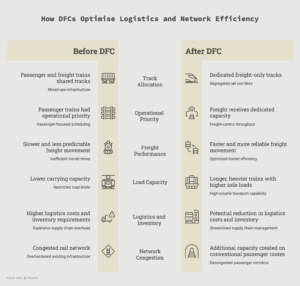
Prior to the development of DFCs, freight and passenger trains shared the same tracks. Since passenger trains received priority, right-of-way freight trains were forced to wait in loops or sidings. This resulted in lower average freight speeds, unpredictable transit times, lower asset utilisation and higher logistics costs overall. Slow rail movement also means that businesses have to maintain higher inventory levels across multiple warehouses located close to their customers.
How DFCs speed things up
Unlike conventional railway tracks, DFCs have been designed exclusively for freight movement. They have several features which enable trains to carry more freight and haul goods over longer distances. These include:
- Freight-only tracks with no passenger train interference
- Design speed of 100 km/h
- Higher axle load (25 tonnes, with future upgrades possible on sections).
- Double-stack container operations on the Western DFC
- Longer and heavier freight trains (up to 13,000 tonnes)
- Automatic signalling and modern train control systems
- Improved throughput and terminal efficiency
All these contribute to faster and smoother operations and less time in transit.
How DFCs have the potential to change logistics
DFCs don’t just move goods quicker, they also have implications and benefits across the supply-chain.
- Lower logistics costs: Due to higher axle loads and longer trains, each train can carry more tonnes of goods in one run. The cost is thus spread over a larger payload, reducing cost per tonne-km. Plus, with exclusive tracks, freight trains no longer have to deal with fewer stops, congestion, and bottlenecks, ensuring less transit time and smoother operations.
- Impact on warehousing: A possible long-term impact may be seen in the warehousing sector. With a more efficient freight model, businesses may rely on fewer but larger regional distribution centres. Manufacturers can reduce buffer stock and replenish inventory more frequently. There may also be increased demand for large Grade A logistics parks connected to freight corridors.
- A win for e-commerce and 3PL: The downstream benefits may also be seen in faster inter-city freight movement after shipments reach their hubs. Lower inventory requirements and faster replenishment at fulfilment centres allows for better allocation across regions, supporting e-commerce companies and 3PL (third-party logistics) providers such as Delhivery, Mahindra Logistics, TVS Supply Chain Solutions and Allcargo.
- The multiplier effect: DFCs improve connectivity between ports, manufacturing clusters and inland consumption centres. This strengthens the broader logistics ecosystem by supporting the development of multimodal logistics parks, industrial corridors, warehousing hubs and private freight terminals along those routes. Manufacturers and exporters benefit from lower transit times, better supply chain reliability and potentially lower logistics costs, while logistics providers can improve asset utilisation and network efficiency.
Smallcap and SME beneficiaries
The rail dedicated freight corridor has a direct impact on logistics and businesses, but the benefits also spill over to the SME sector and specific smallcaps that supply to railways, or are tied to them.
| Sector | How they stand to gain | Potential beneficiaries |
| Railway wagons | Higher freight volumes on Dedicated Freight Corridors (DFCs) drive demand for new wagons and fleet modernisation | Texmaco Rail, Jupiter Wagons, Titagarh Rail Systems |
| Rail EPC & infrastructure | Increased investment in rail connectivity, terminals and last-mile links creates more project execution opportunities. | IRCON, Rail Vikas Nigam (RVNL) |
| Logistics and warehousing | Faster transit times and lower transportation costs improve efficiency, and asset utilisation | Delhivery, Mahindra Logistics, TVS Supply Chain Solutions, Allcargo Logistics and developers of Grade A warehouses and multimodal logistics parks |
| Ports | Better rail connectivity enables higher cargo evacuation, increasing container and bulk cargo throughput | Port operators handling higher container and bulk cargo throughput |
| Manufacturing | Improved freight efficiency and lower logistics costs enhance export competitiveness and attract industrial investment along DFC corridors. | Export-oriented manufacturers and industrial clusters connected to DFCs |
A ripple effect beyond railways
Dedicated Freight Corridors are more than a railway upgrade: they represent a structural improvement in India’s logistics backbone. By separating freight from passenger traffic, they improve reliability, increase freight capacity, and lower logistics costs. Over time, the benefits are likely to extend well beyond Indian Railways, supporting warehousing, manufacturing, exports, ports, logistics providers and the country’s fast-growing e-commerce ecosystem.
Sources
Road to rail: Unlocking India’s freight potential
Dedicated Freight Corridor (DFC)