
India’s private hospital sector is entering a major expansion cycle. ICRA estimates that 18 large hospital chains are collectively planning to add more than 34,000 beds between FY26 and FY30, a 48–50% increase over their existing capacity as of March 2025. The required investment is estimated at around ₹40,000 crore.
This is significant because in India, the private sector accounts for more than half (the NSO’s 2018 survey puts the number at 55%) of the total number of hospitals in the country. That number is higher in urban areas, at 61%. In outpatient care, private hospitals and clinics accounted for 66% of cases.
The need for more hospitals and beds is substantial: An infographic from IBEF (India Brand Equity Foundation) illustrates how India has only about 1.3 hospital beds/1000 people, compared with a global median of around 2.9 beds/1000 people, leaving considerable room for capacity expansion.
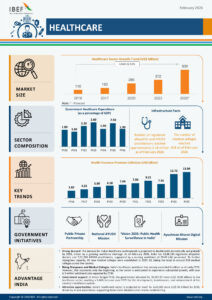
*Courtesy IBEF
Expansion is already underway among India’s largest hospital groups. Manipal Health, following its August 2026 listing, operates more than 13,000 beds across 49 hospitals and plans to add another 2,400 beds over the next three to four years. But, building more hospitals does not necessarily mean that hospital companies need to own every piece of infrastructure themselves — many things can be outsourced, and that is where the asset-light model comes in.
Understanding the asset-light model
In simple words, an “asset-light” model separates ownership of a hospital’s physical infrastructure from a hospital’s operations. In a conventional setup, the healthcare company or hospital chain may have to fund everything, including the land, building, medical infrastructure and equipment, interiors, utilities and other project costs. However, in an asset-light model, a property owner, developer, institution or partner can provide the building/infrastructure/maintenance, while the hospital chain provides the brand, doctors, clinical protocols, technology, operating systems and management expertise.
So how does this help? The hospital chain can concentrate its capital and management attention on what actually differentiates it, such as:
Doctors → clinical expertise → patient acquisition → technology → protocols → outcomes → brand; rather than tying up as much capital in:
Buildings → housekeeping → security → catering → maintenance → sanitation → support manpower.
Also, it’s important to note that running a modern hospital or healthcare chain is a complex, 24×7 operation. Once the medical experts and clinical team are in place, there is a long list of functions that require attention and can be outsourced:
- Housekeeping and sanitation
- Patient-care attendants
- Catering and clinical nutrition
- Laundry and linen
- Waste management
- Technical maintenance, HVAC and electrical maintenance
- Pest control
- Security
- Staffing/payroll
- Ambulance/transport support
- Front-office and other support functions
The asset-light model allows hospital chains to expand their footprint without committing the same level of capital required for traditional greenfield projects. Under an O&M (operations-and-management) arrangement, for example, the hospital infrastructure can be provided by a partner while the healthcare operator manages the facility and invests selectively in critical equipment.
And this segment (of outsourced hospital management functions) is where a handful of smallcap companies come in, participating in India’s hospital-capacity boom.
Apollo Sindoori Hotels: The full-stack service-management experts
Apollo Sindoori, part of the Apollo Hospitals promoter group, is a hospitality service-management and support-services company. Incorporated in 1998, the company is in the business of managing food outlets at hospitals and reputed organisations, and also offers facility management and other outsourcing services. Its hospital-related activities include:
- Food and dietary services
- Clinical nutrition
- Hospital food outlets
- Kitchen management
- Housekeeping/facility management
- Outsourced manpower and support services
While the hospital business has historically been an important part of revenue, the company is increasingly diversifying into other industries as well and aiming to move beyond the Apollo ecosystem in healthcare. In January 2026, Apollo Sindoori’s subsidiary won multiple facility-management contracts worth ₹64 crore, including contracts from Tata Main Hospital and the Government of Rajasthan, with a contract duration range of 1-33 months.
Krystal Integrated Services: The non-clinical infra specialists
Krystal is a familiar name in the facilities management space, and is one of the clearest listed smallcaps in the outsourcing layer behind India’s hospital expansion. While the company offers integrated facility management and staffing services, healthcare functions as a different vertical and contributes more than a third of revenue, with the company managing facilities across more than 100 hospitals and medical colleges.
In the healthcare/hospital space, Krystal handles most of the non-clinical operating infrastructure, including:
- Housekeeping
- Sanitation
- Patient-support services
- Security
- Staffing
- Facility management
- Waste management
Krystal has a client list that includes PD Hinduja Hospital in Mumbai and the National Cancer Institute. In March 2025, Krystal secured a sanitation-services contract from the Ministry of Health and Family Welfare for PGIMER, Chandigarh, under which the company would deploy 1178 trained personnel across patient rooms, operation theatres, high-risk areas and other parts of the medical campus. In September 2025, the company secured a 3-year ₹168 crore (approx) sanitation and housekeeping contract from the Directorate of Medical Education, Andhra Pradesh, covering Zone-I medical institutions. More recently, Krystal secured a healthcare facility-management mandate worth approximately ₹364 crore from Tamil Nadu Medical Services Corporation Ltd, for a period of three years, that covers institutions under various Tamil Nadu health departments.
Supreme Facility Management: The diversified small cap with a healthcare vertical
The company may be a micro-cap given its size and scale, but it still offers a broad outsourcing platform with integrated facility management, employee transportation, supply-chain solutions, corporate food/catering solutions and production support services. The company operates a unique “pay-per-use” activity-based model, where clients are billed dynamically based on actual consumption, specific tasks, or measured operational output rather than standard fixed monthly retainer fees. In addition, Supreme has a dedicated healthcare facility-management offering that includes:
- Environmental hygiene
- Asset management
- Housekeeping and infrastructure support
- Patient support services
- Energy management
- Emergency response planning
- Security access and control
The company extends its services to a wide range of healthcare facilities, including hospitals, clinics, medical centres, and nursing homes.
Direct beneficiaries of India’s healthcare expansion
India’s private hospital expansion is creating opportunities beyond the hospital operators themselves. As large healthcare chains add beds through a mix of acquisitions, new projects, expansions, and asset-light models, the demand for the services required to run these facilities is likely to rise alongside. This creates an opportunity for companies that provide non-clinical services such as housekeeping, sanitation, patient support, catering, facility management and staffing.
References
Key Indicators of Social Consumption in India: Health
Healthcare provider Aster DM looks at asset-light plan for India expansion
IBEF Healthcare-Infographic-Feb-2026
Prerana Hospital Limited: Rating upgraded;