
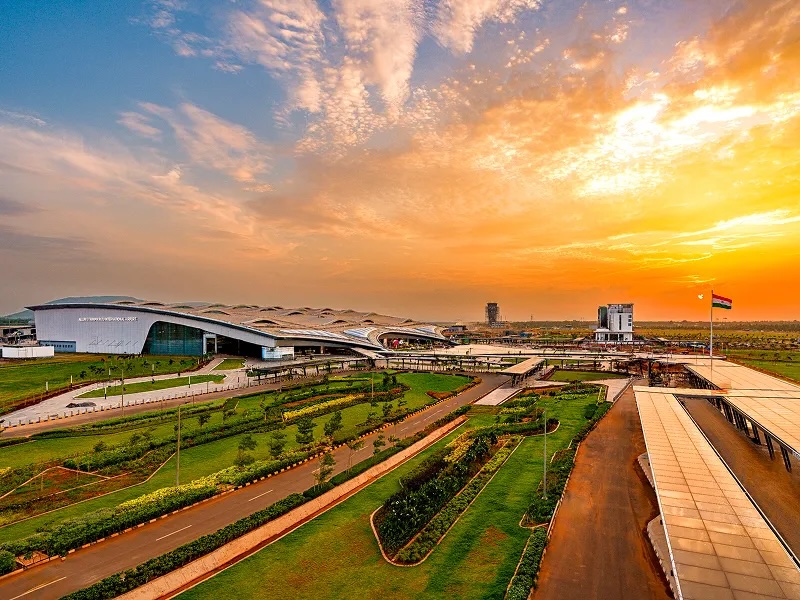
In August, commercial flight operations officially began at the brand-new Alluri Sitarama Raju International Airport in Bhogapuram. The new greenfield airport replaces the old Vizag (Visakhapatnam) airport and boasts a 3800 metre Code 4E runway that can handle large, long-range, wide-body commercial aircraft; a 25-acre MRO (Maintenance, Repair and Overhaul) facility; and the capacity to handle 6 million passengers a year.
Developed by the GMR Group, the airport features a world-class passenger terminal, advanced aviation infrastructure, smart passenger technologies, and facilities designed to meet modern international standards. What does this hold for the aviation industry in India? And how does it impact trade and travel in the region? In this two-part story, we take a closer look.
Why Vishakapatnam had to wind down civil aviation operations
Bhogapuram has been built to replace the old Vizag airport and still uses the same airport code: VTZ. While the airport code and area remain the same, the airport tied to the code is now Bhogapuram (the distance between the two is roughly 60 kilometres). There are several reasons why the 64-year-old Vishakapatnam airport had to be shut.
- Limitations at INS Dega: The old Visakhapatnam commercial airport had a structural limitation: it operated from INS Dega, a naval air station. That meant civil aviation was sharing infrastructure with a strategic military base instead of having its own dedicated commercial airport. The issue wasn’t just the growing number of passengers but constraints on how much they could expand operations.
- The need for a “replacement” airport: The decision to build Bhogapuram had been in the works for years, with the Central government granting in-principle approval for the greenfield airport in 2016. The project was conceived specifically as a new public-use airport near Visakhapatnam. Bhogapuram acts as a replacement for a public airport that operated out of a military enclave. (As per the MoU signed, the civil enclave at Visakhapatnam’s INS Dega will be closed for 30 years from the commencement of Bhogapuram’s operations.)
- High traffic: Visakhapatnam accounts for a substantial share of Andhra Pradesh’s air traffic and the airport at INS Dega couldn’t be renovated to accommodate the growing numbers. The new airport has been designed specifically to accommodate future traffic growth, rather than continually retrofitting the existing airport at the naval base.
Why Bhogapuram was developed
Military constraints aside, there are several reasons why Bhogapuram was developed:
- Room to scale: The new airport gives the region something the old INS Dega airport couldn’t: the capacity to scale and expand. The greenfield airport sits across over 2200 acres, giving it a dramatically different development footprint compared to the old airport within an existing military enclave and urban environment. Phase I has been designed for 6 million passengers a year, with the government’s original three-phase plan envisioning expansion to 12 million and 18 million passengers per year.
- Can cater to more aircraft: The Bhogapuram airport has a large 3,800-metre runway which can accommodate a much wider range of aircraft operations, essential for international long-haul flights. Phase I also includes a dedicated 5000 sq m cargo terminal.
- Positioned to attract more passengers and businesses: Bhogapuram is further away from the old airport, but the location sits along the border of the Visakhapatnam and Vizianagaram districts: roughly 45 km from Visakhapatnam via NH-16 and 25 km from Vizianagaram, according to GMR. The location therefore potentially widens the airport’s catchment area beyond the Vizag urban area itself. So while the location may appear inconvenient for travellers right now, from an infrastructure perspective, it grants access to a much larger undeveloped region.
Bhogapuram: A necessity and an upgrade
The construction of the new airport was in some ways unavoidable. On the one hand, only so much could be done within a military enclave. On the other hand, passenger traffic and the wider economy of Visakhapatnam and north coastal Andhra Pradesh were growing. A new airport, with the space to accommodate future passenger, cargo and aviation-related infrastructure was a necessity.
The Andhra Pradesh government chose to develop the new airport through a public-private GMR is working on DBFOT basis (Design, Build, Finance, Operate and Transfer), with GMR Visakhapatnam International Airport Limited (GVIAL) incorporated as the project vehicle. Under the concession agreement signed in 2020, GMR has the right to develop and operate the airport for 40 years, with a provision for a further extension. The project has also attracted institutional capital, with the National Investment and Infrastructure Fund (NIIF) agreeing in 2023 to invest up to ₹675 crore in GVIAL.
Bhogapuram, therefore, is not just a government-built airport with GMO taking over the operational reins: it’s a long-term infrastructure project. Potential gains for GMR depend on aviation operations and developing a robust economic ecosystem around the airport.
In part 2, we will take a look at the economy of the Eastern corridor and who stands to gain from the new airport.
References
The Gateway to India’s East Coast: Cruising Heights magazine, July 2026
Construction of Bhogapuram International Airport
The first phase of the development of Bhogapuram International Greenfield Airport set in motion
PM Modi inaugurates GMR-developed Alluri Sitarama Raju International Airport at Bhogapuram