
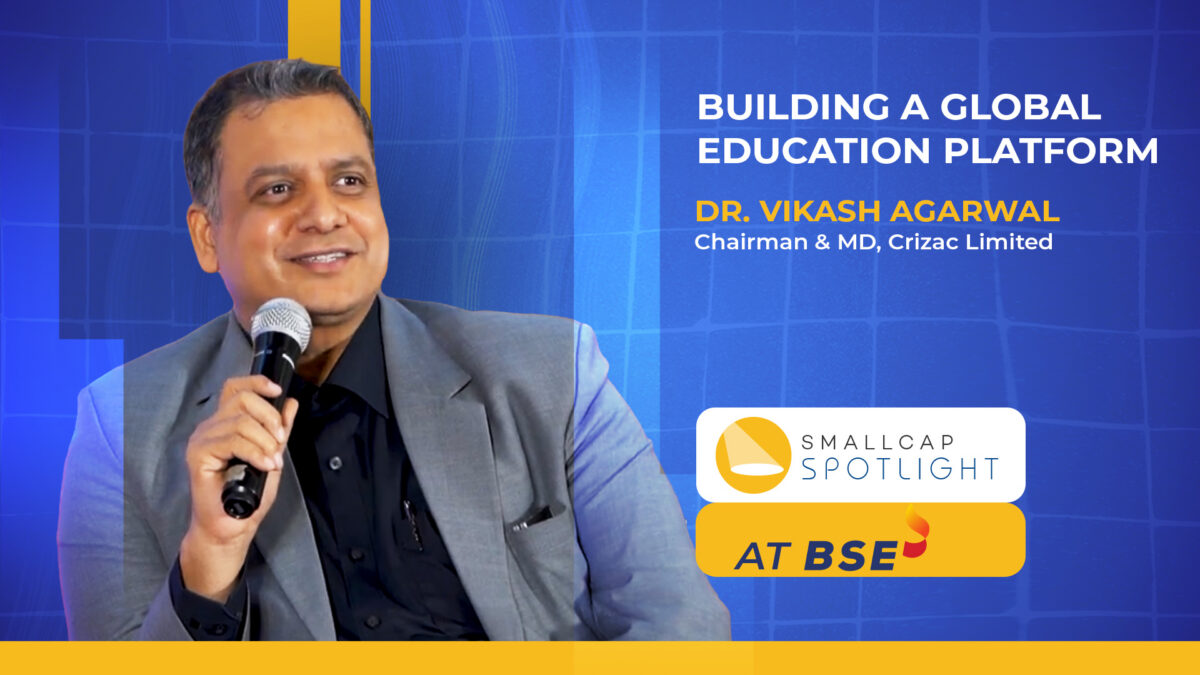
Dr. Vikash Agarwal, Chairman & MD, Crizac Limited discussed how its technology platform connects students, counsellors and universities worldwide, while sharing the company’s vision to expand its global reach in the international student recruitment market. It also highlighted the long-term growth potential of the education sector and the importance of skills, research and global opportunities.
Nikunj Dalmia: A Marwadi from Calcutta, P.H.D. in Technical Textiles and you are running a platform which is very different. What is this?
Dr. Vikash Agarwal: Good question. I come from a small town from Bokaro Steel City in Jharkhand.
I always had a fascination of studying abroad. So the reason I did a PhD is not because I wanted to be a doctor in textile. It’s just that I wanted to see the world.
That was my dream. Whenever someone used to ask me why I didn’t do a PhD, I used to say, why in this? PhD made me educated. It taught me how to analyse anything.
It taught me how to create a proposal. It taught me a lot of soft skills which I am implementing in my business. And that’s what I gained from my PhD.
Half of them or most of them have not studied core subject in their life. So take education as a learning platform to become educated. Not that if I have studied finance, I have to go to finance.
If I have studied textile, I have to go to textile industry. Do something which you like where you can build a future and education will help you. Knowledge will help you in doing that.
Nikunj Dalmia: Fantastic. How did that PhD stint of yours help you start your entrepreneurial journey?
Dr. Vikash Agarwal: Let me give you a brief about how Crizac came into picture and how my PhD actually helped. I did my schooling from Jharkhand, did my engineering in textile from Hyderabad.
After that, I applied to multiple institutions in UK and USA and got a fully funded place in UK to do medical textile. When I was in my last year of PhD, I came to know about business model whereby when you introduce a student to any of the university, university pay you as a referral fee which is kind of a giving you back as a marketing cost to recruit that student. I like that business model and decided to come back to India, start this business.
Over the time, I created a platform so that I can expand the business across India and globally. That’s what Crizac do. Crizac connects all the small and mid-size consultant, individuals, counsellors to our platform and they help to get admissions in any of their desired universities which are on our platform.
Nikunj Dalmia: I just want to understand how many students do you send to study abroad from India and how many students do you send at a company level every year?
Dr. Vikash Agarwal: We send 25,000 students from a company level of which half of them are India, 48%.
Nikunj Dalmia: So, roughly you will say 12,000 students from India go and study abroad. How does the entire process work? This question is for student audience, then we will talk about the investor part.
Dr. Vikash Agarwal: Sure. A student will connect with any of the counsellors or agency company in their city. These agencies are connected to our platform.
So, a counsellor will coordinate with students, help them identify the course they want to do, the universities they want to apply, destination they want to go. Once they have decided, these counsellors or the small agencies would punch those applications to our platform. We are the one who coordinates to the universities for that student.
We’ll analyse the application, whether the candidate is eligible to go to the desired universities they have applied for. If yes, we’ll submit the application to university. We’ll coordinate with university, get the admissions of any of the papers what are required, pass it back to the consultant and they will do the visa for the student.
Nikunj Dalmia: Okay. Good universities have a long queue. Some percentage of the total applications which are submitted every year, they only get accepted.
I think the number in Harvard is about 10. The number in Cambridge and also Oxford, I understand, is in single digit. So, for universities where, you know, supply is much more and seats are less, why would they pay commissions?
Dr. Vikash Agarwal: Interesting question. Let’s give an example of two of the UK universities. One is King’s College London. Second is UCL.
Both are concerned by QS top 100. UCL was never paying commission in the past, if I talk about three years back, while King’s College was. Both the institutions are trying to attract the same talent, let’s say for India.
Since King’s College is paying, all the agencies who are supporting students to go to King’s College, they would talk more about King’s College than UCL. So, there is a natural bias which gets created for King’s College. Similar level of universities, similar teaching, similar ranking, but UCL see that they are losing their good students against King’s College.
So, what they do? They want the same students, they start doing the same thing, start attacking the agents, start paying the commission. Okay. You need to understand that commission is not as an incentive that they want to give a bias option to the students.
Students make a decision, kis college mein jana hai, kis university mein jana hai. Agents just make it visible. And for that visibility, for that filtration, universities pay commission. It’s like a marketing cost for them.
Nikunj Dalmia: Okay. I understand the gap which you are filling.
But let’s understand the child or a student who goes to study. Some is because of experience, little bit learning, but 80% I would say they are going to study for prospects of getting a better career. And that is a grain of truth which we cannot debate.
But getting a job, at least outside India on a foreign degree for a Indian student, earlier was tough. Now the word is hard and hard could easily become impossible with the current policies which different governments are following. So, the whole pitch of studying abroad, is that itself now getting challenged and which could be a threat for a business model like yours?
Dr. Vikash Agarwal: Not really.
If you look at, let’s take China as an example. In terms of education industry, I’ll say China is at least 15-20 years ahead of India. And if I look at their education system, what policies, thought process, what India is implementing today, China has implemented 10-15 years back.
For example, today we are packing a lot of international campus to come to India and open the campus. It was there in China 10-15 years back. And if I look at the same coalition, Chinese are still going abroad, still studying.
The desire to go abroad and find a job, if that’s the only objective, you’re making a mistake. I have, on an average, we deal with almost 4 lakh applicants of which 20,000 students, 25,000 students go abroad. I’ve met a lot of them who had come back earlier.
And I’ve asked them, do you regret the investment what you’ve made for studying abroad? And believe me, I’ve not found one who said, I’ve made a huge mistake. I won’t go abroad. Everybody gains something out of it.
It’s like a PhD degree. When you came after studying, you learned something. Absolutely.
Today, my business is because I did that degree. And I use all the skill sets of my PhD for my business. In PhD, they teach you how to write a very thick book, research thesis.
So, you learn how to write a proposal. Without a proposal, you won’t get a contract. How to analyse data.
You can’t run a business without that. You learn a lot of soft skills that you can implement in your business in real life. And that’s what I did.
Nikunj Dalmia: So, we’ve looked at the part A, the business, the students. Now, let’s look at part B. You’re sitting in a stock exchange. Shareholder, market cap, profit, return on equity.
I’m sure you’re getting used to these numbers now. Yes. Since you’ve been listed.
QS, QT, from quarter to quarter. Analysts come in every quarter. It’s very painful.
You’ll start asking questions in Nikunj Dalmia. Let’s talk about shareholders.
Dr. Vikash Agarwal: Sure.
Nikunj Dalmia: What should your shareholders expect from you in terms of where the business is moving? Because suddenly, a lot of global uncertainty is staring at us. Students who wanted to go in April, they were not able to go because of Middle East War. Students who wanted to go US last year, US Embassy is not giving appointments.
Students who wanted to go three years ago, they got stuck because of COVID. While your business has enviable return ratios, some would say that due to geopolitics, the predictability is decreasing.
Dr. Vikash Agarwal: That’s right.
I won’t deny it. But if I look at the numbers, every year, 6 lakh students leave India. 6 lakh kids.
6 lakh kids study abroad from India. Globally, I see, 18 lakh students study from one destination to another globally. Out of 18 lakh students, I have dealt with only 25,000 students.
Imagine, what is the market size? We call it TAM. We call it TAM. Our percentage is nothing.
And in today’s date, it’s fine. I am based in India. It’s an Indian company.
We process applications from 85 different nationalities. This March, 52% of the applications that we receive, we are non-Indian. Because at one time, 100% was Indian.
So, the company is expanding. Today, Trump did not give an appointment for Indians. He gave an appointment for China.
Today, India has become a destination country in itself. Today, if I bring someone from Africa to India, the government will support me.
Nikunj Dalmia: How many students are coming to India to study?
Dr. Vikash Agarwal: As of now, less than 1 lakh.
Nikunj Dalmia: So, about 15 lakh students are going abroad to study from India. About 1 lakh students are coming to India to study.
Dr. Vikash Agarwal: Correct.
But you have to see a bigger picture. India is becoming a destination country now. In the last 5 years, the infrastructure that has developed in education, institutions like Plaksha, Flame, Ashoka, many international campuses have come.
They have made India an education destination now. Earlier, there were small colleges whose infrastructure was not of the world standard. So, children used to think whether to go or not.
Today, India has a different outlook. There is a different outlook of the economy. There are many opportunities.
And it is a right campus. Which makes India a perfect destination from where children can come.
Nikunj Dalmia: You know, education has a very strong tailwind.
Not only in India, anywhere in the world. It is a sector which is growing. It is a sector where the tailwind, largely because of a young country like India, is very strong.
But frankly, if I look at India, education is still very fragmented. State level, central level, private universities, IB universities. And if I look at the stock market also, one side is online, the other side is K-12.
Education for shareholders in India, the sector has not created a lot of them. Why is that?
Dr. Vikash Agarwal: Nikunj, we are in the education industry, but we are not teaching education. We are a platform.
So, we are different. But, yeah, you are true. Unfortunately, most of the ed-tech business in education has not really created a lot of wealth for shareholders.
And it’s sad. I see a lot of potential in the education industry as such. You can imagine the size of this industry.
Nikunj Dalmia: What is the wide board opportunity in your business? Connect as many students to as many destination countries globally. Okay. Which is that last exciting tie-up which you’ve done with any university or where you send a student from A country to B country and to B country to C country? Tell us a bit about that.
Dr. Vikash Agarwal: The exciting one was when we started up our operation in China and could send Chinese kids from China to UK. That was the most exciting and, I’ll say, happy moment for me. If you look at it, we export money.
Student goes, we bring revenue for Australia. And China is already a very developed market. There are many companies like Pfizer and others already there.
We were able to establish our name in that market. It’s a great thing. It’s a moment of pride for the company.
Nikunj Dalmia: Your business generates a lot of cash. And yet you went public about one year ago. This company went public about one year ago.
It’s a coincidence that it’s been a year and two days. Was the listing here or at NSE?
Dr. Vikash Agarwal: The listing was here. This is the podium and room.
Nikunj Dalmia: That’s great. What was the price then? 274. For any entrepreneur to take that company public is extraordinary.
Why did you go public? You don’t need cash because you generate a lot of cash. You don’t need debt because the return ratios are so strong.
Dr. Vikash Agarwal: Very much so. Multiple things. One, since we went global, in this business, the small agencies we work with, they spend all the marketing cost. They hand hold students from initial counselling till the student gets admitted to the university.
So, the entire cost of marketing, the cap is with the agent. When we send the students to university, we get the money and then we pay to our agent. What if we don’t pay? Somebody from Nigeria, for a few students will never be able to come to India to recover that money.
When you are listed, that trust becomes very big. Not only for Nigeria, but even for Indian companies. That trust is very important.
10 students pay, a bill of 40 lakhs is made. And small agencies, these are not like big entrepreneurs doing thousands of students. The people who are in our platform are normally, on an average, do 5, 7, 10 students.
So, for them, that matters. And that trust comes because, one, you are listed. Two, visibility becomes immense.
I know you because I am listed. Institutions, they know you. Okay, you are a listed company.
Trustworthy. They start talking to you. So, your engagement goes to a very different level.
And all these things help businesses to grow much faster. If I want to get students from, let’s say, Africa to India, if I go as a crisis app, they will trust, okay, you are a listed company, the guidance you have given is correct. So, that trust can only come when you are listed, when a company is visible, that helps.
But apart from that, being listed was always a deal. Aditi had said, she wants to build her own fund house. A long time ago, I thought, yes, when I get listed, it will be a life achievement.
So, I am proud for that.
Nikunj Dalmia: Do you remember what Aditi said? Mr. Gupta said that a lot.
Dr. Vikash Agarwal: I got late.
Nikunj Dalmia: They say that every man is choosing a number. And that’s not my line. Gordon Gecko said that. So, what is that number you are choosing?
Dr. Vikash Agarwal: I have heard a lot. Right from my beginning days, unicorn, unicorn. It’s not a dream.
See, I want to become a unicorn. So, that’s the first number I am choosing.
Nikunj Dalmia: And how far will it be?
Dr. Vikash Agarwal: The market will tell.
Nikunj Dalmia: Last question. Mr. Gupta had asked how to apply for a visa. But I am sure, you must be getting calls every day, to get you admitted, to get you a job.
You run such a big company. You deal with universities. Please forward our application.
How do you handle that?
Dr. Vikash Agarwal: I can forward the application. I can get a fast decision for you as well. But I cannot change the decision for you.
All the universities in India, and I am assuming, there is a trend in India as well, that we cannot influence the decision. For example, your file will be put in FastTrack. But the decision will be taken by the embassy.
In my case as well, the decision will be taken by the university. Yes, I will forward your file. I will find out your reason.
What was the decision? When did it come? But I will not be able to influence it.
Nikunj Dalmia: For the student audience, what is the message? If they want a shortcut for a good university, can they call you? Can they approach you? Can they reach out to you?
Dr. Vikash Agarwal: They can always reach out to me. No doubt on that.
But definitely for the students, 1. Plan your journey much ahead. Do research. Most of the students, when Nikunj said that there is no job outside, the reality is that we don’t work hard for that job.
We don’t work hard for that. The students who go for their masters, when they finish their masters, they make their CV. And they make one CV, which they want to send to every company, whether it is for SI or finance.
They don’t work that hard to change the line in the CV. There is a job. But not everyone will go for MBA or master’s in international business.
Even the locals will say the same. Pick the technical field. If you want to go for finance or business, there is a course for the family office.
Go for that. There is a course for investment management. There is a course for risk.
Specialisation is a little hard. But there are jobs. There are opportunities.
But you need a shortcut. If you take a shortcut in life, then it is difficult to get a job.
Nikunj Dalmia: And final question.
I am sure you must have done analysis, thought through it. You have data. You have counsellors.
Is AI going to eat up the job vault?
Dr. Vikash Agarwal: AI will make a big difference. And as a company, we are using a lot of AI as well. So I can say this from a real-time experience as well.
AI will definitely have a big impact on your job, how you do your job. If you are not learning AI skills, you will be left behind. Every company is using AI to automate a lot of process to make decisions which are unbiased where a mistake can be avoided.
So you have to learn how to use AI for your advantage. If you don’t learn that, AI will take away your job.
Nikunj Dalmia: Which is that dream university which every student is choosing?
Dr. Vikash Agarwal: If you want to go to UK, Oxford, Cambridge.
If you want to go to US, Harvard, Stanford, Ivy Leagues. But I want to say that universities don’t matter. I went to the airport in Edinburgh.
It’s about what skillsets you learn, what connections you make, what ideas you can generate. That matters. What is your percentage in that university? That matters.
If you take any university, the top 10% students get a permanent job whether they are Indian or non-Indian. You have to go to the top. Going to the top university is not the only objective.
Yes, you get connections in the top universities. But you can make those connections outside that university as well. Mehnat Kalli Bhai.
Nikunj Dalmia: The whole ethos of this business is that you are fulfilling people’s dreams. Congratulations. Good luck.
Dr. Vikash Agarwal: Thank you very much.
Nikunj Dalmia: Thank you very much for flying all the way from Kolkata just to be a part of this summit of us. Thank you very much.
Dr. Vikash Agarwal: Thanks Nikhilesh. Just to tell you. In 2004, when I opened my website, I saw the company’s tagline.
Changing dreams into reality. That’s what I am trying to do. Thank you.
Thank you very much.