
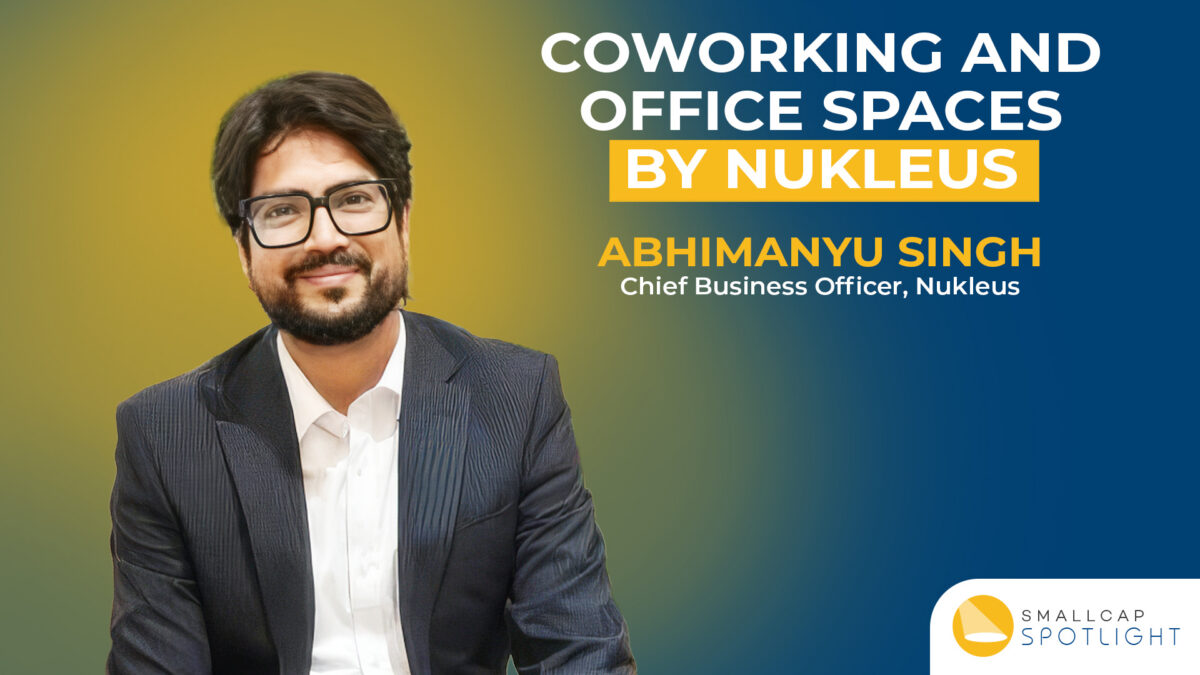
Abhimanyu Singh, Chief Business Officer at Nukleus Office Solutions, highlighted at The Growth Exchange 2026 – Investor Connect Series by AKMIL Strategic Advisors that the company is capitalising on the growing demand for managed and flexible workspaces driven by changing workplace preferences. He added that Nucleus is focused on rapid expansion, targeting 10 million sq. ft. of managed office space and a position among India’s top three managed workspace brands.
Anjali Palod: Hello and welcome, you are watching Small Cap Spotlight with me Anjali Palod. And today on the show, we are joined by Abhimanyu Singh, the Chief Business Officer at Nucleus Office Solutions. Hi Abhimanyu.
Hi. Welcome to the channel. Lovely to have you here.
We want to start by taking a look at the company’s journey so far since its inception in 2019. What inspired you to enter this space of managed offices and co-working flexible spaces and what has the journey been so far?
Abhimanyu Singh: When you are in the market and you are very vigilant and you keep observing what is happening in the market, we realise that starting 2015-16, the commercial real estate market is transforming. It is basically an industrial transformation where a lot of players took the advantage of entering early and transforming the market with time.
Right. Now, when I talk about what kind of transformation, real estate everywhere after the digitalisation, after so-called organisation of the market, after everything came into smartphones, you will see that every industry has started getting organised. Now, when I say started getting organised, what does that mean? Anything and everything, any business that is available on a smartphone is called organised business.
Right. So, when we talk about entertainment industry, what do you do? You go to book my show. When we talk about travel industry, what do you do? You go to maybe, you know, make my trip and everything is available on a dashboard.
Right. Similarly, same thing started happening in the real estate industry also. So, when the transformation started happening, the end users wanted the complete final services from the service provider.
Okay. Like over the period of time when we started journey way back of the commercial real estate, offices used to be bare shell. I hope you understand what bare shell is.
Just the shell of the building and then you go to the building, you have to do everything. You do the flooring, you do the washrooms, you do the fit out and then you start using your office. Evolution happened to start in 2000, you know, 98, 2000, 2002 when the international companies started coming into India, developers started providing them fitted out offices.
Right. Yeah. But standardised.
Correct. So, plug and play. You just go to office and you can just start using it.
Right. You don’t have to do anything. And then slowly and gradually companies started coming in India which are international property consultants like Jones Lang LaSalle, JLL, CBRE, Cushman.
They started providing facilities also to these kind of company. But now started 2016, 17 the trend came in wherein operators like us, they started coming in taking huge chunk of spaces and making custom offices for people. Okay.
And those are fully managed and operational by us. So, what client has to do is, what convenience they have is, they just have to pay one check. Okay.
Right. So, they don’t have to worry about electricity, they don’t have to worry about maintenance, they don’t have to worry about security of the building, they don’t have to worry about anything. They have to work for 5-7 hours extra, one day they just have to write a mail and everything is taken care of.
Right. So, these kind of services which included a lot of hospitality into real estate, this is what started luring a lot of clients and they want these kind of services now. Right.
So, this trend started way back in I say 2012-13 and then it picked up big time in 2016. Then is where a lot of brands started getting into this particular field. And then the COVID happened.
And blessing in disguise, after COVID people wanted flexibility. Right. They wanted hybrid nature in business and that’s how the operator business became favourite for everyone.
Anjali Palod: Yeah. Right. So, COVID is obviously one of the inflexion points for flexible working generally and therefore it has its effects on real estate, also commercial real estate. But how sustained do you think this trend is going to be where people are looking for flexible working, hybrid solutions and you know, how does that translate to any challenges that you foresee for flexible services? Do you think we will go back to you know, more sort of rigid structures?
Abhimanyu Singh: Correct. So, let’s talk about customer behaviour. Suppose you are a customer and you start getting this level of services, you will never go back to that.
And if it is at the same price. Right. So, what has started happening in real estate is from bare shell, now occupiers have started enjoying a service where they don’t have to worry about anything.
You know, your job is to make software, you will go to the office and make software. You don’t want to bother about what is happening with the AC, you don’t want to change bulbs. And that is what managed office services and operator services is providing them.
This industry basically is very easy to understand if you understand the hotel industry. So, you have brands like Marriott, Hyatt, what they do? There is a developer, there is a landlord who has a money and he has an aspiration of making a hotel. Right.
So, what he does is, he invests money in making a hotel and then he brings a brand to operate it. Correct. So, depending on location, depending on the market segment, which is the best suited brand for your property, you get that brand to operate your building.
Right. Similarly, the office operator service is exactly like say, depending on the market and the segment, you have various brands, those who have taken their space already. Right.
From super premium, luxury to maybe, you know, the economical, the value provider to all these kind of brands have already start, you know, taken position in the market. So, depending on what kind of market a particular property is a real estate is, you have a brand solution there. Right.
So, that’s how developers tie up with brands. Right. Now, what happened with COVID is, see service providers have already started trying their business in the market.
From 2012 to 2019, everything was going okay, but going very slow. Okay. And then COVID became a very big push into it, wherein the occupiers and the customers also started realising the need of such kind of solution.
So, basically COVID was something that gave a lot and lot of push to this business, wherein a cycle that could have happened in probably 10 years time happened in two years time. Right. But it’s here to stay.
This had to happen. Yeah. But it’s here to stay.
Of course, this is here to stay. This is a transformation. This is not going to reverse.
Okay. So, what happens is, like banking. So, banking services are not going to go anywhere, it’s just that the nature of banking services will change going forward in future.
Earlier people used to go to bank, now bank come home. You know, now everything is in mobile phone. So, definitely the industry will start getting organised, but it will get organised through operators.
Understood. So, industry will stay. It will stay like the way it is.
Of course, there are a lot of changes with the technology, with lot of things, metaverse coming up. So, of course, things will change, but this is going to stay.
Anjali Palod: So, Abhimanyu, I want to take one question on your personal entrepreneur journey as well. What are the industries that you’ve dabbled in before and what are you bringing from those experiences into Nukleus?
Abhimanyu Singh: So, I’ll tell you what I’m doing right now, I think is the perfect combination of my experience. I started my journey with real estate and definitely IPC is the name that I took with JLL and CBRE. And after maybe, you know, four or five years of experience, I started my journey in retail because I was a retail consultant when I was with, you know, IPCs.
So, initial stage of Indian retail sector booming. So, I was part of a transaction team, planning team, various things. So, after that experience, I decided to try my hand in retail myself.
So, I ran various restaurants, pubs, clubs, all those things for a good amount of period in time. And then is when I returned into commercial real estate in the year 2019. And ever since then, I have been trying to do innovative things here because then is when the market changed, you know, COVID taught us a lot and COVID got a lot of new formats in the market.
So, that is where probably my experience of real estate, retail and everything worked very well because what we do as operator businesses, we do the retailing of commercial real estate. So, we break the larger offices and we provide office to small, small occupiers and that is, that is almost a retailing of commercial real estate. So, that has helped a lot, of course.
Anjali Palod: That’s good to hear. But coming back to Nucleus, you’re largely centred in the Delhi NCR region. And that’s where you have your flexible working options, you’ve got managed office services, also virtual offices, but we also have large national level players in this field as well.
So, how do you differentiate yourself and how do you stand out in a market like this?
Abhimanyu Singh: So, again, the industry is not very old, right? So, even the largest of the player has 80% of the concentration in their hometown, right? So, when we talk about our competitors, also those who are there from Bangalore, 80% of the portfolio is still in Bangalore, though yes, they have a couple of centres in Bombay, they have a couple of centres in Delhi. Similarly, you know, we have a centre in Bangalore, we are opening centres in Pune and Hyderabad, we are trying to be in Mumbai very soon. So, of course, every brand, first you have to gain the expertise of the industry, once your unit economics is sorted, once your product is very, very clear, once your positioning is very clear, then is when you expand your boundaries.
So, of course, for any business to understand where we are, what are we doing, what our positioning is and what is our product makes it takes four to five years of time, especially when your product is a product as well as service combined together, right? So, a lot of systems and procedures, your unit economics, because in real estate everything is broken down to per square feet. So, there is a lot of learning that comes in the business. Once that learning is there with you and you know who your customer is and you know what kind of landlords are you servicing to, then is when you can expand.
So, now if you see last two years of Nukleus was all about expansion, expansion, expansion, because yeah, the journey of exploring ourself, understanding ourself happened in the last four or five years of time. And now we are just growing.
Anjali Palod: So, how many offices are you at right now? How much time it took for you to reach there and what’s the pipeline looking like from here on?
Abhimanyu Singh: So, we are near about 26 operational offices and the portfolio of near about a million square feet.
Going forward in future, we are planning to, you know, make this number go to 10 million square feet and there is a target of next five years, which is pretty achievable. The way the market is going, the way the transformation is happening, because in a transforming industry, which industry itself is very huge. So, so, again, I’m quoting an example so that it is easier to understand.
You understand, I don’t know, I don’t know how, how young are you, but there was an age when there used to be individual theatres, right? Single screen. Correct. And those individual theatres, when you have to go and watch a movie, you used to go there and buy a ticket then and there on the window, whether it is available or not available, you never know.
And then you used to find a couple of people, those who say, you want a ticket, you can take it from there. Now from there to today, see the transformation. Now there are no theatres.
Everything is multiplex. Everything is operated by PVR, INOX, Cinepolis and the brands of the world, right? Now this is evolution. This is converting an industry from an unorganised to an organised industry.
Now why this happened is because human is a very convenience loving creature. We want everything on a phone, right? We want to book a movie, we want to open a page and we want to book it. Similarly, going forward in future, the real estate industry is also going to get organised.
So when we talk about real estate, there are various siblings inside a huge family, right? So we have commercial real estate, which is office services, we have retail, we have residential, we have hospitals and we have blah blah blah, various things. Now you see one segment of real estate has started getting organised. You know, commercial real estate is still something which is going a little slow, but ultimately it has to get organised, right? Unless the industry is there on your smartphone or there in a digital media, it is not called organised and it does not have a future.
So of course, the journey has started already with the operators coming in, with a lot of organised people coming in and running this industry, the customers have that kind of faith wherein you can probably, this industry will get organised over the period of time. So that is what is happening. There is a huge amount of growth that can happen in future.
Anjali Palod: Right. So I mean, the opportunity you’ve clearly spelled out, but you know, with every opportunity there are some challenges that come with it. So what do you think are the biggest challenges for what you’re trying to build with Nukleus? And you know, some problems that we might not be able to understand right now, but as the industry expands in the next 3-5 years, what do you think will be the biggest challenges you will have to overcome?
Abhimanyu Singh: So I think the challenge is that lack of partnership and lack of togetherness in the industry.
When hotel industry started getting organised, the same problem was there in the hotel industry as well. Landlords used to think that hotel operator is a tenant. I will give my property on a rent to a hotel operator and then he will run his own business.
Similarly, what is happening is, developers are considering us as a tenant, we are not a tenant. We are a service provider, we are operator. What we do is, we have two customers.
One client is the developer himself, wherein we take his property and operate for him, so that he is completely hassle-free. He does not have to look into the day-to-day maintenance of the property, he does not have to look into the leasing of the property, he does not have to look into various things that happens in the property on a day-to-day basis. What he can do is, he can be an investor, invest into one property, move into the second property, give it to an operator, be tension-free for life.
So that sense is yet to come in the market, which will come in another 3-4 years time, I completely understand, because developers have also started getting, I will not say educated but aware, that okay, we are operators, we are not tenants. So their expectation and the calculation has started changing over the period of time. They are more friendly, they are more supportive, but this is one of the very big challenge, wherein operators are treated as a tenant.
So we have to make dual business plan right now. One, definitely we understand and we believe that we are the operator and we have to be operator going forward in future, but you cannot stop your business because you are treated as a tenant. So what we have to do is, we have to do a lot of calculation and a risk analysis assuming that we will be treated as a tenant.
So that will go over the period of time, but this is the biggest challenge as of now. Second yes, as in when the transparency comes into the market, when people start understanding this business to the core, of course, you know, the client at both the sides, of course, there is a lot of pressure that comes at the person who is at the centre and of course at the operator. So yes, the margins are getting thinner, the market is getting more and more open, which is always a very very healthy sign, I will not say because being an operator is a game of volume, it’s not a game of a profit percentage.
So of course, you know, I mean, these are the challenges and then yes, of course, there are a couple of hidden challenges also that market miss with the changing technology. As a interface, as a mode of operation, AI has already come and it will completely be accepted as I interface in another one, one and a half years time, you know, and then we are getting into the age of virtual reality, which is metaverse, you know, the entire world is going to get converted into digital and you can experience everything and do everything sitting at your home. Now, that is the time when of course, there will be a huge challenge on how we and operators react, because if the real world is getting converted into a digital world and you will get the real world experience sitting at home, what will happen to the state which is so real as of now.
So of course, that is a hidden challenge, which is still five, seven years away from now, but of course, yes, that is a challenge. We have internally started building for it. We are coming up with our metaverse conferencing, metaverse offices, we are launching those services in another, you know, maybe the first thing will be out in the market very soon, but we are preparing for that challenge as well.
Anjali Palod: So since you mentioned it’s a game of volume, and that’s where, you know, any company grows. And I also want to take you back to when you said that a lot of the players are largely concentrated in the markets that they started off with. What’s the potential that you see for your services and flexible working in beyond tier one and metro cities in the country? Because at some point that would get saturated and you’d have to look elsewhere to find newer avenues.
So is there, you know, a case to be made for such services in smaller towns or smaller cities in the countries?
Abhimanyu Singh: So I’ll tell you, the need of such kind of services is more in tier two, tier three cities, because how these cities are evolving when we talk about commercial real estate. So for an example, when Genpad and GE came into India, their major focus was Bangalore and then maybe Pune and Hyderabad because of the manpower pool. Now what happens is, slowly and gradually all the companies, those who started providing office very close to home.
So these companies started opening offices, TCS for instance, in cities like Indore, Jaipur, you know, cities, tier two cities. And then they started attracting a lot of very good, you know, working people pool at a very, very economical cost and they started growing multifold. Now there is a little bit of scares with, you know, the interface AI coming in between what will happen to that kind of skill set of people.
But then trust me, AI is only an enabler. It is going to increase the volume of business, not going to do any harm to any kind of manpower. Of course, their skill set, what they do currently will enhance a lot.
They will start doing a lot of different kind of work going forward in future. But then yes, tier two cities are big time because real estate is very defined. Very few developers over there.
Right now it is very important to establish yourself as a operator. Because going to tier two city, introducing yourself an operator right now is a little difficult thing. But of course, tier two city has a great future and we are planning three, four different kind of models for tier two cities, which on a test marketing in a meeting with a couple of developers turned out to be very, very promising for the developers.
So I think 2027 is the year where we will be making a lot of breakthrough in tier two and tier three cities. That is there in the cards and we are very bullish about tier two, tier three cities.
Anjali Palod: Understood. So now just to tie it all together, what’s the long term vision for Nukleus looking like? What should investors be looking for in the next five to 10 years in the company?
Abhimanyu Singh: See, we are very short. The only motto and the logo that we have right now is the growth, growth and growth. We are in a market which is a commodity.
Real estate is a commodity, right? In a commodity market, if you don’t become the largest, you don’t survive. So another couple of years, people are learning. Definitely, you know, like I said that you are figuring out your model, you’re figuring out your product.
And once you’ve figured out your product, if you’re not amongst the top three, you’re not going to survive in the market. So of course, as a Nucleus, we want to be the top three brands. And that is where we’ll be by 2031.
Anjali Palod: Any milestones that you’ve set in terms of number of offices or managed office?
Abhimanyu Singh: So I said in terms of square feet, we’ll be 10 million square feet as soon as possible. The minimum time that will be needed is two and a half years time. The maximum that we have kept for us is five years.
But I know that 10 million also will not help us because by the time we reach 10 million square feet of a benchmark, our competitors would be at 15 million to 20 million. So of course, this is an endless journey. We have to be very fast.
And you know, by grace of the great management team that we have, the manpower that we hold, anything that is needed to chase the target is happening very fast internally. So I’m very, very, very, very sure that you’ll see Nukleus as the top three brands in the market very soon. And the journey has already started, I think, probably a year back or something wherein we made sure that we are good enough to do and to chase that journey and we’ve started achieving the journey and I’m sure we’ll be there very soon.
Anjali Palod: Perfect. That’s great optimism. Abhimanyu, great to hear from you and taking us through the company.
Thank you so much for joining us on this conversation and all the best to you.
Abhimanyu Singh: Thanks for having me here. Thank you very much.