
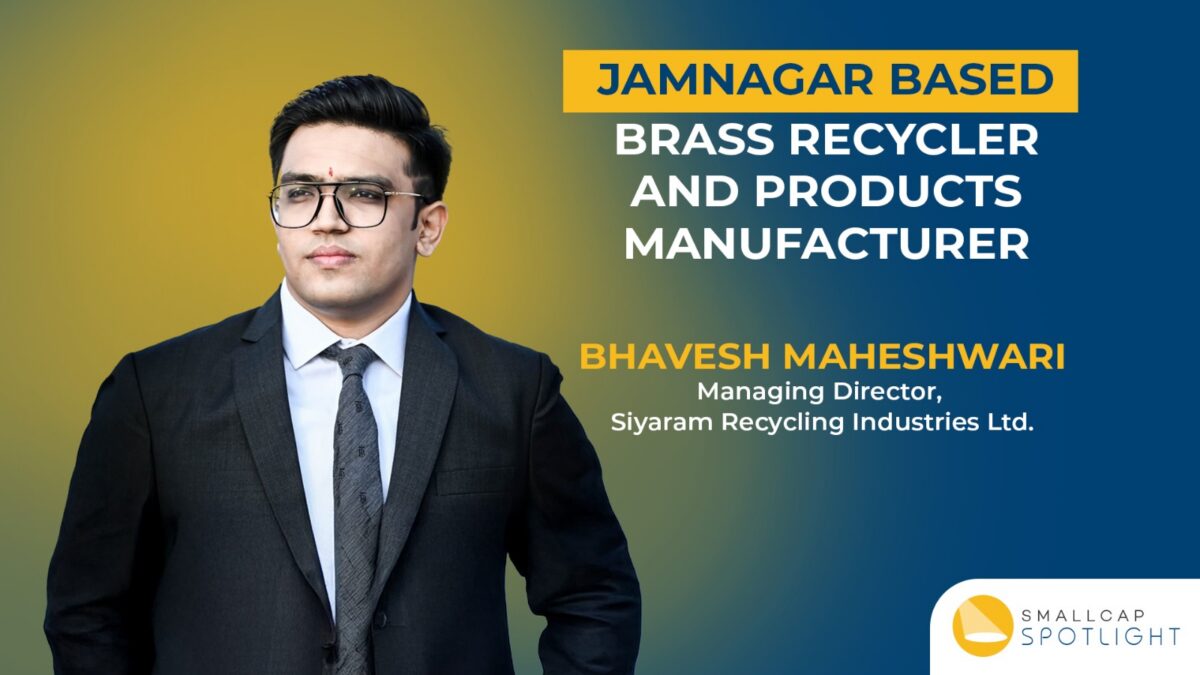
Bhavesh Maheshwari shared the journey of CRM Recycling Industries, tracing its evolution from brass scrap trading to a fully integrated brass recycling and manufacturing business. He highlighted the company’s focus on value-added components, operational integration, and long-term growth despite recent industry challenges.
Mubina Kapasi: Hi everyone and welcome to SmallCap Spotlight. I’m Mubina Kapasi and today we’re going to be talking about a very interesting industry, brass recycling and manufacturing. The company’s name is Siyaram Recycling Industries Limited and I have with me the Managing Director Mr. Bhavesh Maheshwari who’s joining us on the show.
Bhavesh, thanks so much for joining us today. To begin with, if you could just introduce the company for our viewers, what exactly does it do and you know the products that it manufactures?
Bhavesh Maheshwari: Hi everyone, so basically we are situated in Jamnagar which is known as the brass hub of Asia. So there are around more than 7,000 brass industries in the small town Jamnagar.
So this is the brass which recycling what we are doing. It is basically related to a copper alloy. So brass is a mixture of copper and zinc.
So we are into the brass recycling. The processes are almost same like the scraps are imported, the ingots and billets are manufactured, then the extrusion rods are manufactured for the further process. And then in brass industry, you know brass is used everywhere in plumbing, sanitary, defence, aerospace.
There is not a single industry where brass is not used. Hardware, electrical, everywhere. So yeah, we are into a very good industry which are having very much up and down since last one and a half year.
But yeah, we are very much positive now since last one month that it is going to be a great time going ahead.
Mubina Kapasi: I mean honestly, I think every industry has had its share of up and downs in the last six or eight months at least with the geopolitical tensions. So walk me through the journey because I understand that we all are relatively new.
You have been established in 2007. And as I understand that it is primarily been into small components and now you moved on to the larger brass products and are more in sanitary ware and in that industry. So could you walk us through the milestones and how this journey from 2007 to 2026 has progressed?
Bhavesh Maheshwari: I will just give you a short brief. Basically, this CRM recycling was established in 2007. But we as a CRM group, this journey was started by my grandfather in 1978. Then my father started with the scrap trading business in 1981.
So we are into the brass line since 1981 having my experience of more than 45 years now situated in Jamnagar. So earlier our business was only like manufacturing, sorry, the scrap. We used to import the scrap and we used to sell to the local market.
Then in 2007, my father decided to go into the manufacturing. So we established this factory under the name of Siyaram Impacts Private Limited, which is now known as Siyaram Recycling Industries Limited. So this factory was further like we had already experience of importing the scrap from various suppliers all over the world.
So we installed this factory with a view to export the copper alloy ingots and billets to Australia, Germany, China, Belgium, different countries. And we did that business for two, three years. Then again, due to global scenarios, sometimes the working does not come due to China becoming more competitive.
Sometimes the dollar price is low, so the prices change on every day. So then in 2011, we went for further brass expansion into the brass extrusion plant. So brass extrusion plant is always manufactured from brass billets.
So I’ll just give you a short brief that the scrap which we import, then we further installed with the factory of ingot and billet. Now from the billet, we manufacture the rods. So up to 2015, we were up to the rod, brass rod, we used to sell into the market, scrap, billet, ingot and rod.
When I came back from my studies, I studied Masters in International Business from London Greenwich University. So I came back in 2015 and then me and father, we were both deciding what to do further. And because of a huge experience of my father, we just decided to expand it more where brass rods are used.
We used to supply brass rod to people who are manufacturing brass components. So we ourselves decided to have our own factory of brass components. So then another two years, we installed heavily capex for manufacturing of brass components.
So the brass component factory in the current space only, we started. And slowly, slowly, slowly, slowly now, I think we are the one of the very few people in the industry who is doing the whole recycling process. Scrap import, manufacture, segregation of scrap, manufacturing of billets, manufacturing of ingots, manufacturing of rods, manufacturing of components till the end.
And in the component sector also, we have done all the machinery, CNC machines, forging machines, plating plant, polishing plant, the normal lathe machines, everything we are having in now. So regarding this, we are not having any major cost competition because we are having everything in now, from scrap till the end. So obviously, we are going to compete with anyone in the world.
So this is the plus point what we are going through. And this is a short brief of how we are doing the business. Also, we have our own big multinational customers like Plumbing Cemetery Components, we are doing with Supreme Industries Limited, Somani Ceramics, Roka Periwear, Indware, Ashirwad Pipes Private Limited, you know, we are having all the multinational group of the component customers.
So, you know, we are enjoying doing business with them.
Mubina Kapasi: Okay, so it’s very evident that slowly from when you started, it’s been like a forward integration of sorts where you’ve kept adding new product portfolios. I want to know that, you know, when you joined the business, just personally your own journey, what were the most challenging moments for you as you know, an entrepreneur, as you took that family business forward, if you could share some of the most challenging moments, from a broader perspective, and also perhaps from a day to day perspective, because obviously running a business like this, it’s hard, you have challenges every day.
Maybe you could just share a glimpse of that with our viewers.
Bhavesh Maheshwari: I’ll be very honest with you. You know, from the very first day when I was in my school days studying here, I was very clear that we want to, I’m going to join the family business and get it right.
So it was clear in my mind that I went to London for studies in masters, and I was coming back and move on with the family business. So that was a great thing, which I think most of the people are not clear in college also what to do in the career. So I was very clear with that.
When I came, when we decided to have the component factory, obviously, you know, we need a big team, a big technical knowledge of manufacturing components, because it is a precise components, we need to have the technical people and everything. It was very, very hard. And in the initial days, what we were afraid of, we are doing a big capex.
And if somehow if we fail, then what will happen? So that was a time when my father gave me a, you know, big bag, don’t worry, you just go ahead with the hard work and honesty. If anything happens, just forget it, just go. So you know, he was like, he is today also, you know, and you know, there are a lot of challenging issues in manufacturing industries coming on, you know, sometimes it’s good, sometimes.
But to be very honest, whenever any challenges or any problem arises, our focus is only on the solution, because the problem has been done. Now we have to discuss about the solution. So we don’t cry on the problem, we just decide how to move ahead, how to get out the problem out of the situation.
And yeah, by God’s grace, and we are a believer of God Dwarkadheesh. And we believe in our Guruji. So yeah, we always pray that.
So you know, prayers honestly works. So that is the main thing we are going ahead with. And that is always our priority.
So this is a short thing. And yeah, initially, I used to get afraid what will happen, what will happen. But now, being in the industry more than 10 years, this is the 11th year.
I don’t know how it is used to. So we don’t get afraid now. In 10 years, you almost see everything, right? And especially in these last 10 years, when we’ve had all kinds of black swans, especially in the last one and a half years.
Yeah, I’ll be very honest, the industry is not worse, is in a very serious situation. Because earlier, you know, the US tariffs occurred. So Jamnagar industry have a big portion of exports to the US market.
So obviously, it impacted the local production industries, it impacted everyone. Slowly, slowly, from December, it was going good. And suddenly, the war started.
So the war crisis is the bigger one than the tariff. So because we are into the imports, all the imports have been halted due to the state of almost the containers were not arriving, is not arriving. The exports to Middle East have been completely Jamnagar industry export 40% to Middle East, approx.
So you know, there are a lot of challenging in last three months. And, you know, after tariff, we were feeling that now everything is going to be regular. And suddenly the war came and the industry went into a bigger crisis.
And the problem what we generated is, because of the war, there was no demand from customer, no, the production was becoming difficult, due to the containers not coming. So the raw material become a shortage in the local Jamnagar. So the price is increased almost double in last six months.
So obviously, when the price is increased like this, we need more capital. So you know that there are challenging periods. But now since last one month, we are arranging our funding, we are doing our more work to expand the business.
But now we are feeling that it is going to be positive now. And very positive, not positive. We just had our results last month.
And you can see we had a little bit of revenue drop, bad drop. So that is all the reason being the currency fluctuations, the import not being arriving in last two months. And you see from June to September, the dollar constantly increased from 85 to 90, 91.
So what happened, ma’am, due to the tariff, there was no demand here. So prices were not increasing, but the import cost was increasing. So we stopped importing the material that the costing is locally lower than the import.
So that was a major reason in the revenue drop, the bad drop. But now again, this April, which we started this 2026. So we are expecting a great year, even the half year we are targeting to cross 300 crores of revenue for till September.
So yeah, we are working hard towards it. And the situation is improving day by day is getting good day by day.
Mubina Kapasi: So I mean, understandably, you know, the last six months, it’s been a double whammy demand has also been low. And of course, even sourcing has become very difficult, you know, with the rupee depreciation, etc. So do you, you are in the commodity business, there will be price fluctuation, do you have any sort of set contracts, which will help at least cut down some of the massive volatility that we’ve been seeing?
Bhavesh Maheshwari: How we do the business, ma’am, that so today, suppose the local market price is 840 rupees per kg, brass crap price. So what we do is how we hedge the material considering today’s dollar, today’s price, if I sell 25 tonnes of material into the market at 840.
And if we are getting a new import at 825, considering today’s dollar and today’s price. So I book it in import 25 tonnes, and I sell it locally. So this is a type of hedging that the container, no doubt the new container will arrive after two, three months.
But we have sold locally and we have hedged the material 15 rupees, 17 rupees lower or whatever the market conditions are. So this is how we hedge the commodity business. Obviously, the volatility is there.
But in coming two years, we are more focused towards the component business. Because I think that is giving us more good margins, more good customers like, you know, we like to work with multinational companies like all the big people. So the main reason is the payment is safe with them.
Obviously, sometimes the payment is late and it goes on in every industry. But we are comfortable working with them. So now since the raw material prices have doubled, we are just looking to get more capital into the business and expand the component business in coming two years more.
So we have changed the way of doing the business, the scrap import which we used to do 100%. Today, the imports are only 60-70%. We are procuring 25-30% locally.
The reason is the supply chain disruptions are a major issue for the industry. So, you know, we did 30-40% local supply, local Jamnagar and 60% in imports so that the containers if they become late, it does not hamper the production if we source locally. So what’s stopping you from increasing your imports? I know it cannot happen overnight, but what’s stopping you from substantially increasing your sourcing from Jamnagar? So nothing is stopping me.
The main reason since last three months is obviously, you know, the Middle East ports have been closed. Dubai, Kuwait, all the ports are closed. So Middle East people are not able to export to India.
So that is a major source where the supply is not coming. UK, Europe, due to the insurance company taking higher prices, due to the freight increasing, the costing of imports are not so much viable as it was before. So nothing is stopping me.
It is just a temporary phase. So we decided until the war situation gets closed completely, I think September, October, whatever time it takes, we take it 30-40% locally and balance because, you know, you see the dollar is moving like anything. Sometimes one rupee plus, sometimes one rupee down, you know, it is a big volatility.
So we are just reducing our risk. I will just say a small thing in Hindi. My father has told me one thing, that a person gets old, but the business does not get old.
So if we reduce some work for six months and reduce the risk a little, then there is no problem. So that is the only reason, you know, we are going safely and steadily.
Mubina Kapasi: Bhavesh, according to you, how are we in extracting materials back in India? Because one of the key reasons why we are not able to source scrap from India is because extraction is bad from the system.
Once a product goes into the system, then to get it back, you know, what we call as 360 degree circular economy. So what is stopping us from becoming fully circular because getting it back from the system is bad. If that happens, then of course, industries like yours really stand to benefit.
So how is India placed on that?
Bhavesh Maheshwari: So ma’am, I’ll be very honest with you that regarding the scrap sourcing, we have no option other than importing the material because brass is a mixture of copper alloy, copper and zinc. So what happens in copper is that in copper, you know, they get the mines where they can extract the material, copper and zinc. But in brass, there are no mines.
Basically, brass is made from copper and zinc. It is alloy. So we have to import it.
That is for sure. If import is not working, then the industry would be shut down. So what happens is today, the imports are not viable.
So how the market works, when there is a material shortage, the local market prices will increase and the import will be viable. Otherwise, ma’am, I’ll just give you a short brief. The coming five years, we are just very, very, very much positive regarding India because the exports are becoming viable.
People from Europe, USA, we also started exporting some components to US also with a new company. So our component export to US, we started last year, then the tariffs occurred. It was stopped again.
But since last two months, we are getting orders from them also. So, you know, slowly, slowly, we are starting exporting to USA market, which is a big deal. To export to USA is a, you know, we took almost six to seven months to get the firm audited because their team comes, they audit our factory, how we work, what is the cleanliness, how you see for the environment, you know, US, it’s very strict.
So yeah, by God’s grace, we got it approved. We are getting orders slowly, steadily. So ma’am, what we think is scrap is our old business since 1981.
Margins are in the component business. So slowly, slowly, we move towards the component business because scrap, you see, if we pay someone 2-5 rupees extra per kg, it does not matter to me being in a component business. So why to take the headache of the volatility and be focused on component? Because in component, no volatility can make loss.
It are having margins.
Mubina Kapasi: Okay, that’s, that’s very interesting. And how is your product portfolio right now? You said that components are increasing.
So that’s why your margins are also increasing. So what’s your, if I have to look at the contribution to your revenue, which product is it coming from the most right now?
Bhavesh Maheshwari: Still, this coming six months, one year, the component business will increase in coming two years. The reason is we are starting to focus more on component business.
And component business is not so easy to develop because to develop a multinational customer or export, it takes minimum six months to get a new customer. We approach to the customer, they give us the component, we make samples, we get it approved. Sometimes we take two, three times to get it approved.
Then they give a trial order. You know, it is a big process to enhance the component business. So currently, what we are doing man is we are bringing in more capital due to the raw material prices going up and up.
So as soon as we infuse more capital, we are looking forward to have it like more developing of component, which gives us more, more margins. And yeah, we are, it will take around two years time. But you see this year, our pet has decreased, revenue has decreased.
So the decreased reason is due to the dollar depreciation, due to the demand issue, due to no material coming. There are a lot of reasons. All right.
But I believe in coming two, three years, I mean, we are targeting 901 crore revenue, which is not a big deal if everything goes well. But you know, now whenever I speak to anyone, I always say, if everything goes well, because the situation over the night, what happens is, you know, the last six months has been, so we are looking to be more clear with investor people, with anyone we talk. Because for me, man, no matter if someone invest or not invest, or it is his decision, right.
But it is my duty to be honest. Yeah. You know, I got some calls before five, six months that how will you cope with the industry, this, that.
And I just became very clear that, sir, this quarter is not going good. This will, this is happening, this, that. So I’m always clear with everyone.
Because you speak the truth, you are tension-free and you focus on business. I don’t like to lie to anyone. Well, there are certain external factors, of course, that have been impacting the business and how much ever you set your internal controls and processes, sometimes some things are beyond control.
Mubina Kapasi: Absolutely. I would like to talk to you about what your current production capacity is like, and if there are any plans to expand capacity.
Bhavesh Maheshwari: Ma’am, there is no plan to expand any capacity because the current capex we have done heavily in 2017-18.
So today we are using only 20-30% of the capex. What we are lacking is more working capital. As we infuse more capital, I mean the capex which we have done, the capacity will increase slowly, 50, 60, 70, and then only we plan the expansion.
Because we have already invested in all the machinery and everything. So there is no point of, we are having our own land to expand, we don’t need anything, everything is there. But first, what is done, we make it utilised, then only we plan any new capex.
Mubina Kapasi: So since you’re so optimistic about the demand in India over the next two or three years, 25-30% is really small in terms of utilisation. And it’s important that you exercise and sweat out your assets properly. So where do you think you can take the utilisation then to?
Bhavesh Maheshwari: Ma’am, this year we are targeting to take the utilisation to 45-50%.
And I mean in coming two years, 75-80% we are targeting. The target, we have the business, we have the customer, we have everything. The main issue is working capital.
So we are looking to get something, some more capital from banks, some NBFCs or either through equity or whatever. So we are looking forward to it. But I think the main issue with the metal business is always the capital.
We are into a capital-intensive business, ma’am. I’ll just give you a short example what problem we used to face or we are facing. Last year, one component piece was 8 rupees per piece.
So I used to supply 20 lakh pieces per month. So obviously, 20 lakh into 8 is 1.60 lakh PO we used to receive from the customer, right? Today that piece is 20 rupees. So if I supply them on 45-60 days credit, we need double capital to give the credit.
So this is the issue going on, but this issue will be solved very soon. I mean, we are just working on it and looking forward to it.
Mubina Kapasi: Okay. I’d like to know a little bit about your team. Of course, you’re there at the head of affairs as the managing director. Who else forms a part of your leadership team? And also if you could tell me a little bit about that middle level management as well, who’s at the end of day dealing with your vendors, your customers, who’s looking after operations?
Bhavesh Maheshwari: So yeah, we have everything organised.
We have our component division head who manages under him the quality people, everything. We have our extrusion plant head who manages the production. We have our purchase managers in the company who take care of the vendors and everything.
So in total, we are running a staff of 65-70 people right now. And the labour force is almost 300 people. Some are on contractual basis, some are on daily basis.
So this is how our team management is. But the management is, I mean, I would like to say it is super because I’m just focussing on just bringing more capital and expand the business because everything is set. The machinery is set, the team is set, everything is set.
So let’s say once your working capital is set and we get out of this you know geopolitical conundrum that we are in, if you had to work and be optimistic that you’re able to hit that 80-90% capacity, which I’m assuming would take another five, seven years, what sort of Siyaram are we looking at in terms of revenue levels, in terms of… Today the CapEx what we have done, including everything, the furnaces and everything, if we take 70-80% capacity utilisation, the revenue can easily get 2,500 to 3,000 crores. All the profitability obviously matters on what we are doing. The component has more margin, the ingots have less margin, the scrap have less margin.
So it is a blended business, a market mix of all the products. So the PAT almost today, last year our PAT was 2%, this year it is one and a half something due to the geopolitical issues and all tariff issues and all going on. But the PAT can increase around 3% to 4%, depending on how debt reduction also we plan in future.
So there are a lot of technical things also. But yeah, we have a very… I can just say we are one of the biggest players in Jamnagar industry. All right.
Mubina Kapasi: Well, Mr. Maheshwari, thank you so much for sharing that insight into the company. Yes, challenging times, of course, for almost everybody, but powering through and coming out of it is what makes companies as well stronger. So we wish you all the very best.
Bhavesh Maheshwari: Thank you, ma’am. Thank you.
Mubina Kapasi: Well, there you have it. That’s the management of Siyaram Recycling Industries. Do remember that this interview is not investment advice. Please conduct your own research before taking any investment decisions.
Thank you very much for watching. Stay tuned to SmallCap Spotlight.