
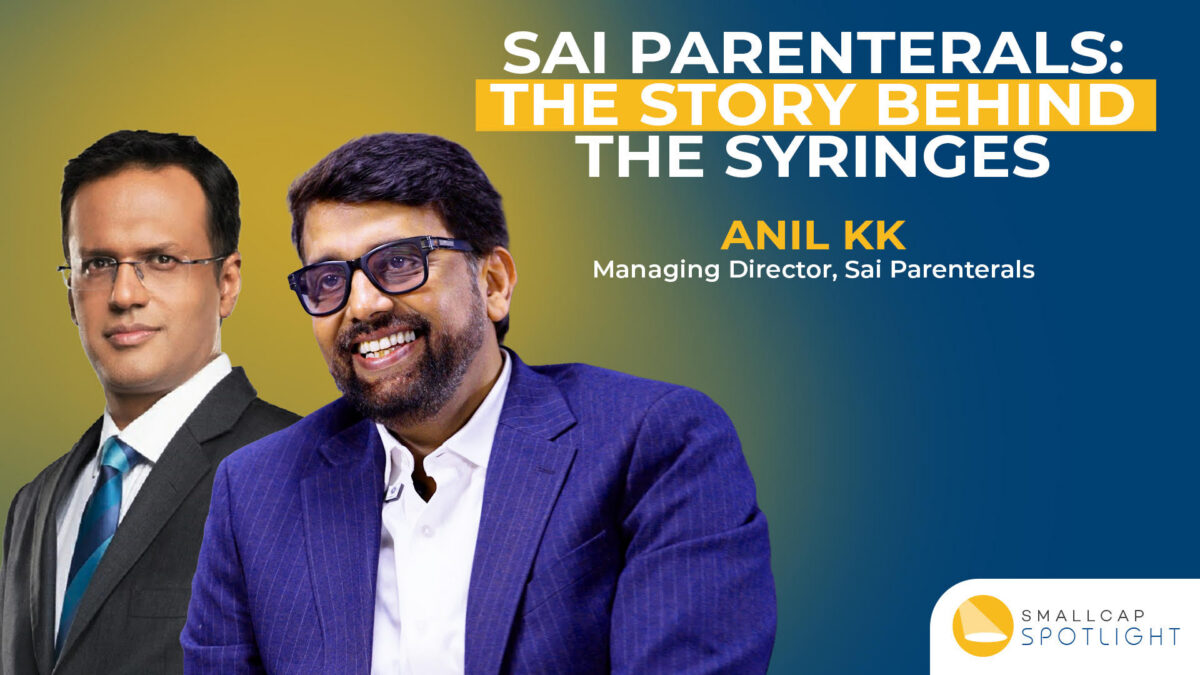
In an interview with Nikunj Dalmia, Anil KK, Managing Director of Sai Parenterals, outlined the company’s evolution into a global pharma player, driven by its Australian acquisition, expansion of regulatory-compliant facilities, and focus on injectables and CDMO opportunities. He emphasised that ongoing capex and integration efforts are expected to support long-term growth from FY28 onwards.
Nikunj Dalmia: We’re living in a world of twists and turfs and peaks and turns. At a time there is war in the world, AI is disrupting the world, and a lot of changes or the preamble for the pharma sector pearl is changing now. So interestingly, post COVID, most of the governments are trying to become Atman Nirbhar, which is an opportunity for Indian companies as well as global companies.
And one company which specifically I want to call out, which could be huge beneficiary of this wave of manufacturing, I think is going to be Saif Eddington. You’ve gone public.
Anil KK: Thank you, yes.
Nikunj Dalmia: You know what it means. You’ll have to deal with anchors like me every quarter. Every quarter, yes.
You’re prepared for it.
Anil KK: We are prepared for it, because eventually that’s our goal, the first goal of going for an IPO. So we want to be public, we want to be more responsible.
More scrutiny. More scrutiny. Quarter and quarter.
And complaints, more complaints, and make ourselves more adaptable to the markets.
Nikunj Dalmia: There’s a term I used to use called QSQT, quarter is quarter. What is the right way to look at your company, QSQT or?
Anil KK: No, it’s more of my company is basically once I start about the company, it’s more of we are into pharmaceutical manufacturing with an outlook of growing company with the global outcome, with the global reach and everything.
So we have started as a domestic manufacturing company, then gone into the regulatory export market, then transformed into CDMO, then now acquired a global company in Australia, which has put at the last mile marketing from a CDMO to the last mile marketing. So the transformation, if you see at all levels, we have been there through all the journeys and reached as a global formulation player at the end. What does it make is it makes us more CDMO player plus a player who reaches to the last mile of the marketing.
So what happens in benefits is that our product directly goes into the chain stores, pharmacy chain stores. So we don’t have to really depend on any other marketing tie-ups or any other distributors. We have a direct marketing with this Australian acquisition.
So what you can see me as a long-term player. So we are not here to prove for a tomorrow, day after tomorrow. It’s all about next to five years.
You see what the SAI Parenterals, where it has started, then how it’s transformed, now how it’s going in the next five years. And this IPO will also help these SAI Parenterals to get the growth capital, invest that capital into the plants, because by end of this 2026-27, we have five good regulatory plants, four in Hyderabad, one in Australia, which will be all approved European GMP facilities and which can go long term into the markets. So 27-28 is what the year you have to start looking at us, because all the CAPEX, whatever we are investing in this next one year are going to deliver the results, start delivering the results in 27-28 and 28-29.
So we will be a long term player with an IP based. Everything is connected to our IPs. See by purchasing this Australian company, we got a dossiers, 451 dossiers have been there in Australian company.
All the dossiers have been transferred, the rights of the dossiers have been transferred to SAI Parenterals where we can leverage them in all other countries for marketing the products of on the SAI Parenterals.
Nikunj Dalmia: So if somebody is looking at investing in your company for three years, what could be the differentiating factor? Because every pharma company we have spoken to, they like to call out something different. I have this, what others don’t have.
Obviously, you have a model which is different. But generally, what is the differentiation?
Anil KK: So more of a regulated facilities and dosage forms. See, everybody is specialised in one dosage form.
Say, somebody good in Parenterals, somebody good in OSD, somebody good in nasal spray, somebody good at cephalosporins. If you see our growth pattern now, whatever we are built in and we are upscaling, we cover every dosage form and a customer comes to us, either it is a distributor, CDMO or end customer comes to us, he doesn’t have to go to anywhere. So, we have so much of spread of dosage forms.
We have injectables. In injectables, we have lyophilizations. We have pre-filtering technology.
Now, we are coming up cartridge technology. We have penicillin dosage forms. We have cephalosporins.
We have tablets, capsules, liquid orals, ointments, nasal sprays. Now, we are coming up with soft gelatin and metre dosing. You name any dosage form, we are there.
The end customer, however it looks like, this is a complete package. So, we are there. Our facilities allow the person who is coming in to capture everything at our level.
So, that is the beauty of this. Every product from us, we don’t do any job work. We don’t get our products, anything job work from other companies.
In fact, everything is manufactured internally. So, the distributors more will be connected to us because of all the various dosage forms. And the number two is the dossiers.
So, right now we are sitting on 451 IPs of Australia and 55 IPs in India. So, altogether 551 IP dossiers are available on our platter. Somebody is coming to market us, there is a vast number of dossiers available with us, CTD dossiers, which we can be a good use for any distributor to market in any country.
Nikunj Dalmia: Okay. Just to break up the pharma sector, there is oral generics. Yes.Very simple. Yes. But very thanda business.
Correct. Then you move into what could be called as more and more complex products. Yes. CDMO. Yes. CROs.
Yes. Injectables. Yes. Yes. How much of your total revenue is coming from what could be called as a short speciality revenue?
Anil KK: Yes. Nikunji, if you see right now, as of 26, if you see, we are not having any revenue from injectables outside from exports.
Everything is concentrated more onto the domestic sales. There is a lot of scope in injectable CDMO and injectable business. We see that because once we started exporting to all the countries post-2022, while I was travelling to all the countries, I understood underlying markets like Latin America, Southeast Asia, Middle East, there is a huge potential for injectables.
But our always challenge for injectable CDMO is the plants, two plants which we have in injectable manufacturing doesn’t suit us to go for a regulatory audits because they are built in 2015, not upgraded to the latest regulatory plants. There are WHO GMP plants. The first thing what we are going to do with IPO money is we are upgrading both the plants to a European GMP.
This is in Australia? In India. So, injectable exports to countries CDMO business will start from 27, 28. So, we are spending 110 crores both on injectable plants to upgrade to UGMP, which will deliver the results in 27, 28.
So, as of today, if you see, in our total revenue, the entire OSD, tablets, capsules, liquid, orals, ointments, revenue is coming from exports. Entire injectable revenue is coming from the local branded GeneXus. So, more of a complex molecules are there in domestic also and there are branded, even in Australian business and New Zealand business, there are complex and OTC products.
Australia is predominantly OTC run based, but there are also good complex molecules there. So, on a holistic, if you see, 45% of revenue last year has come from injectables and 55% has been come from OSDs.
Nikunj Dalmia: Now, if one looks at a comparison, whom would you say you are the, your closest peer in the pharma industry in India is?
Anil KK: See, what I can say is two, I can look this question in two ways. One is whom you want to compare, like what is that comparison you want to do, which will be the most Let us say the CDMO comparison. CDMO. Because that is where the P multiples are the highest.
I want to compare always with Gland, Gland Pharma from Hyderabad, because they have done a commendable job in injectable space, more of an injectable space. So, I wish I should become them. And when I said in the last question about the markets available for injectable CDMO, I say these are the three markets where I said Latin America, Southeast Asia and Middle East, because why, lot of people left this space weekend.
There is a lot of space available in these markets for injectable CDMO. So, I always want to build a story like Gland Pharma, wherein lot of molecule development and regulatory facilities built up for injectables and start going in there. So, my aim would be going as, as looking at the Gland Pharma as a high tall.
Okay. Now, if one looks at the domestic market, the listed companies which are completely domestic focus in India, Alchem, Mankind, they get very different P multiples because the domestic business is considered to be a stable business. It may not be great on margins, but it is great on predictability.
Nikunj Dalmia: You said 55% of a business is coming from India.
Anil KK: Yes, India. So, if again one is looking at, and I am looking at reducing investors here. So, if an investor is looking at Sayaparinthal, they are getting right now 55% revenue from India. Yes. 45% which is coming from… Exports.
Within that Australia labour will start increasingly going up. In 2017, because Australia is consolidated on November 12, 2020. The results will be consolidated only from November.
So, you will see the complete consolidation on 26-27 balance sheet.
So, where you were, which is a domestic focus pharma company moving to a global export pharma company, where you were increasing up your capacity and upgrading your injectables which is a higher margin business. Then we add another layer on top of that and that another layer is coming from the acquisition which you have done in Australia, where the CAPEX has started.
Nikunj Dalmia: So, FY28-29 is when the J curve would kick in.
Anil KK: Yes. So, what they traditionally, what happens with this Australian facility which we have acquired Nikunj is that, that facility predominantly is till date is as a marketing company.
It is more of a marketing company with a lot of IP dossiers. What they are doing is they are backward integrating with building a facility where the upscale of the margins, EBITDA margins will almost be tripled because of the backward integration. That backward integration facility which they are constructing with 52 million they are investing on the project, out of which the good thing is the government of Australia, federal government of Australia has invested 20 million as a grant into that project, which gives more viability into the project and number two, it has offered more incentives for marketing into the hospital range in Australia.
A preference has been given to NUAD.
Nikunj Dalmia: When you are adding the business in Australia, I am assuming in three years the business from Australia alone will be more than 20 percent?
Anil KK: In the total portfolio, it will be 50 percent.
Nikunj Dalmia: 50 percent, that will happen in three years?
Anil KK: Three years.
Nikunj Dalmia: So, the Australian business, high in turnover and low in margin?
Anil KK: As of now, yes, but as of the backward integration happens, because their first manufacturing facility what they are building will start from February 2027, in 26-27. Once it completes in 27-28, 30 percent of the production they will be shifting from outside the country to Australian manufacturing. For example, they are making 10 percent EBITDA.
Now, on the manufacturing segment, whatever they are building they will make 30 percent EBITDA. So, the year on year, 27-28 they will shift 30 percent, 28-29 they will shift another 20 percent. So, for the next three years, 50 to 60 percent of the production will be shifted back to their own manufacturing, which will start upgrading their EBITDA margins.
Nikunj Dalmia: The other thing which everybody is obsessed in the market is that how much is coming from US? You have not consciously used the words that I was in US or I am in US or I want to go to US. Are you avoiding that market completely?
Anil KK: I do not say I am avoiding the market, because for my size, for my size, I am not looking at US at this point of time. Because for me, investing on a US-based manufacturing facility will not be viable at this point of time.
And I also feel that once we have done this survey, there are a lot of markets wherein available with much more good margin than US and much more regulatory less compliance when compared to US. So, there is a lot of space available which is untapped. So, we are trying to concentrate on that area.
I am not shutting down that I am not going to US, I am not making any statement like that. But at this point of time, for the next three years to four years, my concentration will be integrating Australia and New Zealand business with India and building a relationship between both the NewMED and SAI and making it a global company, then acquiring, starting, leveraging the dossiers, whatever we are getting 451 IPs from them, leveraging them with all these markets, build a robust business, then look on. That is as of today, we are not looking at US.
Nikunj Dalmia: Now, and pardon my ignorance, but I have seen a lot of companies which are operating out of semi-regulated market. They are largely dependent on government tenders. They are largely dependent on government pricing.
There are companies which export to Africa, but they are dependent on WHO tenders. There are companies which export out of semi-regulated markets. They are dependent on the local government in the policy and pricing.
Australia will become 50% of your business, means half the business will come from there. That is a very large pivot which you will have. How does that market operate? Is it tender? Is it a short? I mean, how is your deal structured?
Anil KK: Predominantly operates, Australia operates like this.
There is no tender business in Australia. The business is completely managed by the retail pharmacy chain of stores. They control the business.Every pharmacy chain of stores have a number of stores across Australia. I think 14 to 15 big people control the whole chain of store market. They don’t own the product.
They only own the brand. What they predominantly do is, they come to a company like Numed, who owns the product. They get the product of their brand manufactured on a private label and they market it through the chain of stores.
So, the last mile marketing when I spoke is what all about this. The chain of stores, retail pharmacy chain of stores and Numed have a very long-term agreements for 2031 and 2035. They all have the long-term agreements.
So, they can’t bring the prices down. They can’t bring the prices down. Your product prices are fixed.
Prices are fixed unless there is a raw material price which goes beyond 15% or less than 15%. There is no, in the war situations like this. If there is an escalation above 15%, the price has to be revised.
If there is less than 50%, the price has to be revised. So, it is a cost plus business. Cost plus, yes.
So, most of the times in traditionally, if you look for the last three years, there was not even a single instance in Australia where the prices were subjected to change. So, can I say that while we are talking about Atmanirbharta in India, this is an Indian company taking a bet on Atmanirbharta happening in Australia. So, in Australia also the government post-COVID everywhere they want to bring manufacturing back.
Manufacturing back. Because post-2015-16, there was no facility has come up in Australia. So, the government also understood the facilities has to start building in Australia to make their make in Australia concept.
They have come up with the concept of make in Australia. How is, that’s how they started exploring the possibilities of people investing in Australia and building the facilities. So, that’s where Newmet took an opportunity because they already have a business.
They were doing the business while they are manufacturing the product with various CDMOs in India, Netherlands, UK. Now, what is that simply they are trying to do is, they are trying to shift the outside manufacturing into the domestic manufacturing inside their facility and upscale the margins.
Nikunj Dalmia: Final question, we are dealing with different geographies. Every geography has different tax rate. You have a subsidiary now in Australia. Yes.
Which means it would be following what would be called as Australian tax laws. Yes. At effective rate, how will your tax rate be? How will it work? And when the combined company, which is Indian company will report, what could be the impact of the subsidiary?
Anil KK: So, with our good advisors in backward in India, how we have structured this deal to be more precise on the tax matters, to be effective on tax matters.
We have started a Singapore company with a 100% subsidiary of SAI Singapore, with a 100% subsidiary of SAI India. The reason being, Singapore and Australia are most favoured nation status. So, they have a different tax withholding tax policy between both of them.
So, what we have done is, we have invested company money from India to Singapore and Singapore acquired Numed Australia and Numed New Zealand. So, the withholding tax between both Singapore and Australia is almost like a in negligible.
Nikunj Dalmia: So, what would be the total corporate tax rate then at a company level for you?
Anil KK: Here in India, it is at 22%, we are at 22% tax level right now.
And we will continue to do that. On a consolidation basis, we will be consolidating Singapore balance sheet and Indian balance sheet. Because both Australia and New Zealand will consolidate it at Singapore.
Nikunj Dalmia: Final question, your shareholding has come down to just from below 60%. At this current rate, are you committed to keep it to 51% plus?
Anil KK: Yeah, 51.8% to be precise, Nikunj, as we are. See, while I am doing Australia in 2025, I have to dilute more.
That is my question that I am asking you. Because the reason being, I emphasise that is the biggest step in my life, to do the Australian, because see, I can give you a 200 crore company, acquiring a 400 crore company and becoming global player. I am obsessed with that.
And I said, yes, I can do it because double my size, I’m attempting to do it. Then I involved good people, like the consultants who are travelling with me. Then I emphasise and I live with the dream that, yes, we should be a global player.
Then at that point of time, I have involved the best of the people who has investors coming in, like Mohandas Pai family office, Nikhil Kamath family office.
Nikunj Dalmia: They’ve not sold in the IPO.
Anil KK: No, they are not.
They will be.
Nikunj Dalmia: So the old marquee investors are still there.
Anil KK: Yes, everybody, Kim’s Hospital, Bhaskar Aghori, everybody is going to stay.
Three large investors, one is Nikhil Kamath. Nikhil Kamath from Guruhas. Mohandas Pai from Samarsh Capital, Polycare family office, Kim’s Hospital, Bhaskar Aghori and Blue Lotus from Dubai.
Okay, they’ve not sold at all. They’ve not. In fact, they’re coming again in IPO.
The beauty is. They’ve invested in the anchor book. One of them has come in the anchor book.
Some of them has come in HNI. So the imposition of their faith in me is a good thing because they come in the pre-IPO and they have come in the IPO also and they are all going to stay for a long time because I said them only one thing, look me at 28, 29. If you want to, because this is regulatory business, it doesn’t multiply overnight.
It requires something effectively to be done at all levels. So I’m doing it. I need some space and time to do that.
So everybody understood that. And I told them, if you want to look Sai Parenterals, how it performs, you should look me at 28, 29. Of course.
That is the way you have to look at Sai Parenterals. And we will try to put all our best efforts to see that the integration correctly happens. The risk of building the CapEx will be completed.
We will take utmost care in seeing that the timelines, whatever we have promised in the RHP to be completed, whatever the CapEx we are investing. Because it’s all about now, the risk I only see is, I don’t see any risk in the business. I see only the risk is to complete what I said on the CapEx side, getting them operated and delivering them is the only challenge I see.
And we have accepted the challenge because time and again, all the three plans, whichever I have acquired, everywhere, everything, I have made it profitable. So this also, I’m very sure that we will make it more profitable.
Nikunj Dalmia: You know, I mean, I’m aware of the fact that how you took over the company in lean times, managed to transform a double-digit revenue to almost a four-digit revenue, taking this giant leap of faith. Like you said, the biggest bet to go in Australia. So I won’t use the word bet. I would say more like a calculated investment in your case.
And for any entrepreneur, when you go public, it’s a great moment. For any son to take his father’s legacy, I think it’s a great moment. To have that kind of commitment towards long-term shareholders is extraordinary.
So good luck for your journey.
Anil KK: Thank you.
Nikunj Dalmia: From an entrepreneur to a company which would be tracked on a monthly basis and updated on a quarterly basis.
I guess in future we would be tracking that as well.
Anil KK: I want, I fairly request you to keep a tab on me and see how I’m doing. Because see, some things which we can pick up from an inner perspective, always I feel that I’m doing good.
I’m doing right. It’s only you people can tell us, wherever, if I’m doing something out of the way, you can guide us to do the things in a right way.
Nikunj Dalmia: When we do together, I think the magical word is actually India, which is what glues us together.So thank you very much.
Anil KK: Thank you, Nikunj.