
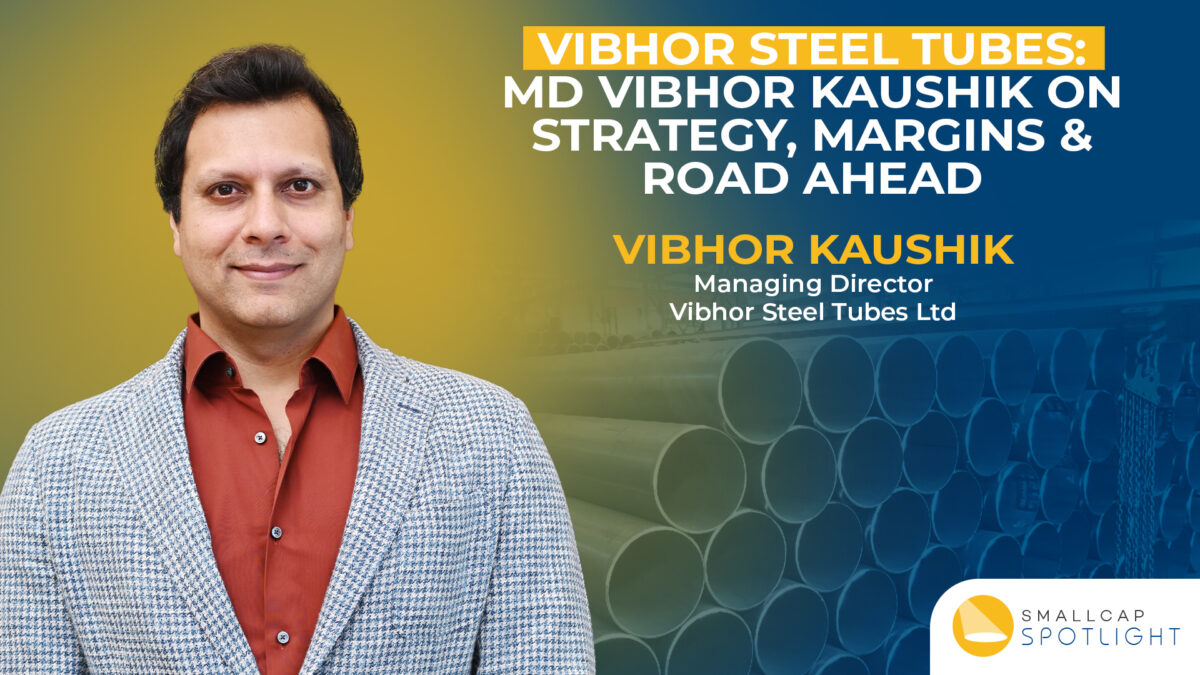
Vibhor Steel Tubes Limited highlighted its expanding presence across infrastructure, construction, water supply and power sectors, supported by manufacturing units in Maharashtra, Telangana and Odisha. Managing Director Vibhor Kaushik discussed the company’s focus on disciplined capex, regional expansion and growing opportunities driven by government infrastructure spending and rising steel demand.
Karunya Rao: Hello and welcome to SmallCap Spotlight. Today we have with us the management of Vibhor Steel Tubes Limited. The company is essentially an Indian manufacturer of ERW, which is Electric Resistance Welded Steel Pipes and Tubes.
These are used in sectors like infrastructure, construction, water supply and oil and gas. The company offers products like galvanised pipes, structural tubes and hollow sections, supplying mainly to government projects and private sector clients through a B2B model. Let’s understand more about what they do, how they do it and what’s the way forward for the company.
Let’s welcome on board the managing director Mr. Vibhor Kaushik, who’s joining us right now on the show. Thank you Mr. Kaushik for taking time out.
Vibhor Kaushik: Thank you for having me here.
Karunya Rao: To simply help our audience understand, what is it that you do, Vibhor Steel Tubes? What is the company all about and what kind of work and where exactly are your products used?
Vibhor Kaushik: I am located in Bombay. The company has three manufacturing units. One is located in Maharashtra, another one in Telangana and the third one we’ve recently operated.
It’s working now. Manufacturing is happening, production is happening, dispatch is happening. It’s in Odisha.
These are the three locations where we have manufacturing. Primarily, we started 20 years ago, a little over 20 years ago. We started with steel products, primarily pipes.
These pipes are steel pipes, which are used in a variety of sectors. It’s something that builders use for firefighting equipment. The farmers use for irrigation.
The furniture industry uses it for tables, chairs, fancy items. Structurals are used everywhere, even as much as airport uses it. Airport facade is made using these pipes.
Metro. So, the usability of pipe as an industry is very big, very massive. Sometimes, I joke about it.
No matter where I’m sitting, I’m always surrounded by some pipe or the other. Even if you look around, right above you, there’s a fan hanging and there’s a pipe through which it’s hanging. So, this is one thing about the product that maybe one sector offline is having a hit, but the other is not.
So, there’s always a volume that we see in our product. So, that is something we’ve been doing for 20 years. These products of pipes, they come in different diameters.
Half inch, which is the smallest, which is used in the bathroom fittings. All the bathrooms used to be a lot more. That was driven by these pipes.
The showers, the taps, the wash basins, every fitting used to be these pipes. Then, as we go outside, we see the bigger diameter. From half inch, it becomes two inches.
Then, the master pipe becomes six inches or eight inches. There’s a lot of push from the government right now for these products through various incentives, through various yojana. There’s a Jal Yojana, which is a government initiative, which is to have water in every household of India.
So, all of those require these pipes. It’s a great way to transport water, even gas. Gas pipelines, MNGL gas lines uses these pipes.
So, the usability and the application of the pipe as a product is very large, very big. Apart from these products now, we have done a lot of diversification also. There are other products that we have ventured in.
Primarily, one of this is an infrastructure product called crash barriers or highway guardrails, which is used on a highway. On both sides of the highway, you see these metal guards, which is what prevents a lot of vehicles to go off the track and it prevents a lot of accidents. So, that is one product, an important product, and we are very happy that we’re contributing to the safety of the road through this product.
It’s been around two years that we have ventured into this product. It’s primarily in Telangana and Odisha we’re doing it. And apart from pipe and crash barrier, now we have ventured into other products.
One is a power sector, which is transmission line towers through which you transfer the electricity. So, it’s a cable that runs all the transmission cables that you see. Big farms has it on the highway on right and left.
You see those big robot structure. It looks like a robot made out of angles and it’s holding the wires on both sides of it. So, that’s another very interesting sector that we have now ventured into.
Karunya Rao: So, help us understand right now you have pretty much painted a picture where the company and the product seem to be omnipresent across different verticals, different areas of our day-to-day life and of course the B2B segment. Where is all the main part of your revenue or a larger part of your margin coming from? Where is it that the company is actually making money or seeing good volume from?
Vibhor Kaushik: So, we are called known as the converter of steel. So, we use what we call hot roll coil and we convert it into into a pipe or a crash barrier.
So, for us the very important part is to always achieve volumes. So, a lot of times we are only focussing how do we increase our turnover? Where do we get the turnovers from? So, the margin more or less remains the same. Maybe one year there we’ll see a margin increasing, the other year margin decreasing.
But if you see a longer horizon of time, the margins in this is primarily similar. It goes around the EBITDA levels of five to six percent. That’s where it stays for more or less everybody, the big players, the small players, everyone.
The way to grow in this industry is to expand the regions in which you can cater, the markets that you can cater. Which is why in the beginning we only had Bombay as a market because we were in Maharashtra. So, we were only giving, we were only selling in the markets of Bombay or Pune or Gujarat.
So, then we understood that for us to increase our turnover we need to venture and we need to put this industry elsewhere. Because logistically, logistic plays a very important role in it. The margins are so thin that you cannot sit in Maharashtra and sell it in say Telangana or to sell it in West Bengal.
So, you have to go there and do it. So, that’s why in the past 10 years of our journey we have expanded first into Telangana which almost had a 50-50 share. Bombay and Hyderabad both were equal.
And now we have Odisha as a third because we’ve understood that we have to go there and this is how we can increase our turnover and make our presence global all over India now. So, with these three units now we can say that our presence is in more or less every corner of the world, every corner of India.
Karunya Rao: What has your personal journey been like in this company? How you have seen it grown and how has that shaped your work and what you do as well?
Vibhor Kaushik: Very important thing when you put up, when you get into a product such as this where you have to always chase after big volumes.
You very important thing that I have personally understood very early in this industry is that you have to make sure that when you are putting up this industry you have a very, very strong control over your cash flow in terms of the, especially in terms of the capital investment that you’re doing to run these plants which has always been our USPN. And I try to put this across to even the new entrepreneurs who are getting into steel industry as a manufacturer is that you have to watch out where your capital investments are going. Are you controlling it enough that you get your ROI right, you get your ROV right.
So, that is one of the very important things which has how we have been successfully running this industry at a very low capex. For example, I remember, just one example. So, these are run into a tube mill.
So, tube mill is a machine which makes your pipes or makes your tube. So, a tube mill for a size of two and a half inch is roughly around, I remember back in the days used to be 4CR. And even 4CR looked like a very big number to us back then.
I’m talking about in 2010. So, I started to figure out a way to put this pipe mill in a way that I don’t have to shed 4CR. So, we started looking for secondhand tube mills but not in India.
Eventually, I got my hands on a tube mill which was sitting in Australia. And this tube mill was in line or maybe even better than a lot of tube mills that was available in India at that point in time. So, sourcing that tube mill was only for 50 lakhs.
Eventually, I ended up getting that tube mill in India for 50 lakhs as opposed to 4CR. So, the ROI when you are like six times less than anybody else, it just becomes very easy. Especially when you go into a new logistic or a new region, if you go on a low capex at first and then see where you’re standing and increase your capex and do your expansion, see where the market is.
So, it’s very important to have a balance between your spending and the market that you capture. Which is why even in Hyderabad, we took a little time to grow from 3,000 tonnes to now we’re sitting at 6,000 tonnes. We’ve almost doubled it.
Because every investment we did, we gauged it, we made sure that all the steps we’re doing, we’re doing the right steps and it’s going to increase our turnover. At the same time, it’s going to keep our investments low. Now, similarly, what we’re doing in Odisha is a similar product.
That now, we have entered into four different verticals. There is power sector, there is power sector transmission line towers, there is monopole that we’re doing, there’s crash barrier we’re doing, there’s pipe we’re doing. All of that we’re doing at relatively very low capex.
The reason I say that is because now an Apple to Apple comparison becomes very easy. A lot of companies are listed, so we see where they are, where their capex is and where we are. So, the comparison that I always make is that we will be able to make our turnover increase and our margins with the bottom line also see a lot of number grow in it at a very, very low capex.
So, for me, the biggest journey that I’ve learned is to be very, very vigilant in your spending and very, very correct in your approach towards capturing the market and have a great balance between both these things about your spending and about your capturing of the market.
Karunya Rao: Okay, interesting. But tell me something, you’ve talked about how your offerings have diversified over time.
What about your customers? Who would you say are your major customers? And in terms of client base, how diversified is that?
Vibhor Kaushik: See, it’s the general way how the pipe industry works is that for a manufacturer, it’s very difficult to go all the way down to the consumer. So, there’s always a network. For example, we have a distribution network here in Maharashtra which is limited to 10 distributors.
So, those 10 distributors, give or take, maybe a little more or less, are the ones who we sell it to and they further sell it to the end user. And the end user is a variety. There’s always a government.
There’s always a government tender where it goes. There’s always a builder lobby. Builder lobby is very big.
Farmer’s lobby is very big who takes it. The general fabricators, the fabrication of various products everywhere, pipe is required. Even if you’re making a simple as a gate of your house in a farmhouse, generally, an element of pipe is used.
So, we always sell it to a distributor and they further sell it to the end user. And the end user list is just would run into hundreds. All the fabricators will get in there.
Structural people will get in there. The farmers will get in it. The carpenters, the furniture industries will get into it.
Builder lobby will get into it. Pipe transportation will get into it. Gas line will get into it.
So, it’s a very, very vast application of these products.
Karunya Rao: If I have to broadly ask you between, let’s say, government versus private, what is the revenue split like?
Vibhor Kaushik: So, in pipe, I would say a lot of it goes into the builders. So, every sector is different.
For example, in Pompeii, builder lobby is very active. A lot of it goes into the builders lobby. So, I’ll give probably the most to the builders lobby.
But when you go to Odisha, a lot of farmers will take it. The farmer lobby is big there. If you’re in Hyderabad, the fabricator lobbies are big.
So, every place you were in, your consumers tend to change. But it’s a very rapid evolving sector. So, for example, one push from a government and the builders will start coming into it.
For example, now we’ve seen a lot of pick of builder lobby in Hyderabad. Hyderabad is ever expanding as a city. So, the builder lobby, as opposed to where seven years ago, when we started off, the builder lobby wasn’t as strong.
But right now, it’s very, very strong. So, a lot of it goes into the builders. The government sectors for the crash, the highway guardrail, the other sector that we are doing is 100% government because it goes on a road.
So, these are the EPC contractors who have taken up the contract of the road. They buy it from us. So, I would say crash barrier or guardrails, which is a new sector, is 100% government-driven.
Power sector, which is your transmission line towers or monopole is 100% government-driven because these are all the power sectors. Only the EPC contractors take it from us. So, the new sector is widely defining the growth of India through the government spending.
So, I would say around 25% of the new products, 25%, which is the new product volume we’re targeting in years to come, will be coming from the government sector. In terms of pipe, I’d say around about 25-30% still is the government project that we are doing. But rest of it is private.
Karunya Rao: And how about the margins? What margins are you operating right now on a consolidated basis?
Vibhor Kaushik: As I started off saying that we are chasing the turnovers mostly. The EBITDA margins are anywhere around 4.5-5% give or take. I mean, something around there.
But the bottom line for us, because we’re doing a lot of expansion in Odisha, there is a depreciation factor that’s coming in. So, bottom line might not reflect the growth that we have, but in terms of the turnover and the EBITDA, it is very prominent. For years, we have seen the growth in terms of the EBITDA level more or less in this industry is similar.
Karunya Rao: Okay. But right now, given so many global headwinds, especially in terms of geopolitical tension, there’s logistical issues as well. Are you seeing any fluctuations in the commodity prices affecting your margins or your overall financial picture?
Vibhor Kaushik: When COVID happened, I was very quick to gaze that scenario as a war situation, even COVID.
Because any COVID or a war or a geopolitical scenario that we have currently, whenever there is a disruption, the commodity prices tend to go up because there’s a shortage of supply. The supply chains are not smooth. So, we always see that.
We saw that in COVID, we see it now. It’s not something that we find pride in that the prices are going up because of the geopolitical factor or because of the things which are not in our hand, such as the supplies of gas not streamlined or the coal not coming in or the iron ore not coming in, but it always happens. So, the prices during a situation like this is beneficial for us because our inventory where we’re sitting on is always rising.
Same thing happened during COVID. Same thing is happening right now. Just before the war started, we were from there to now, the raw material prices have increased, give or take around six to seven percent.
And they’re talking about another six to seven percent. And we’re only into like one month into the conflict. So, now, however, now, at this point in time, the situation is, for it to get back to where it was one month ago, I think it is going to take a fair bit of time, because even if the geopolitical, it streamlines the state of Hormuz opens up, for things to start trickling down and coming into the market as the supply chain was before, will take a fair amount of time, I think.
So, there will always be a pressure and there will always be a demand and more and more demand of our products due to this geopolitical conflict which is going on right now in the world. And more so, a lot of damages have happened in these countries in terms of their infrastructure, in terms of their production, in terms of their manufacturing capability. They are attacking all kinds of infrastructure.
There are aluminium factories we keep hearing, the steel factories we keep hearing. Every infrastructure has taken some hit or the other, which means the production of the steel in those areas is, for it to come back to normal, is going to take a certain amount of time. Which also means that we will not only be catering to the domestic market, but India as a steel producer will have a very vital role in supply of steel globally in time to come, because the production in that certain area has really taken a hit.
So, this geopolitical factor for steel is a positive, because the demand and the supply in India will have to be ramped up and there will always be increase in prices in steel. So, it’s beneficial for us.
Karunya Rao: Positive in the long term, like you said, but short term, how much of a hit are you looking at to your numbers over the next couple of quarters, maybe?
Vibhor Kaushik: Numbers are, in terms of our margins, in terms of our profitability, it’s going to increase just because our inventory prices will keep on increasing month on month.
And I see this increase in inventory or the price as far as down easy on May, because we are getting all kinds of signs from the raw material supplier that April is very tight. As a matter of fact, we have MOUs from these steel industries. We have an active MOU with Steel Authority of India, active MOU with JSW.
However, despite all these MOUs, they’re not very sure how much they’ll be able to cater to us, because everything is very uncertain right now. So, in a situation like that, just because we are sitting on the product is as such, we have to sit on certain inventory. The inventory prices will increase and it will reflect on the cost in our industry.
It has to be passed on. So, not 100% gets passed on. It is passed on in phases.
We have to retain the market also. We have to see if the market be able to absorb these prices. So, it’s not something that happens right away, but it happens over the course of time.
Karunya Rao: But it’s primarily a supply issue and not a demand issue. Demand is intact, correct?
Vibhor Kaushik: Demand is, yes. So, because a lot of these products, a lot of these projects have deadlines, the deadlines have to be met.
May that be with our highway guardrails, may that be the power sector, may that be the gas sector, the gas pipeline that we provide, or may that be any government. They all have a target. The contractors have to do it within that.
So, the demands are not reducing at all. Plus, all the builders lobby. India is a consumer at the moment.
It’s an ever-growing as a nation. So, we don’t see any demand dropping. We never saw demand dropping during COVID, which was high time.
We don’t see any demand dropping now.
Karunya Rao: Okay. You were also talking about capacity expansion and eventually the efficiency is kicking in.
So, if you can give us some sense of what the capex is about, how much have you invested and by when will it meaningfully start showing benefit to the company?
Vibhor Kaushik: So, the capex in Bombay, we’re not doing anything. It’s running on optimum level, maximum levels. Hyderabad is quite stable.
We’re doing some expansion there because much to our surprise, the highway guardrail sector, which we ventured into two years, have given a phenomenal result and it has a lot more demand. So, we’re doing some expansion there in terms of our increase of production of highway guardrails. In Odisha, we started off with a very important product in our portfolio is the galvanised product.
That’s where all the margins are. So, it just shows how many galvanising lines you have. For example, in Bombay, we have two.
In Hyderabad, we have two. They’re both running at 100% capacity, full efficiency, the galvanising plant. But in Jhansuguda, we only had one galvanising line because we thought it was going to take us some time to be able to capture the market, but it’s already full.
That galvanising line is already full. We have started investing in another two months. We are operational another galvanising line.
And I have a very strong feeling that even the third galvanising line is going to be set up very, very soon. As I started off that, I’m very, very vigilant in terms of the capex. I will only do capex when I’m 100% sure that the demand has kicked in and there are orders to back it with.
So, same thing we did with galvanising there. One galvanising line right after that. We had an option of going with three galvanising at the same time.
But I took time because I am always 100% sure if I’m going into something, I have to be very, very sure that it is fruitful. So, those expansions that are happening, most of the expansion I define in terms of how many galvanising lines we have because that’s where the margins are. So, one galvanising line almost running at full capacity.
Now, we’re going to go for another galvanising line. So, the result of all of this has already started to show in terms of our turnover, in terms of our utilisation or the capacity. So, that’s why the expansions are kicking in.
Once the expansion comes in, I think the results of all of it will become very prominent from quarter three onwards. Looking forward is difficult to say, but I would give an estimate that around third quarter, we should be able to see it. Some bit of it in second quarters also.
Karunya Rao: Okay, that’s good to know. Finally, I wanted to understand how things have been operationally after the company got listed. So, post-listing, what has changed in terms of structure, the way you function, the amount of accountability now that you have that there are so many shareholders also who are keeping a close watch on every move of the company?
Vibhor Kaushik: One of the major things that has changed for us is that we are watching out for everyone now.
So, all our investors are our family members. So, we are watching out for everybody. That’s why I, during the IPO times to now, we started off all the announcements that we made during our IPO time, we have fulfilled all of it.
For example, we said we’re going to expand into highway guardrails. We have not just expanded, we have established ourselves in India. I also said we’re going to put up Odisha.
We have put up Odisha at that point in time with only a pipe production, but besides pipe, we have ventured into four different vertical at the same time. So, a lot of the decisions that we make, we’re keeping into the factor that now we’re listed and we have to perform for the market, we have to perform for the investors. That’s why we are going very aggressive into all these product line, which will not only increase our turnover, will also increase our EBITDA levels because all these other products have 1 to 1.5% more cushion than pipe ever had, which is why it’s been noticed, it’s been observed and it’s been credited to us through our rating agencies as well.
Our rating has just improved and we got a new rating in two weeks earlier and it’s a clear indication to and we’re very happy that we’ve been able to translate it and communicate over through the rating agencies that we have a certain target, we have a certain mindset and we are following it and we’re getting results out of it.
Karunya Rao: Wonderful, great. It’s good to know as well.Thank you so much once again Mr. Kaushik for talking to us in such great detail about what the company has been doing over the years and what the way forward looks like. Thank you for joining us on Small Gap Spotlight.
Vibhor Kaushik: Thank you for having me.